Best Commercial Interior Graphics Solutions for Facilities & Institutional Spaces
Introduction: Evaluating Commercial Interior Graphics Solutions for Modern Facilities
Commercial interior graphics have moved from one-off decorative elements to core tools for wayfinding, branding, and experience design across healthcare, education, workplaces, hospitality, and public buildings. For facilities leaders, the decision is no longer simply “what looks good,” but “what installs fast, wears well, and scales without disrupting operations.” The right system should meet demanding schedules, integrate into existing finishes, and perform across multiple locations without surprises.
Today’s options include vinyl wall coverings, traditional wallpaper, modular panels, paint and stencils, and emerging direct-to-wall printing. Each approach carries trade-offs in installation time, maintenance, flexibility, and sustainability. Teams responsible for multi-floor campuses, high-traffic corridors, or active patient care areas need more than a visually strong choice—they need a solution that is consistent, predictable, and lifecycle-efficient.
EastCoast MuralPros serves these environments with next-generation direct-to-wall printing that delivers high-definition, seam-free graphics without vinyl or adhesives. The approach is engineered for rapid deployment—typically under five hours on site—while providing durable, cleanable finishes designed for facilities traffic and cleaning protocols. Whether rolling out institutional interior branding across a hospital network or refreshing a corporate HQ during business hours, the goal is simple: elevate the environment with minimal downtime and clear operational value.
If you’re evaluating wall graphics for commercial buildings, begin with a framework that weighs speed, substrate compatibility, image quality at scale, and total lifecycle cost. With that foundation, it becomes clear which systems can genuinely support your program without imposing construction-style disruption or ongoing maintenance burdens.
Key Criteria for Selecting Commercial Wall Graphics Systems
A practical selection process focuses on performance, logistics, and lifecycle. Use these criteria to compare commercial interior graphics options:
Installation speed and disruption
- Can the system be installed in occupied spaces without shutting down a corridor, clinic, or classroom? - Typical on-site time per wall and total project duration.
Substrate compatibility
- Works on finished and unfinished surfaces: drywall, CMU, concrete, and brick. - Minimal surface preparation; realistic patch/prime needs for uneven substrates.
Visual quality at architectural scale
- Photoreal, high-resolution output with crisp detail on long runs or double-height walls. - Color consistency and profile management across locations and batches.
Seam-free appearance
- Ability to print continuous imagery across wide spans without visible seams, overlaps, or panel edges.
Durability and cleanability
- Resistance to abrasion and impact in high-traffic corridors. - Compatibility with standard cleaning agents and disinfection protocols.
Lifecycle efficiency
- Paint-over-ready finishes vs. adhesive removal. - Reduced replacement cycles and simplified updates.
Sustainability
- Absence of PVC, adhesives, and related landfill waste. - On-site printing to eliminate shipping and fabrication scrap.
Operational fit
- Low odor, low-VOC processes suitable for occupied buildings. - Quiet, dust-free methods appropriate for healthcare and education.
Scalability and consistency
- Predictable execution for multi-location or campus-wide rollouts. - Process controls for repeatability and procurement-driven standardization.
Flexibility for updates
- Subscription options for seasonal branding, program changes, or instructional updates. - Integrated wayfinding and safety graphics without adding hardware signage.
Vendor alignment
- Experience with facilities and procurement workflows. - Clear milestones, warranties, and post-install care guidance.
A system that scores well across these metrics will reduce project risk and deliver sustained value beyond the initial install.
Direct-to-Wall Printing Technology vs. Traditional Vinyl & Wallpaper
Traditional vinyl and wallpaper have long been the default for interior graphics, but they come with known challenges: seams that draw the eye, adhesives that can fail under humidity or cleaning, and time-consuming removal that disrupts operations and adds to landfill waste. Vinyl can bubble or peel in high-traffic areas, and panelized installations magnify color shifts or misalignments across seams. Wallpaper improves the aesthetic but still relies on adhesives and careful seam management, and it shares many of vinyl’s lifecycle drawbacks.
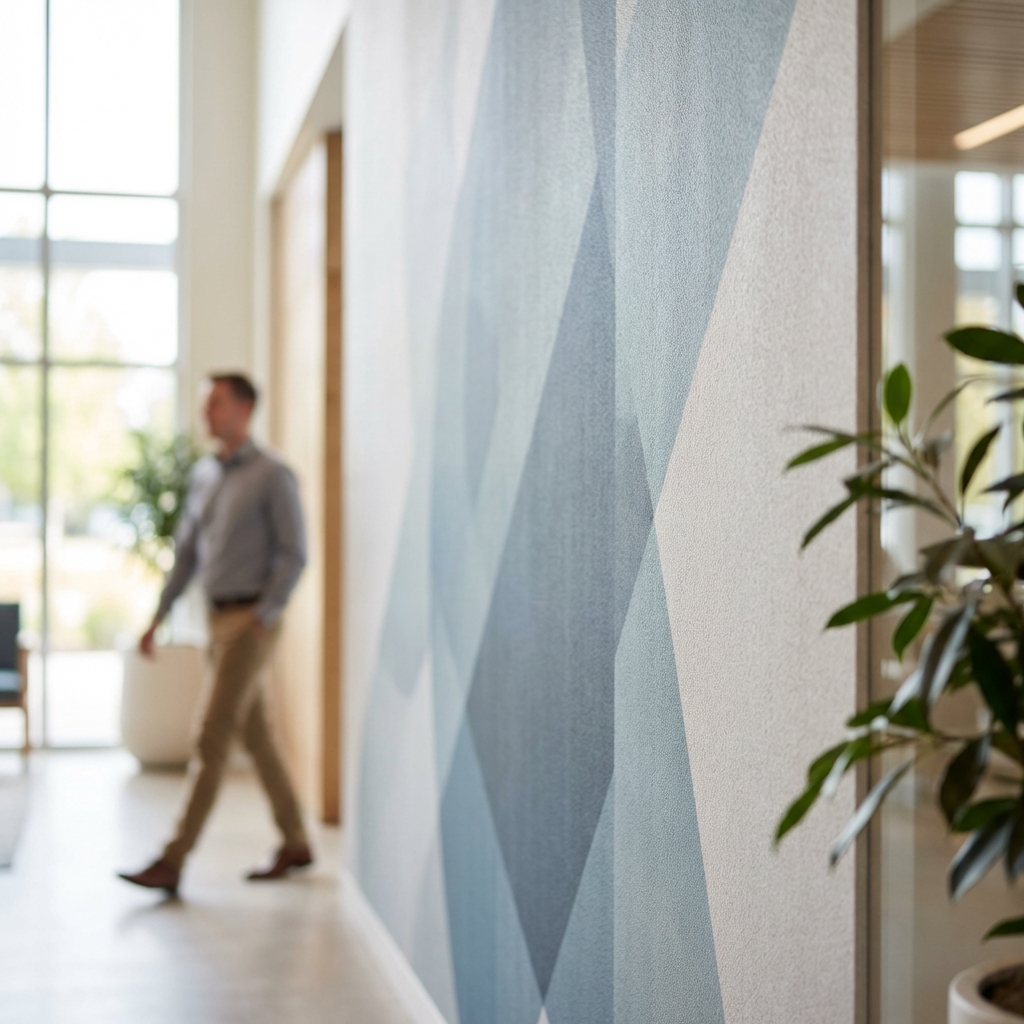
Illustration 1
Direct-to-wall printing addresses these pain points by imaging directly onto the existing surface—drywall, CMU, concrete, brick—without adhesives or applied panels. The result is a seam-free, integrated finish that reads like part of the architecture rather than a layer on top of it. Because there’s no vinyl film, the look and tactile feel are different, too: graphics appear painted-in, with crisp detail and photoreal resolution at architectural scale.
Operationally, direct-to-wall printing supports speed and certainty. On-site printing eliminates shipping delays, crate handling, and fabrication re-dos. Installers no longer wrestle with stretching, repositioning, or trimming panels—a key source of rework with vinyl. When it’s time to update, walls are paint-over-ready. That means no adhesive residue, no labor-intensive tear-down, and no hauling failed panels to the dumpster.
For facilities and procurement teams evaluating alternatives to vinyl wall coverings, direct-to-wall systems provide a performance-based path that aligns with sustainability and lifecycle goals. For a deeper breakdown of environmental impacts and waste, see this overview on direct-to-wall vs. vinyl.
Fast-Installation Graphics for Occupied Commercial Spaces
Downtime is expensive, and corridor closures or construction zones can derail operational plans. Direct-to-wall printing is built for speed in live environments. Crews arrive with calibrated equipment, confirm substrates, and begin imaging immediately. Typical installations complete in under five hours per zone, allowing work to be phased across floors or departments without shutting down entire areas.
Because printing occurs on site, teams avoid the typical delays tied to panel fabrication, shipping windows, or warehouse staging. The “last mile”—historically the riskiest for graphics—is streamlined. If a change is needed, operators can adjust layouts on the spot to accommodate unanticipated site conditions such as conduit changes or access panel locations.
Low-odor, low-VOC inks and dust-free processes make the method suitable for healthcare and education. In patient care or academic settings, infection control protocols and quiet-hour needs can be accommodated with night or weekend shifts and small-footprint rigs. For corporate or hospitality tenants, lobby and corridor updates can be scheduled to minimize peak-hour interaction.
EastCoast MuralPros structures installation plans to match occupied-building realities: segmented work zones, safety cordons without scaffolding clutter, and coordinated sweeps that return spaces to service by the next morning. The approach is designed for facilities that measure progress by hours, not weeks.
Durable & Cleanable Wall Graphics for High-Traffic Environments
High-traffic interior graphics systems must withstand bumps from carts, daily cleaning, and occasional impact without degrading. The durability profile of direct-to-wall printing includes abrasion resistance and cleanability tailored for facilities protocols. Surfaces are engineered to be wiped down with common non-abrasive cleaners; in clinical or food-service zones, compatibility with disinfectants is critical and can be validated during a pilot.
In corridors, elevators lobbies, and cafeterias—spaces that see constant touchpoints—printed walls retain crisp color and detail without edges that can be picked or peeled. This eliminates a common failure mode with vinyl where corners lift and seams collect grime. For schools, that means murals that survive backpacks and after-hours events; for hospitals, branding and wayfinding that stand up to gurney traffic and terminal cleans.
Maintenance protocols are straightforward:
Routine dusting or microfiber wipe-downs as needed.
Spot cleaning with mild detergents; avoid abrasive pads.
Periodic inspections during existing facilities rounds.
When long-term updates are required—new donor recognition, refreshed brand language—paint-over-ready finishes simplify change management. No removal crews, no adhesive residue, and no extended closures.
For more detail on durability and surface maintenance considerations, see this discussion of direct-to-wall printing benefits.
Seam-Free Solutions at Architectural Scale for Large Interior Projects
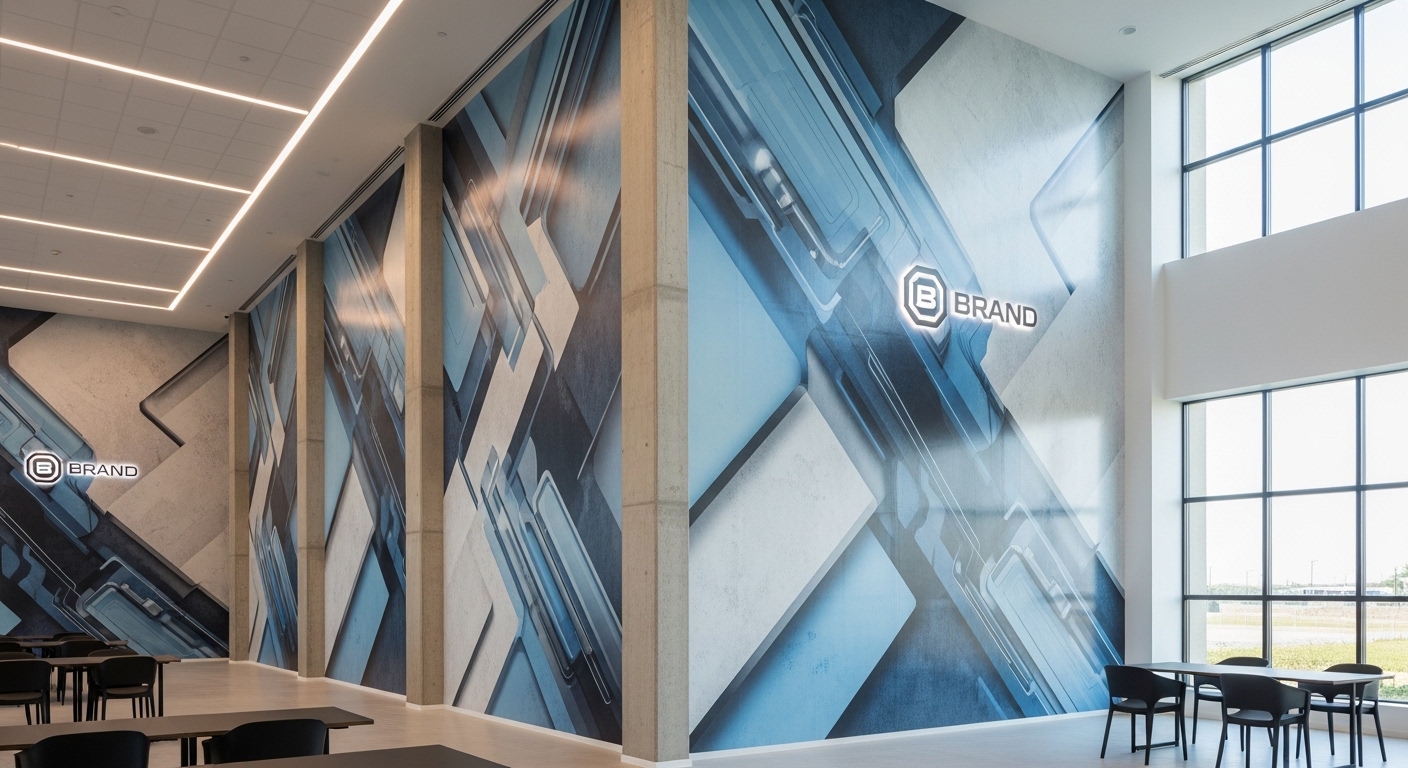
Large interiors amplify both the possibilities and the risks of wall graphics. Seams and panel edges that are minor annoyances on small walls become visual interruptions on 80-foot corridors or double-height atriums. Direct-to-wall printing resolves this by delivering true seam-free commercial wall graphics at scale—continuous imagery that follows the architecture, not the panel grid.
Image quality is not an afterthought. Photoreal output with crisp edges holds up at viewing distance and across long spans. Color management protocols ensure consistent results between floors and buildings, supporting unified brand experiences. For art programs or museums, this means gallery-quality reproductions and supergraphics that feel integral to the space rather than applied to it.
Design coordination is equally important at architectural scale:
File preparation aligned to viewing distance and substrate texture.
On-site test swatches to check color and contrast under actual lighting.
Edge-to-edge alignment across corners, soffits, or transitions.
EastCoast MuralPros also supports digital artists and curators with collaborative tools that scale original work. High-resolution assets are tiled intelligently without visible breaks; repeatable templates allow series-based installations across multiple buildings. The result: audacious, seamless storytelling that retains fidelity from sketch to wall.
Multi-Location Rollouts & Brand Consistency Across Facilities
Institutional interior branding solutions often need to span dozens—or hundreds—of walls across multiple sites. Consistency becomes the defining challenge. Direct-to-wall printing excels here because it minimizes variables: no panel batch-to-batch shifts, no adhesive behavior changes by substrate, and fewer opportunities for field improvisation that derails standards.
A disciplined rollout includes:
Standardized brand libraries with approved color profiles and wall templates.
Survey-driven wall schedules that capture dimensions, substrate types, and environmental constraints per site.
Pilot installs for each facility archetype (e.g., inpatient wing, student center, retail concourse) to validate cleaning compatibility and lighting.

Illustration 2
On-site printing helps solve the “last mile” by adjusting layouts to physical realities that never appear on plan—electrical panels, fire strobes, corner deviations. Centralized QA and photography ensure each site is documented against standards, while care guides equip local teams to maintain surfaces without guesswork.
EastCoast MuralPros delivers consistent execution across multi-location and national rollouts by combining process control with field flexibility. Color fidelity, alignment, and finish are managed upstream, while installation teams adapt responsibly on site—keeping brand integrity intact and projects on schedule.
Wayfinding & Instructional Graphics Without Signage Clutter
Facilities need clear instructions, but sign proliferation can overwhelm users and maintenance teams alike. Integrated wall graphics offer an elegant alternative: zone colors, patterns, and iconography embedded directly into architecture to guide movement naturally. The effect declutters ceilings and walls by reducing hardware, brackets, and adhesive plaques.
Direct-to-wall printing supports layered systems:
Primary wayfinding (departments, floors, zones) established through color fields and large-type supergraphics.
Secondary prompts (room clusters, restrooms, exits) handled with durable, legible typography placed at decision points.
Instructional and safety messages integrated without encroaching on egress or ADA requirements; high-contrast color and minimum character sizes are addressed during design.
Because updates are streamlined, facilities can adapt quickly. A change in clinic routing or classroom numbering no longer requires sourcing hardware; targeted overprints or paint-over-and-reprint cycles keep information accurate. Subscription-based refreshes let schools revise seasonal messaging or hospitals roll out new safety protocols on a predictable cadence.
For procurement and safety teams, integrated wayfinding reduces the total count of hardware signs to maintain, while retaining compliance. The result is a navigable, branded environment where the walls themselves communicate—without visual noise.
Sustainable Interior Graphics Alternatives to Vinyl & Wallpaper
Sustainability is now inseparable from procurement criteria. Vinyl wall coverings and traditional wallpaper rely on adhesives and, in the case of many vinyls, PVC—a material with known environmental trade-offs. Removal compounds the issue: failed film and contaminated adhesive typically head to landfill, and solvent-based cleanup introduces additional concerns.
Direct-to-wall printing is a more sustainable alternative on multiple fronts:
No vinyl or applied adhesives: Eliminates PVC use and associated waste streams.
On-site printing: Cuts shipping-related emissions and avoids crate and packaging waste.
Lifecycle efficiency: Surfaces are paint-over-ready, reducing demolition waste and simplifying end-of-life transitions between tenants or programs.
Right-sized production: Imaging only what’s needed, where it’s needed, avoids overproduction and offcuts common with panelized systems.
From a facilities perspective, sustainability pairs with practicality. Without adhesive layers, walls maintain their substrate integrity. When programs change—new branding, new donor walls, new safety standards—updates are measured in hours of print time rather than days of tear-down and cleanup. Fewer materials in and less waste out support both environmental targets and operational budgets.
If your organization is actively seeking alternatives to vinyl wall coverings to meet ESG goals, direct-to-wall solutions provide measurable, repeatable benefits alongside schedule and maintenance gains.
Cost & Lifecycle Comparison: Installation Speed, Maintenance & Replacement
Initial quotes tell only part of the story. To compare commercial interior graphics options effectively, map the full lifecycle:
Pre-installation
- Vinyl/wallpaper: Design, panelization, printing, finishing, packaging, shipping, staging. - Direct-to-wall: Design, color proofing, on-site test swatches; no panel fabrication or shipping.
Installation
- Vinyl/wallpaper: Surface prep, adhesive management, panel alignment, seam finishing; multi-day durations for large runs; disruption risk if panels misalign or bubble. - Direct-to-wall: Surface prep and calibration; continuous imaging; typical completion under five hours per zone; fewer points of failure.
Maintenance
- Vinyl/wallpaper: Monitor seams and edges; address peeling; harder to disinfect without damaging edges. - Direct-to-wall: Routine wipe-downs; no seams to fail; compatible with typical facilities cleaners.
Replacement/updates
- Vinyl/wallpaper: Removal labor, adhesive residue remediation, potential wall repair; new panels printed and shipped. - Direct-to-wall: Paint-over-ready updates; targeted reprints as programs evolve.
Time is a cost driver. Corridor closures, night shift premiums, and rework from failed panels add up quickly. Direct-to-wall’s rapid install and reduced risk of alignment issues translate into fewer labor hours and lower schedule exposure. Over a three- to five-year horizon, organizations often realize savings through minimized maintenance calls, eliminated removal labor, and faster changeovers during tenant turnovers or brand refreshes.
The result is a lifecycle-efficient solution: predictable upfronts, compressed installation windows, and streamlined refresh cycles—without compromising the visual standard.
Selection Guide: Matching Graphics Solutions to Facility Types & Budgets
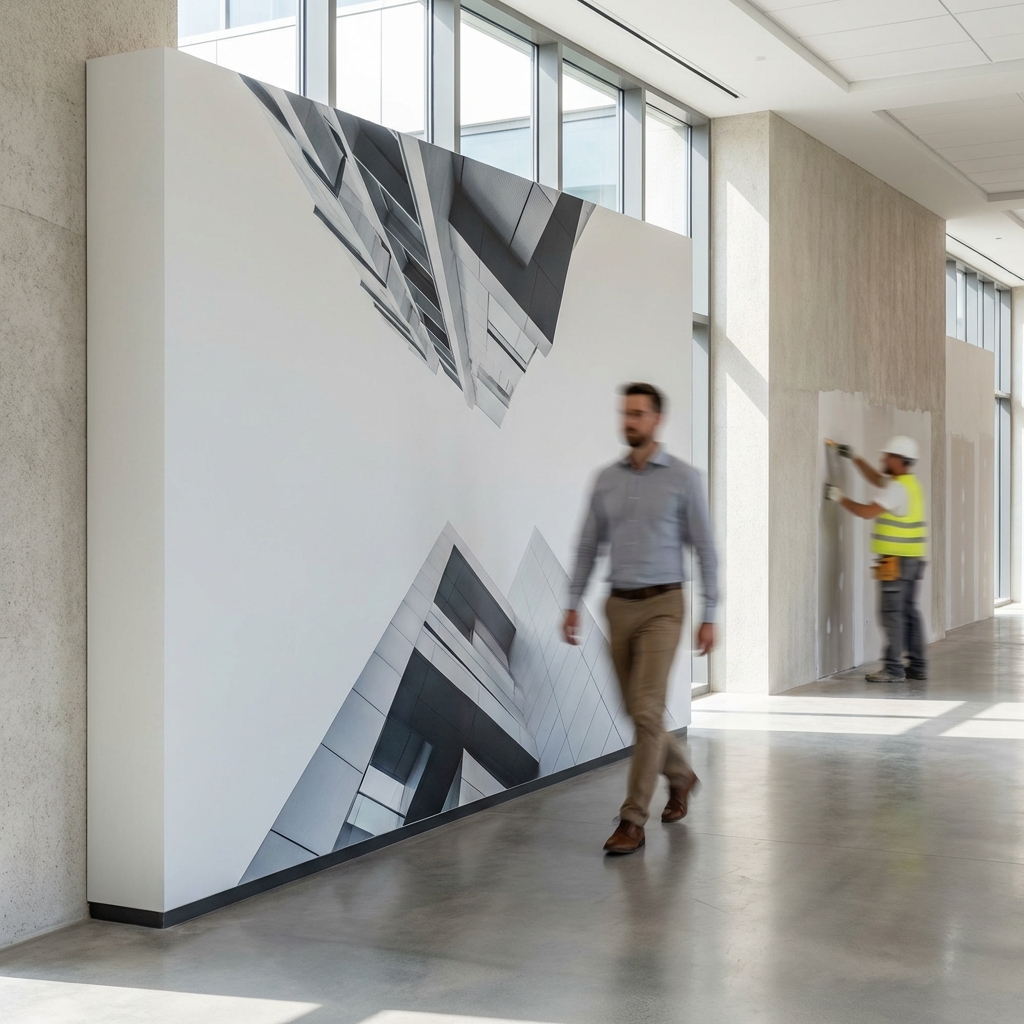
Illustration 3
Different facilities prioritize different outcomes. Use these patterns to align scope and spend with your environment’s needs.
Healthcare systems and medical facilities
- Priorities: Infection control, wayfinding clarity, low-disruption updates. - Approach: Direct-to-wall supergraphics in main corridors; color-coded zones; durable, cleanable finishes compatible with disinfectants. - Budget notes: Pilot an inpatient corridor first; scale to outpatient and admin spaces on a subscription cadence for ongoing updates.
Colleges, universities, and K–12 districts
- Priorities: School identity, donor recognition, athletic branding, low-VOC processes. - Approach: Seam-free murals in commons and gyms; integrated instructional graphics in labs; quick seasonal refreshes for admissions and events. - Budget notes: Phase by building; leverage summer windows for larger installs; use subscription updates for academic calendars.
Corporate workplaces and headquarters
- Priorities: Brand consistency across floors and cities; minimal downtime. - Approach: Lobby and corridor supergraphics; meeting room identity walls; cultural narratives on long runs. - Budget notes: Standardize templates and color profiles; roll out floor by floor during evenings; paint-over-ready finish reduces churn costs.
Hospitality brands and hotel operators
- Priorities: Guest experience, durable finishes, rapid room-turn windows. - Approach: Feature walls in lobbies and corridors; elevator lobby storytelling; wayfinding integrated with design language. - Budget notes: Coordinate with renovation schedules; minimize closure time; deploy regional standards across properties.
Retail chains and multi-location brands
- Priorities: Speed to market, campaign refreshes, consistent color. - Approach: Direct-to-wall promotional graphics and brand zones; quick swaps without fixture changes. - Budget notes: Subscription model for seasonal rotations; on-site imaging reduces missed launch dates.
Commercial landlords, asset managers, and property managers
- Priorities: Lease-up appeal, flexible turnover, minimal capex. - Approach: Amenity and lobby enhancements; spec-suite branding that is paint-over-ready at tenant change. - Budget notes: Use institutional interior branding solutions that upgrade experience without construction; reduce make-ready time.
Museums and cultural institutions
- Priorities: Exhibition-quality fidelity, curator flexibility, sustainability. - Approach: Photoreal, high-resolution imagery with crisp detail at architectural scale; temporary exhibition graphics that paint over cleanly. - Budget notes: Align to exhibition cycles; reuse walls with quick reprints between shows.
Complementary surfaces and assets
In-studio printing on doors, tables, and standees extends narratives into touchpoints and activations without on-site time.
For facilities with complex substrates, test swatches validate finish and color under actual lighting before scaling.
Across these segments, direct-to-wall printing delivers seam-free commercial wall graphics that satisfy speed, durability, and visual standards—while keeping budgets aligned to lifecycle realities.
Getting Started: Implementation, Timeline & Next Steps
A well-structured process reduces risk and accelerates delivery. Here’s a typical path for deploying durable wall printing for facilities:
Discovery and goals
- Define objectives: wayfinding updates, brand refresh, donor recognition, or seasonal campaigns. - Identify constraints: operational hours, infection control, security access, and schedule targets.
Site survey and substrate assessment
- Document wall dimensions, materials (drywall, CMU, concrete, brick), and environmental factors (lighting, airflow). - Flag any repairs or priming needed for optimal results.
Design and file preparation
- Establish templates, color profiles, and viewing-distance specs. - For multi-site programs, create a standard kit of parts and naming conventions.
Test swatches and approvals
- Print on-wall samples to confirm color and finish under real conditions. - Validate cleanability against your facility’s protocols.
Scheduling and phasing
- Sequence zones to keep spaces operational; plan night or weekend sessions where necessary. - Coordinate with other trades to avoid conflicts.
On-site printing
- Typical zones complete in under five hours with minimal odor and noise. - Field adjustments address unforeseen conditions without delaying the schedule.
QA and turnover
- Joint walk-through, punch list, and photo documentation. - Deliver care and maintenance guides to facilities teams.
Ongoing updates
- Use a subscription model for strategic refreshes, seasonal campaigns, or updated instructions. - Maintain brand libraries and rollout checklists for future phases.
EastCoast MuralPros brings a facilities-first mindset to commercial interior graphics—combining direct-to-wall technology with process discipline for speed, consistency, and lifecycle efficiency. If you’re evaluating alternatives to vinyl wall coverings and want a solution that scales across campuses and portfolios, visit eastcoastmuralpros.com to begin a pilot and validate performance in your environment.


