

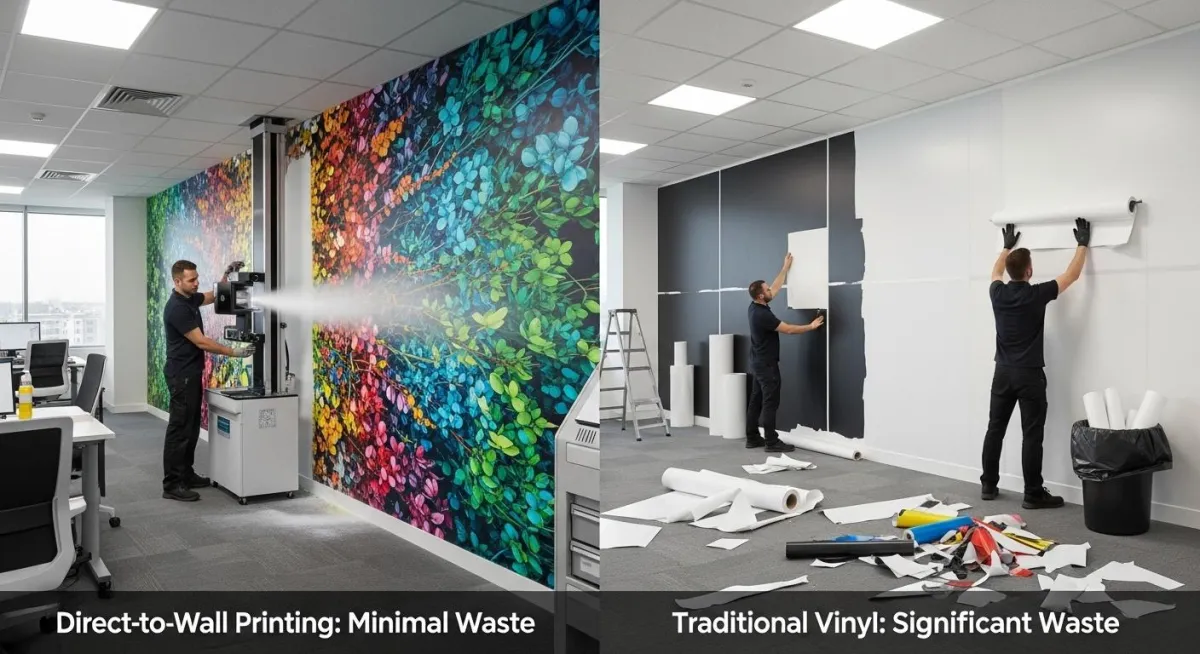
Direct-to-Wall Printing vs. Traditional Vinyl: Comparing Sustainability and Environmental Waste in Commercial Design
Introduction: The Shift Toward Sustainable Commercial Interior Branding
Sustainability has moved from a nice-to-have to a procurement requirement in commercial interiors, and wall graphics are under new scrutiny. Teams in healthcare, education, corporate workplaces, and multi-site retail are reassessing the vinyl wrap environmental impact—from PVC content to short replacement cycles—in favor of eco-friendly interior branding that reduces waste and disruption. This shift places direct-to-wall printing sustainability at the center of programmatic upgrades, brand rollouts, and wayfinding initiatives.
Traditional vinyl and wallpaper generate commercial wall graphics waste at multiple points in the process:
PVC and adhesive systems that are difficult to recycle
Backers, liners, and offcuts that go straight to landfill
Frequent replacements due to seams, bubbling, or wear
Crating and shipping for large panels, plus installation downtime
Direct-to-wall printing offers sustainable wall covering alternatives by eliminating vinyl and adhesives altogether, printing high-resolution imagery directly onto finished or unfinished surfaces (drywall, CMU, concrete, brick). On-site execution reduces shipping materials and fabrication errors, and fast installs—often under five hours—minimize occupant disruption. Durable, cleanable finishes support wall printing lifecycle efficiency, while paint-over-ready surfaces simplify future tenant or program changes without demolition or re-skinning. EastCoast MuralPros leverages this approach for full-campus solutions and multi-location rollouts, and even supports subscription refreshes for seasonal branding or instructional updates. For a deeper dive into materials and process, see their overview of eco-friendly wall printing methods.
Consider a hospital consolidating wayfinding: instead of layered signage and adhesive films, EastCoast MuralPros can integrate room IDs, arrows, and safety cues directly on corridor walls—reducing material counts and visual clutter. A university can refresh recruiting graphics each semester with low-disruption overnight installs, avoiding palletized vinyl and waste. National retail brands can deploy consistent, seam-free murals across locations without the risk of panel mismatch. These practical shifts cut waste now and compound environmental gains over the life of a facility.
Overview of Direct-to-Wall Printing Technology and Materials
Direct-to-wall printing uses precision robotics and UV-LED ink systems to jet imagery directly onto existing surfaces—no vinyl, adhesives, or panels required. The result is photoreal, seam-free graphics that conform to the architecture, supporting direct-to-wall printing sustainability by reducing materials, packaging, and transport. For brand programs and wayfinding, this delivers eco-friendly interior branding without the bulk and failure points of applied films.
The material stack is intentionally minimal: UV-LED cured inks with low odor and low VOCs, optional primers where a substrate needs stabilization, and clear coats only for extreme traffic or scrub requirements. Because there is no laminate or release liner, the printed wall remains paint-over-ready for future tenant or program changes. The method adheres to drywall, CMU, sealed concrete, and brick, and can be extended in-studio to doors, tabletops, and standees—all installed quickly, often in under five hours per wall.
Compared with wallpaper and vinyl, the vinyl wrap environmental impact includes PVC film, acrylic adhesives, release liners, laminates, cutting offcuts, and disposal challenges when graphics are removed. These layers introduce commercial wall graphics waste, add packaging and freight, and often lead to premature replacement due to bubbling, seam lift, or edge contamination. On-site printing removes shipping and fabrication steps, reduces error risk, and delivers consistent results across multi-location rollouts.
Key sustainability and performance advantages include:
No PVC, adhesives, or liner waste, reducing landfill-bound materials.
On-site production that lowers freight and packaging impacts.
Seam-free execution that eliminates common failure points and rework.
Durable, cleanable finishes that extend service life for better wall printing lifecycle efficiency.
Paint-over-ready surfaces that enable strategic refreshes without demolition or stripping.
EastCoast MuralPros leverages this technology for campuses, hospitals, workplaces, and national brands seeking sustainable wall covering alternatives that scale. Explore how it supports brand, wayfinding, and compliance needs in our guide to environmental graphics for commercial spaces.
Understanding Traditional Vinyl Wall Coverings and Environmental Challenges
Most vinyl wall coverings are PVC films printed on wide-format devices, laminated for durability, and applied with pressure-sensitive adhesives in tiled strips. This assembly is durable, but it’s inherently material-intensive: plastics, liners, adhesives, and inks come together in a composite that’s difficult to separate later. From an environmental perspective, the vinyl wrap environmental impact starts at fabrication and continues through installation, maintenance, and removal.
Installations generate commercial wall graphics waste before the first panel goes on the wall. Panels are trimmed to align artwork across seams, release liners are discarded, and overage is ordered to cover field conditions. Freight and packaging—cores, tubes, corner guards, foam, and pallets—add to the footprint, and reprints due to fit issues or damage compound waste.
Release liners, backing paper, and transfer films that are single-use and non-recyclable in most streams
Trim waste from seaming, door/window cutouts, and on-site adjustments
Failed or mis-measured panels that require reprinting and rush shipping
Packaging waste: cartons, plastic bags, cores, and pallets from multi-location rollouts
Adhesive residue requiring chemical cleaners, plus rags and PPE disposal
End-of-life removal debris, including torn vinyl, adhesive, and drywall repairs
At end of life, most printed vinyl cannot be recycled because adhesives, inks, and laminates create a mixed material. Removal typically sends bulk material to landfill, and improper incineration of chlorine-based PVC can produce hazardous byproducts. Frequent refresh cycles for brand updates or wayfinding amplify the footprint, driving up material, labor, and transport impacts.
For teams seeking sustainable wall covering alternatives, direct-to-wall printing sustainability offers a cleaner pathway. On-site, adhesive-free output eliminates vinyl, liners, and most packaging, cuts shipping miles, and reduces error-induced reprints—improving wall printing lifecycle efficiency. EastCoast MuralPros delivers eco-friendly interior branding with seam-free, high-resolution murals on finished or unfinished substrates, fast installs that limit disruption, and paint-over-ready finishes that simplify future changes without generating a pile of plastic waste.
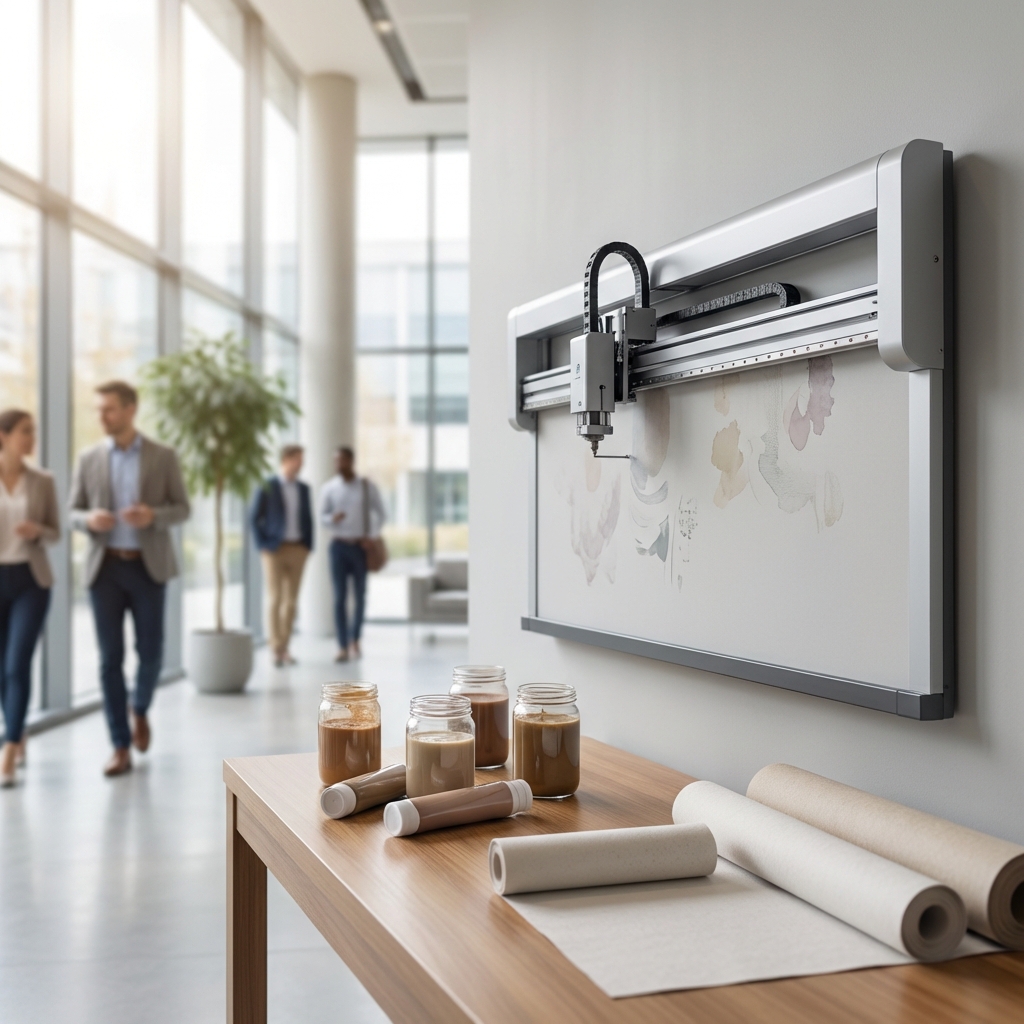
Image 2
Comparing Material Waste: Adhesive Wraps versus Digital Wall Ink
When you compare adhesive wraps to digital wall ink, the biggest sustainability difference is the amount and type of material entering the waste stream. Direct-to-wall printing sustainability improves because the image is built directly on the surface, without a film, adhesive, or overlaminate that will eventually be landfilled. In multi-site programs, every avoided roll, liner, and crate compounds into measurable reductions in commercial wall graphics waste.
Adhesive-based wraps generate multiple waste streams across fabrication, install, and removal. Even when well executed, the vinyl wrap environmental impact accumulates at each step:
PVC film offcuts from panel trimming, seaming, and edge relief
Release liners, overlaminate liners, roll cores, plastic bags, and cartons
Reprints from panel mismatch, bubbling, or surface incompatibility
Masking, squeegees, and adhesive removers used on-site
End-of-life removal waste (spent vinyl plus adhesive residue), often followed by drywall repair and repaint
Limited recyclability because adhesive-backed PVC and contaminated liners are rarely accepted in mixed recycling
Direct-to-wall printing eliminates the substrate entirely, replacing it with durable digital wall ink applied on-site. That shift removes most of the solid materials associated with traditional graphics and supports eco-friendly interior branding goals:
No vinyl, overlaminate, or release liners to ship, trim, or discard
Fewer packaging materials and no panel waste from misalignment
Seam-free output that requires little to no perimeter trimming
Paint-over-ready finishes at end-of-life, reducing demolition and patching
Longer service life in high-traffic areas, improving wall printing lifecycle efficiency
Consider a hospital corridor refresh: a vinyl approach brings in pallets of film, liners, and overlaminate, plus creates bags of trim scrap at every doorway and corner. A direct-to-wall process arrives with a printer, ink, and minimal masking—most waste fits in a few contractor bags rather than a job-site dumpster. The result is a dramatic reduction in solid waste volume, shipping materials, and post-project cleanup.
EastCoast MuralPros delivers sustainable wall covering alternatives at architectural scale by printing directly to drywall, CMU, concrete, or brick—no adhesives, seams, or panels. For teams managing multi-location rollouts, the on-site model also cuts shipping-related waste and fabrication errors while maintaining consistent quality. If your mandate is to reduce commercial wall graphics waste without compromising brand impact, this is a practical, scalable path to direct-to-wall printing sustainability.
Lifecycle Assessment: Durability, Maintenance, and Removal Impacts
A lifecycle lens shows the biggest environmental gains happen after install, not just at material selection. Vinyl wall coverings rely on adhesives and seams that become failure points; when edges lift or bubble, whole panels are often replaced—compounding commercial wall graphics waste. Direct-to-wall printing places ink directly onto the surface, eliminating liners, adhesive carriers, and much of the packaging that typically heads to landfill.
Durability affects maintenance frequency. In high-traffic corridors, vinyl edges can scuff and open under cart impact, cleaning moisture, or thermal cycles, triggering patching or panel swaps. EastCoast MuralPros’ adhesive-free prints create a hard, cleanable surface that withstands routine wipe-downs with non-abrasive cleaners, reducing service calls and keeping visuals crisp for longer intervals.
Maintenance profiles diverge materially over a 3–5 year horizon:
Vinyl: recurring seam and edge repairs, adhesive failures that force full-panel replacement, residue clean-up, and significant trim-off waste with each visit.
Direct-to-wall: spot reprinting of damaged sections without peel-and-replace, no trim waste, and cleaning-in-place to extend service life.
For a hospital corridor, shifting from quarterly vinyl patching to annual touch-ups can eliminate multiple vendor mobilizations and dozens of pounds of mixed-material waste.
Removal is often the hidden hotspot for vinyl wrap environmental impact. Peeling films can leave adhesive residue that requires solvents and wall repair before repainting—plus disposal of bulky, mixed-plastic panels. EastCoast MuralPros produces paint-over-ready finishes, so end-of-life is a standard repaint cycle with no graphic demolition, minimizing downtime during tenant turnover or campus rebranding.
For procurement teams measuring direct-to-wall printing sustainability, the benefits compound: fewer truck shipments due to on-site printing, reduced packaging, less labor, and a cleaner end-of-life pathway. As a provider of sustainable wall covering alternatives, EastCoast MuralPros delivers wall printing lifecycle efficiency across multi-location rollouts and full-campus programs—an eco-friendly interior branding strategy that scales without the waste profile of traditional wraps.
Installation Efficiency and Indoor Air Quality Considerations
Speed and disruption matter as much as design quality. Vinyl and wallpaper require templating, panel tiling, adhesive application, seam rolling, and long cure times—plus the risk of rework if alignment drifts. Direct-to-wall systems print the artwork in place, eliminating panels and adhesives, which compresses schedules. EastCoast MuralPros typically completes a full feature wall in under five hours, fitting installs into overnight or weekend windows without shutting down floors.
Indoor air quality benefits from this streamlined approach. Traditional films rely on PVC and pressure-sensitive adhesives that can introduce odors and adhesive-related VOCs during application and removal, especially when heat guns or solvents are used. On-wall printing avoids those materials entirely and reduces aerosols, overspray, and handling of chemical-heavy consumables. The result is a quieter, cleaner process that better supports healthcare corridors, classrooms, and occupied offices seeking eco-friendly interior branding.
Image 3
Waste is another differentiator tied to direct-to-wall printing sustainability. Vinyl wraps generate release liners, panel trimmings, core tubes, packaging, and replacement panels for handling errors—adding to commercial wall graphics waste and the broader vinyl wrap environmental impact. Printing directly to painted gypsum, CMU, concrete, or brick minimizes packaging and offcuts, and paint-over-ready finishes mean future changes don’t require tear-outs, improving wall printing lifecycle efficiency.
For facility teams, the operational advantages are concrete. A hospital can update wayfinding across multiple wings in a single night without adhesive odors or corridor closures. A school district can roll out a district-wide branding refresh over successive weekends, with consistent color and scale across campuses. EastCoast MuralPros supports these multi-location rollouts with low-disruption, adhesive-free execution and integrated wayfinding graphics as sustainable wall covering alternatives.
To protect IAQ during any graphics install, teams can:
Schedule during low occupancy and run post-work ventilation purges.
Isolate zones and use portable air scrubbers where feasible.
Specify low-odor primers/paints for wall prep and verify dry times.
Conduct a light post-install wipe-down to remove settled dust.
Pros and Cons of Printing and Vinyl for Large-Scale Facilities
For facilities teams managing multiple sites, the sustainability trade-offs are as critical as schedule and cost. Direct-to-wall printing sustainability centers on eliminating vinyl, adhesives, and liner waste while reducing shipping and fabrication steps. Traditional films and wallpapers, by contrast, introduce plastics, adhesives, and frequent replacements—factors that compound the vinyl wrap environmental impact over time.
Material waste: Direct-to-wall puts ink on the wall, cutting commercial wall graphics waste tied to PVC, liners, and release papers. Vinyl relies on substrate, adhesive, trims, test prints, and packaging that typically head to landfill.
Install and disruption: On-site wall printing finishes fast with minimal masking and no odor from adhesives, keeping corridors and workplaces operational. Vinyl installation can be slower in busy areas and often requires staging space, cure time, and post-trim cleanup.
Performance and upkeep: Seam-free graphics resist edge lift and are easy to clean. Vinyl seams can telegraph, collect dirt, or peel in high-traffic zones, driving earlier refresh cycles and added maintenance.
Scale and logistics: Printing in place reduces shipping, crating, and re-fab if dimensions change. Vinyl rollouts add freight, storage, and reprints when measurements or site conditions differ.
End-of-life: Paint-over-ready finishes simplify future tenant or program changes. Most vinyl/PVC systems are difficult to recycle due to mixed materials, adhesives, and inks, limiting sustainable wall covering alternatives.
Lifecycle matters most in healthcare corridors, campuses, and retail networks where updates are frequent. Wall printing lifecycle efficiency shows up in faster turnovers, fewer returns to fix seams or bubbles, and predictable cleaning protocols. Example: a hospital wing can refresh wayfinding overnight in under five hours per zone, avoiding patient disruption and waste from removed film.
EastCoast MuralPros brings an eco-friendly interior branding approach with on-site, adhesive-free printing that works on drywall, CMU, concrete, and brick. Teams get consistent execution across multi-location rollouts, paint-over-ready finishes, and a subscription model for strategic refreshes—an efficient, sustainable wall covering alternative to vinyl and wallpaper.
Conclusion: Selecting the Optimal Solution for Institutional Sustainability Goals
Selecting between vinyl wraps and direct-to-wall printing comes down to performance over the full lifecycle. For eco-friendly interior branding, direct-to-wall printing avoids PVC, adhesives, seams, and liners that often end up in landfills, helping reduce commercial wall graphics waste from the start. When you factor the vinyl wrap environmental impact—PVC content, adhesives, offcuts, packaging, and more frequent replacement—the balance tilts toward print-on-surface solutions that install quickly with less material throughput.
Lifecycle performance is where the gains compound. Seam-free, high-resolution imagery extends service life by removing common failure points like bubbling and peeling. Cleanable, durable finishes and paint-over-ready surfaces simplify future changes, and integrated wayfinding and instructional graphics reduce separate signage, hardware, and patch-and-repaint cycles—key drivers of wall printing lifecycle efficiency.
Consider the operational realities. A hospital updating wayfinding across multiple corridors can print on-site overnight, avoiding weeks of panel fabrication, shipping, and installation noise. A K–12 district can refresh seasonal programs or safety messages without tearing down coverings, and a landlord can rebrand between tenants, then paint over when leases turn, without a costly strip-out.
Choose direct-to-wall when the following are priorities:
Reducing material throughput and packaging while eliminating adhesives and PVC
Fast, low-disruption installs in occupied spaces (schools, hospitals, offices)
Consistent execution across multi-location rollouts with minimal punch lists
Compatibility with finished and unfinished substrates (drywall, CMU, concrete, brick)
Paint-over-ready, cleanable surfaces that support frequent content updates
Integrated wayfinding and safety graphics without additional signage clutter
Procurement requirements for sustainable wall covering alternatives and measurable waste reduction
For institutions aligning capital projects with direct-to-wall printing sustainability goals, EastCoast MuralPros offers on-site, high-definition printing that limits shipping and fabrication errors while standardizing quality at scale. The team’s subscription model supports scheduled refreshes without tear-out waste, and in-studio options extend branding to doors, tables, and standees. This performance-based approach delivers durable results, clearer timelines, and a smaller materials footprint across campuses and portfolios.
Call to Action

Contact Us
📍250 East Sandford Blvd, Studio G2
Mount Vernon, NY 10550
Mon-Sat 7am-9pm · Sun closed


