Commercial Interior Branding Solutions: Modern Alternatives to Vinyl and Wallpaper
Introduction: The Evolution of Commercial Interior Branding
Commercial Interior Branding Solutions: Modern Alternatives to Vinyl and Wallpaper
Commercial interior branding has moved well beyond posters and plaques on white walls. Today’s environments—from hospitals and schools to corporate campuses and retail flagships—are designed as integrated experience systems. Walls function as directional tools, culture carriers, and flexible canvases for change. The most effective commercial interior branding solutions now combine architectural scale with operational predictability, enabling teams to adapt fast without construction-heavy disruption.
This shift has been accelerated by advances in direct-to-wall printing technology. Instead of relying on vinyl, wallpaper, or labor-intensive painting, organizations can print high-resolution graphics directly onto finished and unfinished surfaces with speed and consistency. The result is a design-forward, seam-free look that feels built-in rather than applied, yet installs in hours.
EastCoast MuralPros serves this new standard with a platform built for facilities, procurement, and operations. The company’s approach blends on-site printing, lifecycle durability, and a subscription model for planned refreshes—delivering environments that can evolve as programs, tenants, and brand strategies change.
Limitations of Traditional Vinyl Wraps and Wallpaper in Commercial Spaces
Vinyl wraps and commercial wallpaper were never designed to be agile branding systems. While they can produce colorful results, common pain points surface quickly in high-traffic and multi-site scenarios:
Installation complexity: Panels, seams, and overlaps create alignment risk, especially across long corridors and large feature walls. Irregular surfaces amplify these issues.
Premature aging: Peeling at corners, bubbling over time, and seam creep are routine in busy spaces and near HVAC sources or moisture-prone areas.
Downtime and disruption: Pre-fabrication, shipping, staging, and multi-day installs stretch schedules. Replacements compound the downtime.
Limited surface compatibility: CMU block, brick, textured drywall, and concrete challenge adhesion and aesthetic quality.
Maintenance hurdles: Cleaning chemicals, bump carts, and daily wear can scuff films or break down adhesives, triggering early reprints.
Waste and rework: Mis-measurements, shipping damage, and panel mismatches add cost, time, and landfill waste.
For facilities directors and property teams under pressure to move fast, control lifecycle costs, and keep spaces open, these friction points introduce risk that compounds across campuses and portfolios.
Understanding Direct-to-Wall Printing Technology
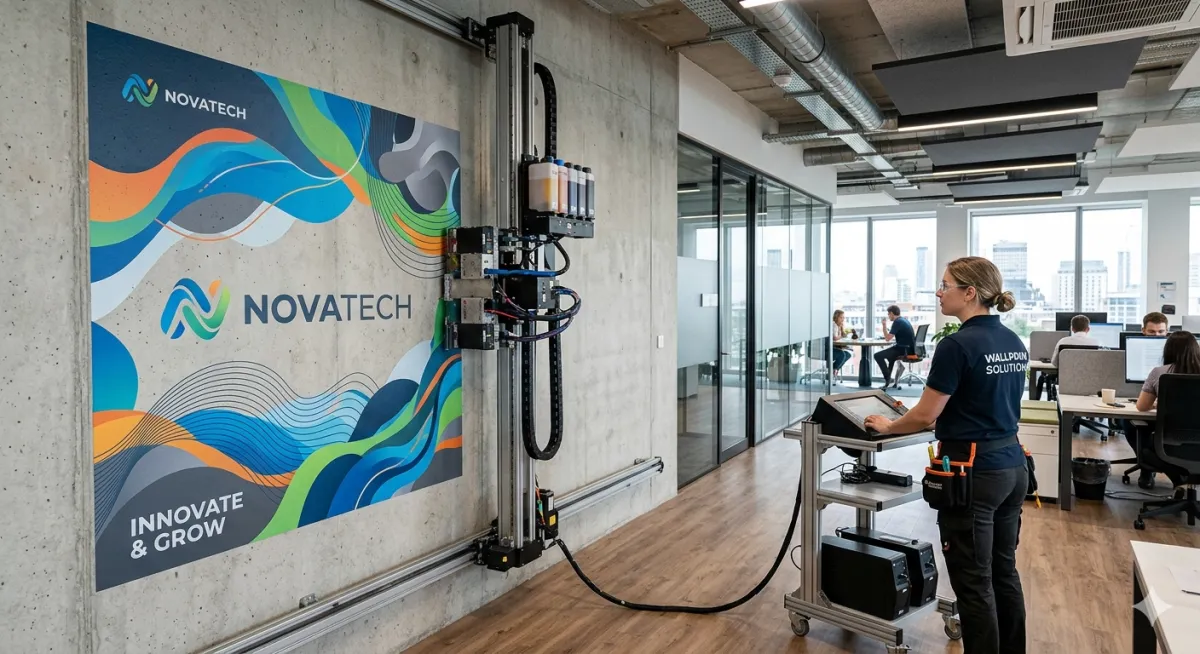
Direct-to-wall printing technology brings industrial printing precision to architectural surfaces. A mobile, rail-guided print system maps and prints photoreal imagery straight onto walls—no vinyl, no adhesives, no panels. Operators calibrate for color, scale, and surface type, then output high-resolution artwork in place with crisp detail at architectural scale.
Key technical attributes include:
High-definition output: Fine-line text, logos, and photographic content reproduce cleanly, supporting both brand expression and functional wayfinding.
Surface versatility: Compatible with finished and unfinished substrates like drywall, CMU, sealed concrete, and brick, producing a cohesive look without seams.
Predictable setup: Site surveys confirm wall readiness (clean, dry, stable) and define print zones around doors, windows, fixtures, and signage.
Integrated color management: ICC profiles and proofing workflows maintain color integrity across multiple walls and locations.
Modular mobility: Printers roll in, align, and print—often completing feature walls within hours and entire corridors the same day.
EastCoast MuralPros employs this technology to deliver seam-free graphics at scale, including full-campus solutions for schools and hospitals. Because prints happen in place, on-site execution eliminates shipping delays and reduces opportunities for fabrication error. The finish is paint-over-ready, so future tenant or program changes remain straightforward for facilities teams.
Key Benefits of Modern Commercial Interior Branding Solutions
Direct-to-wall printing reframes the value proposition of interior graphics for operations, procurement, and design leaders. Benefits extend from first-day installation to long-term performance:
Speed with certainty: Typical installations finish in under five hours per wall, preserving business continuity in occupied buildings.
Seam-free aesthetics: Large, uninterrupted visuals reinforce brand quality and reduce visual clutter.
Durable, cleanable surfaces: Designed for high-traffic environments, these finishes stand up to routine cleaning and daily contact.
Wayfinding integrated into architecture: Instructional, safety, and directional graphics print directly onto walls, reducing reliance on protruding signs.
Lifecycle efficiency: Fewer replacements, minimal rework, and paint-over readiness lower total cost of ownership.
Surface flexibility: Compatible with drywall, CMU, concrete, and brick, expanding design options in existing buildings.
Consistency at scale: Color-managed workflows and repeatable methods support multi-location and national rollouts.
Operationally low-disruption: Quiet, low-profile installs fit into off-hours maintenance windows and occupied settings.
Subscription-ready: Planned seasonal or strategic refreshes are scheduled like facility services—ideal for academic calendars, retail seasons, and corporate milestones.
Extended applications: In-studio printing on doors, tables, and standees enables cohesive environmental branding beyond walls.
Digital artist enablement: Collaborative tools help creative teams scale original work across formats, floors, and campuses.
Together, these advantages create commercial interior branding solutions that are design-forward and facilities-ready.
Real-World Applications Across Industries and Institutions
Direct-to-wall printing isn’t a one-off mural technique; it’s a platform for programmatic branding and communication across sectors.
Healthcare systems: Print corridor wayfinding, unit identifiers, and patient experience visuals directly on walls to reduce sign clutter and improve clarity. Durable finishes withstand routine cleaning protocols and cart traffic.
Higher education and K–12: Activate recruitment messaging, athletics identity, donor recognition, and instructional graphics across residence halls, labs, libraries, and arenas. Refresh annually without construction.
Corporate workplace: Reinforce culture, ESG storytelling, and safety communication in lobbies, huddle spaces, and production areas. Roll updates across regional offices with color-matched consistency.
Hospitality and hotels: Create photogenic backdrops, elevator lobby features, and corridor moodscapes that align with brand standards—executed quickly between bookings or during shoulder seasons.
Retail and multi-location brands: Deploy seasonal campaigns and category storytelling straight onto perimeter walls, stockroom corridors, and customer service zones—without fixture rework.
Commercial landlords: Support lease-up with brandable marketing suites and flexible test-fit graphics. Paint-over-ready finishes simplify turnover.
Museums and cultural institutions: Produce photoreal, high-resolution exhibition graphics that align with curatorial standards, then refresh as shows rotate.
Public-sector and institutional owners: Integrate safety, instructional, and wayfinding systems across large facilities while minimizing signage maintenance.
EastCoast MuralPros builds these programs as full-campus or multi-site systems, leveraging on-site printing for walls and in-studio output for companion elements like doors and standees to maintain continuity.
Installation Speed and Minimal Disruption Advantages
Schedule certainty is a deciding factor for facilities teams. Direct-to-wall printing compresses the timeline by bringing fabrication to the site.
A typical path looks like this: 1) Brief and survey: Scope walls, confirm surfaces, gather measurements, and review adjacent conditions (fixtures, windows, devices). 2) Artwork and proofing: Align on scale, color targets, and site-specific variations; finalize location maps and print order. 3) Day-of execution: The team arrives with calibrated equipment, isolates the zone, prints, and completes within a standard maintenance window—often under five hours per wall. 4) Turnover: Spaces reopen immediately after cure, with no panel curing or adhesive set time.
Operational advantages include:
Minimal staging: No crates, panel stacks, or adhesive prep areas reducing trip hazards in occupied buildings.
Quiet workflow: Low-noise equipment supports after-hours installs near sensitive areas like patient rooms or classrooms.
Fewer dependencies: Eliminates shipping risk and panel sequencing—common sources of project delays.
Precision in place: Real-time adjustments around masonry joints, reveals, and fixtures ensure perfect alignment.
For institutions accustomed to multi-day vinyl installations and punch lists, this approach reduces coordination overhead and keeps spaces revenue-generating.
Durability, Maintenance, and Lifecycle Cost Efficiency
Long-term performance determines the true cost of any interior branding system. Direct-to-wall finishes are engineered for daily use in high-traffic environments while simplifying upkeep.
What durability looks like in practice:
Cleanability: Surfaces tolerate routine wipe-downs with neutral cleaners, helping teams maintain a crisp appearance without specialty products.
Abrasion resistance: Busy corridors, carts, and incidental contact are considered in material and coating selection, extending useful life.
Visual longevity: Seam-free graphics avoid the line creep, peeling, and dirt catch points that age panel-based systems prematurely.
Finish continuity: Matte, low-glare finishes support readability and photography while hiding minor scuffs better than glossy films.
Lifecycle economics improve because:
There are no panels or adhesives to fail, reducing unscheduled replacements.
Paint-over-ready surfaces make decommissioning straightforward during tenant turnover or program changes.
On-site reprints target only the affected wall section, not a full panel set.
For a deeper dive into wear performance, see EastCoast MuralPros’ overview of high-traffic surface resilience: Direct-to-wall printing benefits.
Scalability for Multi-Location Corporate Rollouts
Scaling from a pilot feature wall to a national program requires more than a great print. Governance, logistics, and QA must hold steady across geographies.
Direct-to-wall programs support multi-site consistency through:
Centralized art libraries: Master assets, templates, and typographic systems ensure fidelity to brand standards.
Color management at scale: ICC profiles, test swatches, and device calibration maintain brand colors across different substrates and lighting conditions.
Repeatable field methods: Standardized site surveys, installation checklists, and turnover documentation reduce variance.
Phased deployment: Coordinate site access and windowed installs to support active operations and regional priorities.
Remote QA: Photo logs and sign-offs tie each wall to an approved deliverable, simplifying procurement compliance and warranty tracking.
EastCoast MuralPros is structured for these rollouts, providing consistent execution across multi-location and national programs. For brands with hundreds of walls across dozens of sites, the ability to produce the same quality result—without panel shipments or local vendor variability—is a significant risk reducer.
Sustainability Considerations in Commercial Interior Design
Sustainability is increasingly a procurement requirement, not just a design aspiration. Direct-to-wall printing reduces material use and shipping while supporting longer service life—key factors in lowering environmental impact.
Where the gains come from:
Material efficiency: No vinyl, paper backers, liners, or adhesive layers means fewer inputs from the start.
Reduced freight: On-site fabrication eliminates panel shipments, crates, and replacement logistics.
Longer cycles: Durable, cleanable graphics reduce the frequency of replacements, cutting recurring waste.
End-of-life simplicity: Paint-over readiness avoids tearing down films or disposing of contaminated adhesive materials.
For teams comparing options, this overview explains the differences succinctly: Direct-to-wall vs vinyl.
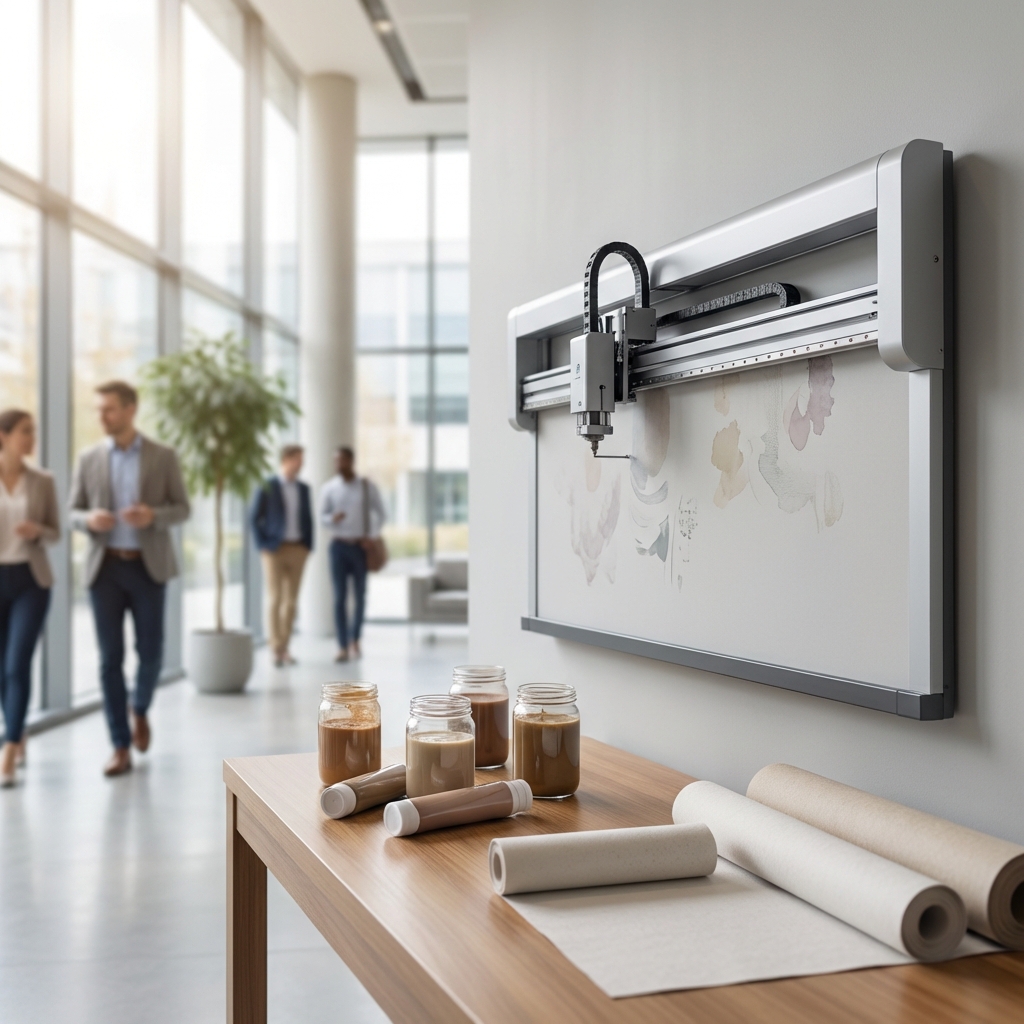
Direct-to-wall printing vs vinyl sustainability
These advantages help organizations demonstrate responsible stewardship while meeting the speed and visual standards of modern branding.
Design Flexibility and Customization Capabilities
Great branding adapts to context. Direct-to-wall systems allow creative teams to balance consistency with local specificity—without incurring fabrication complexity.
What becomes possible:
Architectural-scale storytelling: Seam-free walls accommodate panoramic imagery, large typography, and brand patterns without breaks.
Surface-informed design: Graphics can respect masonry grids, concrete forms, and drywall reveals, creating a built-in aesthetic.
Variable content: Swap local photography, departmental identities, or event messaging inside locked brand frameworks to personalize each site.
Integrated communication: Combine branding with wayfinding, safety callouts, and instructional graphics for clear, space-native guidance.
Multi-surface cohesion: Extend visual systems to doors, tables, and standees via in-studio prints to create a fully unified environment.
EastCoast MuralPros also supports digital artists with collaborative tools, helping translate original works into scalable, color-consistent assets across multiple formats and substrates. For curatorial teams and experiential designers, this removes the typical handoff friction between creative intent and field execution.
Comparison: Direct-to-Wall Printing vs. Traditional Methods
A side-by-side comparison clarifies where direct-to-wall printing serves as a performance-based alternative to vinyl wall coverings, wallpaper, and hand-painted murals.
Installation speed
- Direct-to-wall: On-site fabrication completes feature walls in hours; entire corridors in a day. - Vinyl/wallpaper: Multi-day timelines with pre-fabrication, shipments, staging, and panel alignment.
Visual continuity
- Direct-to-wall: Seam-free, architectural-scale graphics; no overlaps or seams to telegraph. - Vinyl/wallpaper: Seams and overlaps are unavoidable, with higher risk of misalignment.
Surface compatibility
- Direct-to-wall: Works on finished and unfinished drywall, CMU, concrete, and brick. - Vinyl/wallpaper: Adhesion and aesthetics degrade on textured and porous surfaces.
Durability and maintenance
- Direct-to-wall: Cleanable, abrasion-resistant finishes; no edges to peel or bubble. - Vinyl/wallpaper: Edge lift, bubbling, and scuffing common in high-traffic zones.
Disruption and logistics
- Direct-to-wall: Low staging footprint; fewer dependencies; suited to occupied buildings. - Vinyl/wallpaper: Crates, panels, and adhesives increase site impact and safety planning.
Revisions and turnover
- Direct-to-wall: Paint-over-ready; targeted refreshes are straightforward. - Vinyl/wallpaper: Removal generates waste, exposes adhesive residue, and can damage substrates.
Consistency across sites
- Direct-to-wall: Color-managed, standardized methods reduce variance in national rollouts. - Vinyl/wallpaper: Panel manufacturing batches, film lots, and installer variation introduce inconsistency.
Sustainability
- Direct-to-wall: Lower material inputs, less freight, and longer service life reduce waste. - Vinyl/wallpaper: Material-heavy systems produce recurring landfill streams at changeout.
Cost over lifecycle
- Direct-to-wall: Fewer replacements and minimal rework lower total cost of ownership. - Vinyl/wallpaper: Repairs, panel reorders, and recurring replacements accumulate cost.
For teams comparing a renovation path without construction, direct-to-wall emerges as a practical, durable, and design-forward option.
Conclusion: Future-Proofing Your Commercial Spaces with Advanced Branding Solutions
The next generation of commercial interior branding solutions blends architectural quality with operational rigor. By printing directly onto walls—without vinyl, adhesives, or panels—organizations activate their environments quickly, durably, and at scale. The approach supports wayfinding, safety, and culture storytelling while reducing disruption, waste, and lifecycle costs.
Whether you manage a healthcare network, a university campus, a national retail footprint, or a portfolio of commercial properties, the ability to deploy high-resolution mural printing in hours and refresh strategically over time changes how you plan upgrades. It turns branding into an adaptable system rather than a one-time decorative expense.
EastCoast MuralPros partners with facilities, procurement, and design teams to deliver these outcomes—providing full-campus solutions, multi-location rollouts, and subscription-based refreshes that keep spaces current without construction. To explore how direct-to-wall printing technology can align with your timelines and standards, consider a pilot wall or corridor and evaluate the operational and visual impact firsthand.


