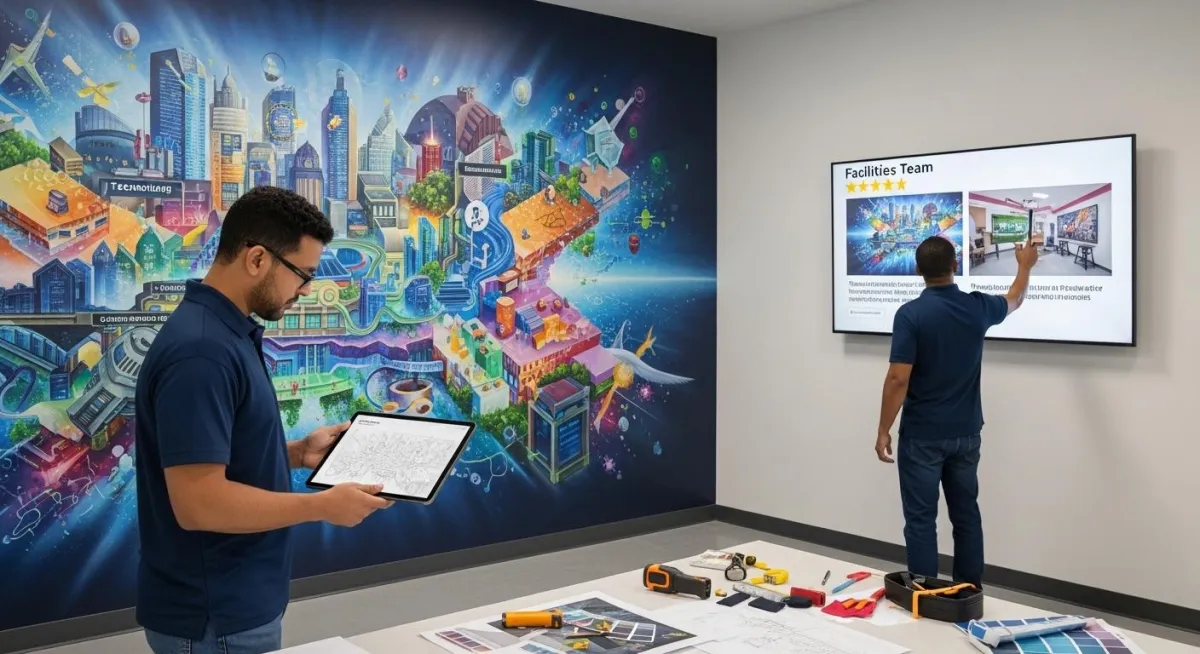
Commercial Mural Project Reviews: What Facility Teams Need to Know
Introduction: Why Commercial Mural Project Reviews Matter for Decision-Makers
Commercial mural projects sit at the intersection of branding, facilities management, and capital planning. For decision-makers, reviews are more than aesthetic opinions—they’re a snapshot of schedule reliability, lifecycle cost, environmental impact, and the day-to-day realities of maintaining high-traffic interiors. Facility teams need evidence that a solution will install cleanly, perform predictably, and scale across multiple locations without introducing risk or disruption.
The shift away from vinyl wall coverings and construction-heavy upgrades has accelerated as organizations look for faster, cleaner, and more sustainable options. Direct-to-wall printing—delivering high-resolution imagery directly to finished or unfinished surfaces—has emerged as a performance-based alternative. Reading direct-to-wall printing reviews with a facilities lens helps teams separate design-forward marketing from operational truth: What happens after the installation crew leaves? How does the finish hold up under carts, backpacks, and daily cleaning?
As a provider of commercial interior branding solutions, EastCoast MuralPros works with facilities directors, procurement teams, and brand leaders to deliver murals that are fast to install, durable under routine maintenance, and consistent at architectural scale. This article synthesizes what facility teams should look for when evaluating options, and how to interpret “great design” as “low-risk, high-performing capital improvement.”
Understanding Commercial Mural Technology: Direct-to-Wall vs. Traditional Methods
Direct-to-wall printing applies ink and curing directly onto your substrate—drywall, CMU, concrete, or brick—without vinyl films, adhesives, seams, or panels. Industrial print heads and UV-LED curing create a crisp, photoreal finish that reads like part of the architecture rather than an applied product. The result is a seam-free look at scale, with high-resolution imagery rendered precisely across large surfaces and complex geometries.
Traditional approaches—vinyl wraps, wallpaper, or hand-painted murals—still have a place, but each carries trade-offs. Vinyl and wallpaper rely on adhesives that can bubble, fail at seams, or leave residue. Panels can introduce alignment and shipping risks. Hand-painting produces singular craft but often extends timelines and complicates replication across sites. If your priority is speed, repeatability, and minimal disruption in occupied buildings, direct-to-wall is designed for throughput and consistency.
On-site printing also eliminates common pain points: no shipping delays, fewer fabrication errors, and fewer constraints related to substrate tolerances since installers can adjust in real time. Teams that need off-wall assets can still combine direct-to-wall with in-studio printed doors, tabletops, and standees for pop-ups, activations, and changeable brand moments.
If you’re comparing environmental and operational trade-offs, a practical resource is EastCoast MuralPros’ guide on direct-to-wall vs vinyl, which outlines waste, adhesives, and lifecycle considerations relevant to institutional settings.
Key Performance Metrics Facility Teams Should Evaluate
A strong review of wall graphics installation quality goes beyond “it looks great.” It captures how a mural performs under institutional conditions. As you evaluate options, build acceptance criteria around these measurable dimensions:
Resolution and image fidelity
- Target pixel density suitable for viewing distance (e.g., 100–150 PPI at typical corridor viewing). - Line clarity and edge definition for logos and typography. - Absence of banding, color striping, or visible dots at normal viewing distances.
Color accuracy and brand consistency
- Document Delta E (ΔE) color variance targets for critical brand hues. - Use ICC color-managed workflows and proofing for repeatability across locations. - Define tolerance for color drift under different lighting conditions.
Surface compatibility and uniformity
- Confirm adhesion and curing on drywall, CMU, sealed concrete, or brick. - Validate print uniformity across patched areas, joints, or varying textures. - Specify acceptable texture telegraphing for architectural finishes.
Durability and cleanability
- Abrasion resistance under equipment contact (carts, backpacks, chairs). - Chemical resistance for routine cleaning agents (quats, dilute bleach where permitted). - Cleanability cycles before visible wear; document maintenance SOPs.
Environmental and occupant impact
- Low odor and low-VOC curing for occupied buildings. - Minimal dust and debris generation; set containment requirements. - Noise thresholds compatible with clinical or educational operations.
Installation efficiency and QA
- Time-on-site targets per wall or per floor. - Staging, access, and safety plans for occupied environments. - Final inspection checklist: color match, registration, edge integrity, and punch-list closeout.
Codify these measures in your RFP and closeout documentation. When you see direct-to-wall printing reviews that include metrics—rather than just photos—you’re looking at a program built for procurement, facilities, and operations, not one-off art.
Installation Speed and Minimal Disruption: What the Data Shows
In occupied facilities, installation speed is more than convenience—it’s risk mitigation. Direct-to-wall systems are engineered for quick mobilization and rapid completion. Typical single-wall installations can be completed in under five hours, including setup, print, and localized curing. For multi-wall projects, phased approaches allow crews to progress floor by floor with minimal isolation.
Compared to vinyl, time savings accrue at several stages. There is no adhesive application, panel alignment, or seam rolling; there’s also no wait for adhesive cure times before areas can return to service. On-site printing compresses logistics by removing shipping and unpacking delays, while also eliminating the back-and-forth when panel measurements don’t match field conditions.
For decision-makers evaluating downtime, plan schedules that align with low-traffic windows—overnights for healthcare corridors, weekends for academic buildings, or early-morning shifts for retail back-of-house. A sample execution plan for a medium corridor might look like:
6:00 PM mobilization, containment, and surface prep verification.
6:30–9:00 PM printing and curing, with live color checks against brand standards.
9:00–9:30 PM touch-ups and QA.
9:30–10:00 PM demobilization and cleaning, corridor opened.
This low-disruption approach enables wayfinding changes, safety updates, or seasonal campaigns to roll out on tight timelines without heavy construction schedules or area closures that complicate patient flow, student movement, or daily operations.
Durability and Maintenance: Real-World Performance in High-Traffic Environments
High-traffic environments demand finishes that can be cleaned frequently without degrading. Direct-to-wall murals are designed for abrasion resistance and routine sanitation protocols. Seam-free graphics remove common failure points where vinyl can peel, bubble, or trap dirt, and the cured finish stands up to incidental contact from carts, strollers, and rolling luggage.
Maintenance teams can use standard procedures—soft microfiber cloths with mild detergents, followed by clean water rinse where needed. For areas exposed to hand traffic, quaternary ammonium compounds typically perform well; always validate chemistry on a small test area and align with your infection prevention or EHS team. Because there are no seams or edges, there’s less risk of moisture intrusion or delamination.
If lifecycle performance is central to your assessment, review EastCoast MuralPros’ discussion of direct-to-wall durability benefits. In practice, facility teams report smoother inspections and less reactive maintenance since there are no panels to replace or edges to re-adhere. And when programs or tenants change, paint-over-ready finishes allow you to prime and repaint without a landfill trip—simplifying turnarounds and reducing cost.
Durability also extends to clarity. High-resolution wall printing performance maintains crisp details over time when cleaning doesn’t abrade the ink layer. In galleries and museums—where visitors stand close—photoreal imagery at architectural scale can remain inspection-grade without the waviness or gloss shifts that seams introduce.
Cost-Benefit Analysis Across Multi-Location Rollouts
The economics of commercial mural projects hinge on total cost of ownership, not just initial install price. Direct-to-wall printing can reduce costs in four areas that matter to multi-site programs:
Installation labor and downtime: Faster installs and immediate return to service minimize disruption costs for revenue-generating areas, clinical throughput, or student services.
Logistics and waste: On-site printing removes shipping costs and packaging waste, and avoids reorders due to fabrication errors or damaged panels.
Maintenance cycles: Seam-free finishes reduce calls for patching or re-adhering, while cleanability supports the same SOPs used facility-wide.
End-of-life transitions: Paint-over-ready surfaces eliminate removal labor and disposal fees associated with vinyl and wallpaper.
To quantify, consider a three-year model for a 20-location rollout with identical corridors:
Baseline: Vinyl wrap with panels, adhesive, and seam finishing; replacement of 10% of panels annually due to edge failure or damage; two hours of downtime per wall for cure times.
Direct-to-wall: Single-phase install under five hours per wall with no seam failures; zero panel replacements; paint-over at tenant transition with standard labor.
Apply local labor rates, shipping volumes, and downtime impact to your environment. For many organizations, the breakeven occurs within the first maintenance cycle. EastCoast MuralPros also supports subscription models for seasonal or strategic refreshes, spreading costs predictably and reducing one-time capital spikes—particularly useful for retail, higher education, and hospitality environments where brand narratives evolve frequently.
Case Study Applications: Healthcare, Education, and Corporate Environments
Healthcare In a medical center’s inpatient tower, corridors and family lounges required calming imagery and unified wayfinding. Clinical operations couldn’t absorb closures or fumes. The team used direct-to-wall printing during overnight windows, completing a floor per night. Integrated room numbering, directional arrows, and safety reminders reduced signage clutter and improved legibility. Post-install, housekeeping incorporated murals into routine cleaning without altering chemicals or equipment. Because there were no seams, there was no edge harboring dust—a small but meaningful advantage in clinical environments.
Education A university needed a full-campus refresh to unify departmental identities across student services, libraries, and athletics. Direct-to-wall printing enabled consistent color across varied substrates—old CMU in residence halls and new drywall in renovated buildings. Graphics embedded welcome messaging, code-compliant floor markings, and wayfinding that supported events and orientation season. Work progressed during summer downtime and continued into the semester with low-disruption night shifts. When academic programs moved, paint-over-ready finishes made changeovers simple for facilities crews.
Corporate A technology company piloted murals across two floors to evaluate employee feedback, cleaning impact, and color consistency. The pilot delivered large-format brand storytelling, photo-driven culture walls, and instructional graphics at maker spaces. Strong results turned into a national rollout, supported by color-managed workflows and vendor QA that ensured ΔE tolerances remained tight. Consistent execution—same clarity, same finish across markets—simplified approvals from brand and workplace teams and reduced back-and-forth with local contractors.
These mural installation case studies share a pattern: fast, quiet installs; durable, cleanable surfaces; integrated information design that reduces clutter; and a documented path to scale without surprises.
Design Quality and Brand Consistency at Architectural Scale
High-resolution wall printing performance must hold up not just in a proof, but across 40 feet of corridor or a two-story stairwell. For brand and experience teams, that means:
Typography remains razor-sharp at viewing distance and close-up.
Gradients and skin tones reproduce smoothly without banding.
Logos lock to approved color targets across all sites.
Direct-to-wall systems use ICC color management and device calibration to ensure predictability. Where natural light varies, pre-proofing under mixed lighting helps maintain perceived consistency. Because there are no seams, large fields of color appear uninterrupted—no gloss shifts or panel joints breaking the composition.
Digital artists and content teams benefit from collaborative tools that translate complex files into production efficiently. Layer management, tiling (when needed for ultra-large canvases), and preflight checks for resolution support fast approvals. For multisite campaigns, template frameworks let teams localize imagery while preserving brand guardrails.
Large-scale experiential moments extend beyond walls. In-studio printing on doors, tables, and standees creates cohesive touchpoints for events, lobbies, and exhibit spaces. Museums and cultural institutions in particular lean on photoreal detail to honor artwork, archival photography, or educational content—without the compression artifacts or sheen mismatches that can distract from the story.
Sustainability and Lifecycle Advantages Over Vinyl and Wallpaper
Organizations are under pressure to demonstrate sustainable choices without compromising performance. Direct-to-wall printing addresses several environmental pain points associated with vinyl and wallpaper:
Adhesive-free application reduces chemical load and related off-gassing concerns.
On-site printing eliminates shipping and excessive packaging, cutting freight emissions and waste.
Seam-free, durable finishes extend lifespan, lowering replacement frequency and material throughput.
Paint-over-ready end-of-life avoids landfilling adhesive-backed materials and accelerates turnover.
From a procurement standpoint, fewer materials moving through the building means fewer dumpsters, less staging space, and fewer opportunities for damage in transit. Operationally, low-odor, fast-curing inks support installation in occupied buildings without displacing occupants.
If you’re building an environmental business case, align sustainability benefits with lifecycle cost modeling and downtime savings. The most persuasive narrative combines reduced waste, fewer replacements, and better performance in service of your core mission—a strong fit for healthcare, education, public-sector owners, and brands with published ESG commitments. For a deeper dive into environmental trade-offs, revisit the earlier comparison of direct-to-wall vs vinyl.
Procurement and Vendor Selection: Questions to Ask
When evaluating vendors for commercial interior branding solutions, decision-makers should press for specificity. Use these questions to differentiate capability from claims:
Scope and technical approach
- Which substrates are supported (drywall, CMU, concrete, brick), and what prep is required? - What are the resolution and color tolerance targets? How are they verified on-site? - Can you provide device calibration logs and ICC profiles used for production?
Schedule and disruption
- What is the typical install duration per wall, and what staffing model supports that? - How do you manage installs in occupied buildings (containment, odor, noise, egress)? - What contingencies exist for after-hours or phased rollouts across multiple floors?
Quality assurance and acceptance
- Share your QA checklist for punch-list closeout and sign-off. - How do you handle reprints or corrections discovered during walk-throughs? - What warranty terms cover color fastness, abrasion, or adhesion issues?
Consistency and scale
- How do you ensure repeatability across multi-location or national rollouts? - Can you replicate brand colors in different lighting conditions? - What is your process for pilot-to-scale transitions?
Risk, safety, and compliance
- Provide safety plans, insurance certificates, and worker training documentation. - How are egress routes, fire code signage, and life safety devices protected during work? - What’s the plan for dust control, cleanup, and waste minimization?
Artwork and data
- How is artwork handled and secured? What file specs do you require? - Do you offer collaborative tools for digital artists to scale across formats?
Look for direct-to-wall printing reviews that address these areas with clarity. Vendors who routinely work with facilities and procurement teams will be comfortable answering these questions and putting commitments in writing.
Common Implementation Challenges and How to Mitigate Them
Even well-planned mural programs can encounter field realities. Anticipate these common challenges:
Surface variability
- Challenge: Patches, joint lines, or uneven textures can telegraph through imagery. - Mitigation: Conduct a pre-walk, specify skim coat or sealing where needed, and align on finish sheen to manage glare.
Moisture and substrate condition
- Challenge: High moisture in CMU or concrete may affect curing and print quality. - Mitigation: Test moisture levels, allow adequate cure time for new construction, and use appropriate sealers.
Access and staging
- Challenge: Tight corridors, busy lobbies, or high walls complicate equipment use. - Mitigation: Schedule during low-traffic windows, use low-profile lifts, and pre-stage materials to reduce time on-site.
Lighting and color perception
- Challenge: Daylight shifts and mixed lamp types impact perceived color. - Mitigation: Proof under site lighting, specify target conditions, and document tolerances for brand sign-off.
Artwork readiness
- Challenge: Low-resolution files or unlicensed imagery slow approvals. - Mitigation: Provide file specs early (resolution, color space, bleed), confirm licensing, and run preflight checks.
Wayfinding and code coordination
- Challenge: Integrating directional cues and safety information without violating code or cluttering walls. - Mitigation: Coordinate with life safety stakeholders; embed compliant iconography, floor designations, and room IDs within graphics to reduce sign proliferation.
Communication with occupants
- Challenge: Unexpected area closures or odors can trigger complaints. - Mitigation: Issue tenant or department notices; define work windows; maintain clean, quiet sites; and provide a hotline for questions during install.
Selecting a vendor experienced in low-disruption installation can turn these variables into routine coordination rather than surprises. EastCoast MuralPros, for example, builds detailed run-of-show plans that align with operations and keep stakeholders informed at every phase.
Conclusion: Making the Right Choice for Your Facility Upgrade
Commercial mural projects succeed when they combine design excellence with operational performance. Direct-to-wall printing has moved from novel technique to proven, facility-grade solution: fast installs with minimal disruption, seam-free finishes that clean easily, and consistent results you can scale across locations. For decision-makers, the strongest direct-to-wall printing reviews are those that quantify outcomes—installation durations, color tolerances, cleanability cycles, and lifecycle savings—alongside photos.
If you are preparing a pilot, establish clear acceptance criteria, schedule installs during low-traffic windows, and evaluate how the solution behaves under real maintenance routines. As you progress to multi-location rollouts, insist on color-managed workflows, vendor QA, and a cadence for updates that complements your capital plan. Integrated wayfinding, safety, and instructional graphics can streamline your environment without piling on signs, turning walls into functional, durable communication surfaces.
EastCoast MuralPros partners with healthcare systems, schools, cultural institutions, corporate workplaces, and multi-location brands to deliver high-resolution, adhesive-free murals that install quickly and stand up to daily use. To explore how direct-to-wall printing can support your next refresh or full-campus program, visit eastcoastmuralpros.com and start a conversation grounded in performance, not guesswork.