
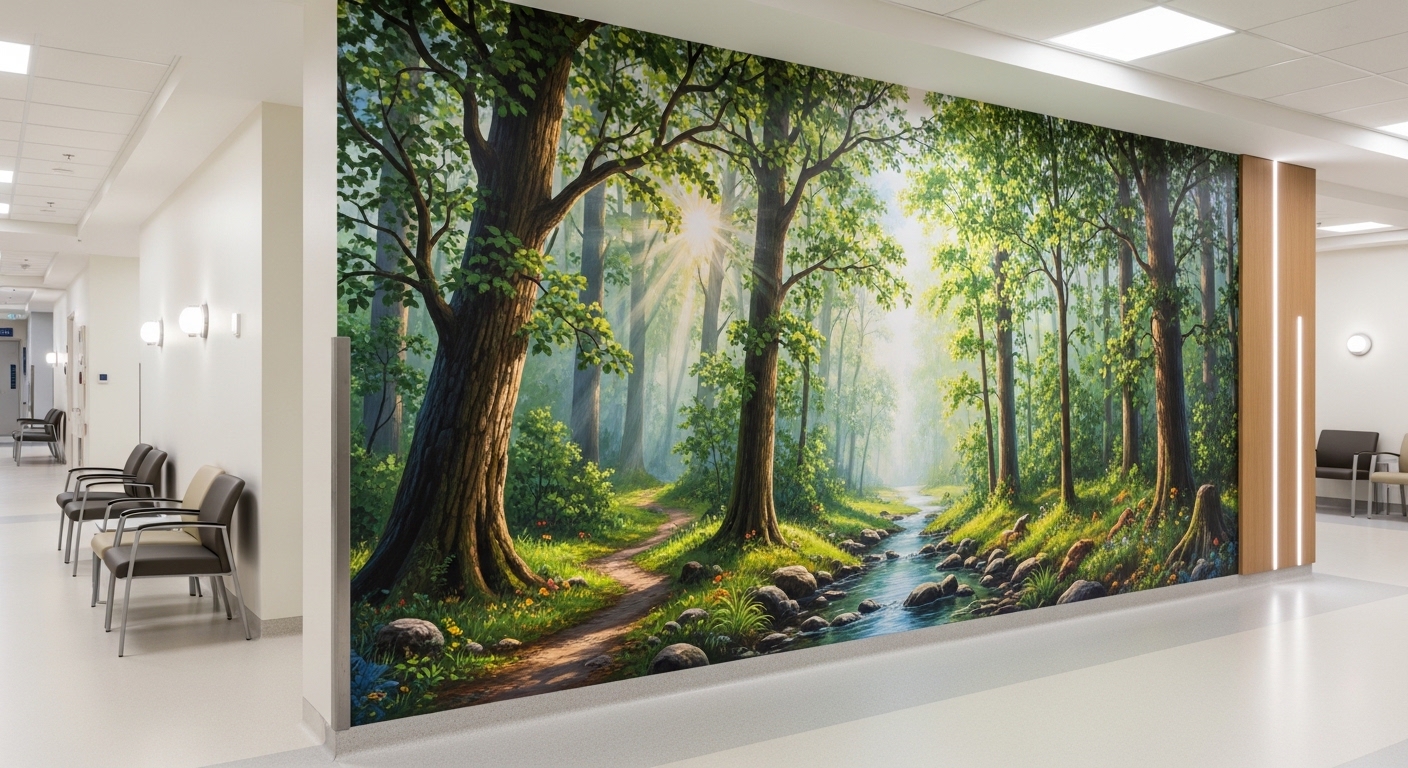
Wall Mural Companies for Hospitals: Direct-to-Wall Printing Solutions
Introduction: The Role of Hospital Wall Graphics in Patient Experience and Branding
Hospitals are complex environments where architecture, operations, and human experience meet. Wall graphics carry a quiet but powerful role in that equation—orienting visitors, setting a tone of reassurance, and reinforcing brand standards without adding visual clutter. When designed and installed with clinical realities in mind, murals can reduce stress, aid navigation, and bring cohesion to facilities that often span decades of construction phases and varied finishes.
Today’s leading wall mural companies for hospitals are moving beyond decorative art. They’re delivering performance-based systems that integrate patient experience, safety, and communication. From pediatric units to behavioral health floors, from emergency departments to ambulatory pavilions, wall graphics can provide positive distraction, room identification, and clear wayfinding while signaling cleanliness and modernity. For health systems managing multiple campuses, they also offer a visible, consistent brand promise across sites.
Why Hospitals Are Moving Beyond Traditional Vinyl and Wallpaper Solutions
Vinyl wall coverings and wallpaper have long been the default in commercial interiors, but healthcare challenges their limits. Seams can lift in high-traffic corridors; edges collect dirt; adhesives complicate future renovations; and the material’s lifecycle often underperforms under aggressive cleaning protocols. In areas with variable humidity or frequent temperature shifts—like vestibules and older wings—bubbling and peeling are common.
Beyond aesthetics, operational issues also drive change. Procurement teams need predictable schedules and durable results, not routine patching cycles or repeated replacements. Infection prevention teams favor surfaces without seams and crevices. Facilities teams want solutions that install fast, limit noise and odors, and don’t require days of area closures. Construction-light interior upgrades that avoid permitting wherever possible are increasingly valued.
Direct-to-wall printing addresses these pain points by delivering high-definition imagery without substrates or adhesives. It creates graphics that read as part of the architecture, not applied on top of it. Hospitals are choosing it to modernize at scale, standardize brand elements, and reduce the friction that historically accompanied vinyl or wallpaper projects.
Key Features to Evaluate in Hospital Mural Installation Companies
Selecting a partner for hospital wall graphics installation hinges on more than just print quality. Healthcare environments demand tight coordination, specialized documentation, and finishes that stand up to rigorous cleaning. Prioritize vendors who can demonstrate:
Proven healthcare experience: References from hospitals or ambulatory centers, plus familiarity with ICRA protocols, off-hours work windows, and contained work areas in occupied facilities.
Direct-to-wall expertise: On-site printing capabilities for drywall, CMU, concrete, and brick; predictable, seam-free outcomes; and precise color management for brand compliance.
Infection prevention alignment: Cleanability testing with common hospital disinfectants (quats, bleach, alcohol-based wipes); low-odor processes; and oversight plans reviewed by facility IP teams.
Speed and scheduling: Installations completed in hours, not days; minimal area downtime; weekend/night crews; clear phasing to keep traffic moving and patient care uninterrupted.
Integrated design services: Wayfinding planning, stakeholder workshops, ADA contrast and readability considerations, and templates that scale across locations.
Documentation and governance: Shop drawings, surface prep guidelines, mockups, and punch list procedures; asset inventories for future refreshes.
National or multi-location reach: Standardized workflows to deliver consistent outcomes across a health system with varied wall conditions and finish histories.
Lifecycle strategy: Paint-over-ready finishes, replacement planning, and optional subscription models for seasonal or strategic updates.
Risk and compliance readiness: Appropriate insurance, background checks, safety training, union/non-union flexibility, and incident response protocols.
Introduction: The Role of Hospital Wall Graphics in Patient Experience and Branding
Hospitals are complex environments where architecture, operations, and human experience meet. Wall graphics carry a quiet but powerful role in that equation—orienting visitors, setting a tone of reassurance, and reinforcing brand standards without adding visual clutter. When designed and installed with clinical realities in mind, murals can reduce stress, aid navigation, and bring cohesion to facilities that often span decades of construction phases and varied finishes.
Today’s leading wall mural companies for hospitals are moving beyond decorative art. They’re delivering performance-based systems that integrate patient experience, safety, and communication. From pediatric units to behavioral health floors, from emergency departments to ambulatory pavilions, wall graphics can provide positive distraction, room identification, and clear wayfinding while signaling cleanliness and modernity. For health systems managing multiple campuses, they also offer a visible, consistent brand promise across sites.
Why Hospitals Are Moving Beyond Traditional Vinyl and Wallpaper Solutions
Vinyl wall coverings and wallpaper have long been the default in commercial interiors, but healthcare challenges their limits. Seams can lift in high-traffic corridors; edges collect dirt; adhesives complicate future renovations; and the material’s lifecycle often underperforms under aggressive cleaning protocols. In areas with variable humidity or frequent temperature shifts—like vestibules and older wings—bubbling and peeling are common.
Beyond aesthetics, operational issues also drive change. Procurement teams need predictable schedules and durable results, not routine patching cycles or repeated replacements. Infection prevention teams favor surfaces without seams and crevices. Facilities teams want solutions that install fast, limit noise and odors, and don’t require days of area closures. Construction-light interior upgrades that avoid permitting wherever possible are increasingly valued.
Direct-to-wall printing addresses these pain points by delivering high-definition imagery without substrates or adhesives. It creates graphics that read as part of the architecture, not applied on top of it. Hospitals are choosing it to modernize at scale, standardize brand elements, and reduce the friction that historically accompanied vinyl or wallpaper projects.
Key Features to Evaluate in Hospital Mural Installation Companies
Selecting a partner for hospital wall graphics installation hinges on more than just print quality. Healthcare environments demand tight coordination, specialized documentation, and finishes that stand up to rigorous cleaning. Prioritize vendors who can demonstrate:
Proven healthcare experience: References from hospitals or ambulatory centers, plus familiarity with ICRA protocols, off-hours work windows, and contained work areas in occupied facilities.
Direct-to-wall expertise: On-site printing capabilities for drywall, CMU, concrete, and brick; predictable, seam-free outcomes; and precise color management for brand compliance.
Infection prevention alignment: Cleanability testing with common hospital disinfectants (quats, bleach, alcohol-based wipes); low-odor processes; and oversight plans reviewed by facility IP teams.
Speed and scheduling: Installations completed in hours, not days; minimal area downtime; weekend/night crews; clear phasing to keep traffic moving and patient care uninterrupted.
Integrated design services: Wayfinding planning, stakeholder workshops, ADA contrast and readability considerations, and templates that scale across locations.
Documentation and governance: Shop drawings, surface prep guidelines, mockups, and punch list procedures; asset inventories for future refreshes.
National or multi-location reach: Standardized workflows to deliver consistent outcomes across a health system with varied wall conditions and finish histories.
Lifecycle strategy: Paint-over-ready finishes, replacement planning, and optional subscription models for seasonal or strategic updates.
Risk and compliance readiness: Appropriate insurance, background checks, safety training, union/non-union flexibility, and incident response protocols.
EastCoast MuralPros regularly partners with facilities directors, brand teams, and architects to align these requirements under one execution plan, streamlining approvals while keeping patient care at the center of the schedule.
Direct-to-Wall Printing Technology vs. Vinyl Wraps and Hand-Painted Alternatives
Direct-to-wall printing uses mobile print systems that produce high-resolution imagery directly onto prepared wall surfaces. The process eliminates adhesive-backed films and the seams that come with panelized applications. For hospitals, this translates to fewer failure points, a thinner profile that integrates with wall protection systems, and visuals that feel embedded rather than applied.
Compared with vinyl wraps:
No adhesives: Reduces the risk of edge lift, grime collection at seams, and substrate damage during future removals.
Seam-free appearance: Maintains design integrity across long corridors and large lobbies without panel breaks.
On-site agility: Adjusts in real time to site conditions, avoiding shipping delays and field-fit surprises common with pre-fab panels.
Compared with hand-painted murals:
Speed and repeatability: Complex artwork prints in hours, not days, and can be reproduced consistently across multiple facilities.
Photoreal detail: Fine gradients and photographic imagery maintain clarity at architectural scale.
Governance and scale: Digital files tie back to brand standards, color profiles, and content approval chains—critical for regulated and risk-averse environments.
For hospitals, direct-to-wall printing offers the precision of a fabrication-driven approach without the materials and adhesives that complicate maintenance and infection control. EastCoast MuralPros’ system supports finished and unfinished surfaces—including drywall, CMU, concrete, and brick—expanding what’s possible in heritage buildings and new towers alike.
Installation Speed and Minimal Disruption in Operating Healthcare Facilities
The best wall mural companies for hospitals build their schedules around clinical operations, not the other way around. Direct-to-wall printing excels here: installations commonly finish in under five hours per zone. That means a pediatric corridor can be upgraded between visiting hours, or a waiting area can be transformed after close and reopened the next morning.
Low-disruption planning includes:
Off-hours and weekend work: Keeps patient traffic moving and clinical workflows intact.
Contained work zones: Clear ingress/egress paths, cordon plans, and dust control to protect adjacent areas.
Quiet, low-odor processes: Suitable for occupied environments without extended air flushes.
On-site quality control: Real-time adjustments to artwork placement, color balance, and wall irregularities.
No shipping dependencies: Eliminates lost panels, damaged rolls, or mis-measured pieces that stall turnover.
Introduction: The Role of Hospital Wall Graphics in Patient Experience and Branding
Hospitals are complex environments where architecture, operations, and human experience meet. Wall graphics carry a quiet but powerful role in that equation—orienting visitors, setting a tone of reassurance, and reinforcing brand standards without adding visual clutter. When designed and installed with clinical realities in mind, murals can reduce stress, aid navigation, and bring cohesion to facilities that often span decades of construction phases and varied finishes.
Today’s leading wall mural companies for hospitals are moving beyond decorative art. They’re delivering performance-based systems that integrate patient experience, safety, and communication. From pediatric units to behavioral health floors, from emergency departments to ambulatory pavilions, wall graphics can provide positive distraction, room identification, and clear wayfinding while signaling cleanliness and modernity. For health systems managing multiple campuses, they also offer a visible, consistent brand promise across sites.
Why Hospitals Are Moving Beyond Traditional Vinyl and Wallpaper Solutions
Vinyl wall coverings and wallpaper have long been the default in commercial interiors, but healthcare challenges their limits. Seams can lift in high-traffic corridors; edges collect dirt; adhesives complicate future renovations; and the material’s lifecycle often underperforms under aggressive cleaning protocols. In areas with variable humidity or frequent temperature shifts—like vestibules and older wings—bubbling and peeling are common.
Beyond aesthetics, operational issues also drive change. Procurement teams need predictable schedules and durable results, not routine patching cycles or repeated replacements. Infection prevention teams favor surfaces without seams and crevices. Facilities teams want solutions that install fast, limit noise and odors, and don’t require days of area closures. Construction-light interior upgrades that avoid permitting wherever possible are increasingly valued.
Direct-to-wall printing addresses these pain points by delivering high-definition imagery without substrates or adhesives. It creates graphics that read as part of the architecture, not applied on top of it. Hospitals are choosing it to modernize at scale, standardize brand elements, and reduce the friction that historically accompanied vinyl or wallpaper projects.
Key Features to Evaluate in Hospital Mural Installation Companies
Selecting a partner for hospital wall graphics installation hinges on more than just print quality. Healthcare environments demand tight coordination, specialized documentation, and finishes that stand up to rigorous cleaning. Prioritize vendors who can demonstrate:
Proven healthcare experience: References from hospitals or ambulatory centers, plus familiarity with ICRA protocols, off-hours work windows, and contained work areas in occupied facilities.
Direct-to-wall expertise: On-site printing capabilities for drywall, CMU, concrete, and brick; predictable, seam-free outcomes; and precise color management for brand compliance.
Infection prevention alignment: Cleanability testing with common hospital disinfectants (quats, bleach, alcohol-based wipes); low-odor processes; and oversight plans reviewed by facility IP teams.
Speed and scheduling: Installations completed in hours, not days; minimal area downtime; weekend/night crews; clear phasing to keep traffic moving and patient care uninterrupted.
Integrated design services: Wayfinding planning, stakeholder workshops, ADA contrast and readability considerations, and templates that scale across locations.
Documentation and governance: Shop drawings, surface prep guidelines, mockups, and punch list procedures; asset inventories for future refreshes.
National or multi-location reach: Standardized workflows to deliver consistent outcomes across a health system with varied wall conditions and finish histories.
Lifecycle strategy: Paint-over-ready finishes, replacement planning, and optional subscription models for seasonal or strategic updates.
Risk and compliance readiness: Appropriate insurance, background checks, safety training, union/non-union flexibility, and incident response protocols.
EastCoast MuralPros regularly partners with facilities directors, brand teams, and architects to align these requirements under one execution plan, streamlining approvals while keeping patient care at the center of the schedule.
Direct-to-Wall Printing Technology vs. Vinyl Wraps and Hand-Painted Alternatives
Direct-to-wall printing uses mobile print systems that produce high-resolution imagery directly onto prepared wall surfaces. The process eliminates adhesive-backed films and the seams that come with panelized applications. For hospitals, this translates to fewer failure points, a thinner profile that integrates with wall protection systems, and visuals that feel embedded rather than applied.
Compared with vinyl wraps:
No adhesives: Reduces the risk of edge lift, grime collection at seams, and substrate damage during future removals.
Seam-free appearance: Maintains design integrity across long corridors and large lobbies without panel breaks.
On-site agility: Adjusts in real time to site conditions, avoiding shipping delays and field-fit surprises common with pre-fab panels.
Compared with hand-painted murals:
Speed and repeatability: Complex artwork prints in hours, not days, and can be reproduced consistently across multiple facilities.
Photoreal detail: Fine gradients and photographic imagery maintain clarity at architectural scale.
Governance and scale: Digital files tie back to brand standards, color profiles, and content approval chains—critical for regulated and risk-averse environments.
For hospitals, direct-to-wall printing offers the precision of a fabrication-driven approach without the materials and adhesives that complicate maintenance and infection control. EastCoast MuralPros’ system supports finished and unfinished surfaces—including drywall, CMU, concrete, and brick—expanding what’s possible in heritage buildings and new towers alike.
Installation Speed and Minimal Disruption in Operating Healthcare Facilities
The best wall mural companies for hospitals build their schedules around clinical operations, not the other way around. Direct-to-wall printing excels here: installations commonly finish in under five hours per zone. That means a pediatric corridor can be upgraded between visiting hours, or a waiting area can be transformed after close and reopened the next morning.
Low-disruption planning includes:
Off-hours and weekend work: Keeps patient traffic moving and clinical workflows intact.
Contained work zones: Clear ingress/egress paths, cordon plans, and dust control to protect adjacent areas.
Quiet, low-odor processes: Suitable for occupied environments without extended air flushes.
On-site quality control: Real-time adjustments to artwork placement, color balance, and wall irregularities.
No shipping dependencies: Eliminates lost panels, damaged rolls, or mis-measured pieces that stall turnover.
EastCoast MuralPros also provides in-studio printing for doors, table tops, and standees, enabling pre-fabricated elements for admissions desks, donor recognition, or mobile communication points to be delivered and installed in parallel with on-site wall work.
Durability, Cleanability, and Infection Control Standards for Healthcare Environments
Hospitals clean hard surfaces much more frequently than typical commercial interiors. Graphics must resist repeated exposure to disinfectants while staying legible and presentable. Direct-to-wall finishes are engineered for abrasion resistance and are compatible with common hospital cleaning agents, supporting daily wipe-downs without edge failure.
Key considerations for clinical durability:
Seamless finish: Eliminates edges that catch carts, snag gowns, or trap soils.
Chemical resistance: Withstands quaternary ammonium cleaners, bleach solutions, and alcohol-based wipes used in routine protocols.
Impact tolerance: Performs in high-traffic areas where beds, wheelchairs, and EVS equipment routinely pass.
Low-glare readability: Maintains contrast and legibility under varied lighting, aiding accessibility.
Paint-over-ready: When departments relocate or programs change, walls can be prepped and repainted without adhesive removal or substrate repair.
Infection prevention teams also value the reduced harbor points associated with seam-free graphics. For more on healthcare-specific safety considerations, see EastCoast MuralPros’ overview: Is wall printing safe for healthcare environments?.
Multi-Location Hospital Systems and Consistent Brand Rollout Execution
Health systems manage dozens—sometimes hundreds—of corridors, lobbies, clinics, and imaging suites across multiple campuses. Consistency is a brand imperative and an operational challenge. Direct-to-wall printing simplifies multi-site coordination by standardizing artwork, color profiles, and approval workflows. The output remains consistent even when wall substrates vary from new Level-5 drywall to painted CMU in legacy facilities.
Execution strategies for system-wide rollouts include:
Centralized asset libraries: Brand-compliant templates, color-coded wayfinding, and service-line graphics ready to deploy.
Pilot-to-scale approach: Test in a flagship unit, validate cleanability and staff feedback, then phase to other locations.
Phased campus mapping: Prioritize high-impact areas—admissions, imaging, med-surg corridors—before extending to lower-traffic zones.
Quality governance: Calibrated devices and color management deliver matching tones across hospitals and clinics.
Logistics and staffing: Regional crews and standardized install kits to keep schedules on track across markets.
Introduction: The Role of Hospital Wall Graphics in Patient Experience and Branding
Hospitals are complex environments where architecture, operations, and human experience meet. Wall graphics carry a quiet but powerful role in that equation—orienting visitors, setting a tone of reassurance, and reinforcing brand standards without adding visual clutter. When designed and installed with clinical realities in mind, murals can reduce stress, aid navigation, and bring cohesion to facilities that often span decades of construction phases and varied finishes.
Today’s leading wall mural companies for hospitals are moving beyond decorative art. They’re delivering performance-based systems that integrate patient experience, safety, and communication. From pediatric units to behavioral health floors, from emergency departments to ambulatory pavilions, wall graphics can provide positive distraction, room identification, and clear wayfinding while signaling cleanliness and modernity. For health systems managing multiple campuses, they also offer a visible, consistent brand promise across sites.
Why Hospitals Are Moving Beyond Traditional Vinyl and Wallpaper Solutions
Vinyl wall coverings and wallpaper have long been the default in commercial interiors, but healthcare challenges their limits. Seams can lift in high-traffic corridors; edges collect dirt; adhesives complicate future renovations; and the material’s lifecycle often underperforms under aggressive cleaning protocols. In areas with variable humidity or frequent temperature shifts—like vestibules and older wings—bubbling and peeling are common.
Beyond aesthetics, operational issues also drive change. Procurement teams need predictable schedules and durable results, not routine patching cycles or repeated replacements. Infection prevention teams favor surfaces without seams and crevices. Facilities teams want solutions that install fast, limit noise and odors, and don’t require days of area closures. Construction-light interior upgrades that avoid permitting wherever possible are increasingly valued.
Direct-to-wall printing addresses these pain points by delivering high-definition imagery without substrates or adhesives. It creates graphics that read as part of the architecture, not applied on top of it. Hospitals are choosing it to modernize at scale, standardize brand elements, and reduce the friction that historically accompanied vinyl or wallpaper projects.
Key Features to Evaluate in Hospital Mural Installation Companies
Selecting a partner for hospital wall graphics installation hinges on more than just print quality. Healthcare environments demand tight coordination, specialized documentation, and finishes that stand up to rigorous cleaning. Prioritize vendors who can demonstrate:
Proven healthcare experience: References from hospitals or ambulatory centers, plus familiarity with ICRA protocols, off-hours work windows, and contained work areas in occupied facilities.
Direct-to-wall expertise: On-site printing capabilities for drywall, CMU, concrete, and brick; predictable, seam-free outcomes; and precise color management for brand compliance.
Infection prevention alignment: Cleanability testing with common hospital disinfectants (quats, bleach, alcohol-based wipes); low-odor processes; and oversight plans reviewed by facility IP teams.
Speed and scheduling: Installations completed in hours, not days; minimal area downtime; weekend/night crews; clear phasing to keep traffic moving and patient care uninterrupted.
Integrated design services: Wayfinding planning, stakeholder workshops, ADA contrast and readability considerations, and templates that scale across locations.
Documentation and governance: Shop drawings, surface prep guidelines, mockups, and punch list procedures; asset inventories for future refreshes.
National or multi-location reach: Standardized workflows to deliver consistent outcomes across a health system with varied wall conditions and finish histories.
Lifecycle strategy: Paint-over-ready finishes, replacement planning, and optional subscription models for seasonal or strategic updates.
Risk and compliance readiness: Appropriate insurance, background checks, safety training, union/non-union flexibility, and incident response protocols.
EastCoast MuralPros regularly partners with facilities directors, brand teams, and architects to align these requirements under one execution plan, streamlining approvals while keeping patient care at the center of the schedule.
Direct-to-Wall Printing Technology vs. Vinyl Wraps and Hand-Painted Alternatives
Direct-to-wall printing uses mobile print systems that produce high-resolution imagery directly onto prepared wall surfaces. The process eliminates adhesive-backed films and the seams that come with panelized applications. For hospitals, this translates to fewer failure points, a thinner profile that integrates with wall protection systems, and visuals that feel embedded rather than applied.
Compared with vinyl wraps:
No adhesives: Reduces the risk of edge lift, grime collection at seams, and substrate damage during future removals.
Seam-free appearance: Maintains design integrity across long corridors and large lobbies without panel breaks.
On-site agility: Adjusts in real time to site conditions, avoiding shipping delays and field-fit surprises common with pre-fab panels.
Compared with hand-painted murals:
Speed and repeatability: Complex artwork prints in hours, not days, and can be reproduced consistently across multiple facilities.
Photoreal detail: Fine gradients and photographic imagery maintain clarity at architectural scale.
Governance and scale: Digital files tie back to brand standards, color profiles, and content approval chains—critical for regulated and risk-averse environments.
For hospitals, direct-to-wall printing offers the precision of a fabrication-driven approach without the materials and adhesives that complicate maintenance and infection control. EastCoast MuralPros’ system supports finished and unfinished surfaces—including drywall, CMU, concrete, and brick—expanding what’s possible in heritage buildings and new towers alike.
Installation Speed and Minimal Disruption in Operating Healthcare Facilities
The best wall mural companies for hospitals build their schedules around clinical operations, not the other way around. Direct-to-wall printing excels here: installations commonly finish in under five hours per zone. That means a pediatric corridor can be upgraded between visiting hours, or a waiting area can be transformed after close and reopened the next morning.
Low-disruption planning includes:
Off-hours and weekend work: Keeps patient traffic moving and clinical workflows intact.
Contained work zones: Clear ingress/egress paths, cordon plans, and dust control to protect adjacent areas.
Quiet, low-odor processes: Suitable for occupied environments without extended air flushes.
On-site quality control: Real-time adjustments to artwork placement, color balance, and wall irregularities.
No shipping dependencies: Eliminates lost panels, damaged rolls, or mis-measured pieces that stall turnover.
EastCoast MuralPros also provides in-studio printing for doors, table tops, and standees, enabling pre-fabricated elements for admissions desks, donor recognition, or mobile communication points to be delivered and installed in parallel with on-site wall work.
Durability, Cleanability, and Infection Control Standards for Healthcare Environments
Hospitals clean hard surfaces much more frequently than typical commercial interiors. Graphics must resist repeated exposure to disinfectants while staying legible and presentable. Direct-to-wall finishes are engineered for abrasion resistance and are compatible with common hospital cleaning agents, supporting daily wipe-downs without edge failure.
Key considerations for clinical durability:
Seamless finish: Eliminates edges that catch carts, snag gowns, or trap soils.
Chemical resistance: Withstands quaternary ammonium cleaners, bleach solutions, and alcohol-based wipes used in routine protocols.
Impact tolerance: Performs in high-traffic areas where beds, wheelchairs, and EVS equipment routinely pass.
Low-glare readability: Maintains contrast and legibility under varied lighting, aiding accessibility.
Paint-over-ready: When departments relocate or programs change, walls can be prepped and repainted without adhesive removal or substrate repair.
Infection prevention teams also value the reduced harbor points associated with seam-free graphics. For more on healthcare-specific safety considerations, see EastCoast MuralPros’ overview: Is wall printing safe for healthcare environments?.
Multi-Location Hospital Systems and Consistent Brand Rollout Execution
Health systems manage dozens—sometimes hundreds—of corridors, lobbies, clinics, and imaging suites across multiple campuses. Consistency is a brand imperative and an operational challenge. Direct-to-wall printing simplifies multi-site coordination by standardizing artwork, color profiles, and approval workflows. The output remains consistent even when wall substrates vary from new Level-5 drywall to painted CMU in legacy facilities.
Execution strategies for system-wide rollouts include:
Centralized asset libraries: Brand-compliant templates, color-coded wayfinding, and service-line graphics ready to deploy.
Pilot-to-scale approach: Test in a flagship unit, validate cleanability and staff feedback, then phase to other locations.
Phased campus mapping: Prioritize high-impact areas—admissions, imaging, med-surg corridors—before extending to lower-traffic zones.
Quality governance: Calibrated devices and color management deliver matching tones across hospitals and clinics.
Logistics and staffing: Regional crews and standardized install kits to keep schedules on track across markets.
EastCoast MuralPros supports consistent execution across national rollouts, aligning brand, facilities, and procurement teams so that each site installs rapidly with minimal rework.
Wayfinding, Safety, and Instructional Graphics Integrated into Hospital Design
Hospitals depend on clear information to move people safely and efficiently. Integrated graphics reduce signage clutter by distilling routes, zones, and instructions into the architecture. Direct-to-wall printing brings precision to this task, producing durable medical facility murals that double as navigational aids.
Effective integrations include:
Color-coded pathways: Department-specific palettes extended along corridors and into elevator lobbies to reinforce direction.
Pictograms and multilingual cues: Universally understood icons and secondary languages placed at decision points.
Zone identifiers: Large-scale, high-contrast markers for departments, pods, and wings visible from a distance.
Safety communication: Fall-risk reminders, isolation protocols at anteroom thresholds, and code-compliant instructional placements where temporary signs often accumulate.
Pediatric and behavioral health considerations: Soothing imagery, simplified arrows, and non-triggering themes that meet unit-specific standards.
Graphics should complement, not replace, code-required signs. Done well, they reduce cognitive load for visitors, shorten wayfinding time, and free staff from repeating directions. EastCoast MuralPros frequently collaborates with brand and experience teams to translate master plans into wall-integrated, route-consistent systems.
Cost Efficiency and Lifecycle Benefits for Healthcare Procurement Teams
Procurement leaders measure not just first cost, but total cost of ownership and schedule risk. Direct-to-wall printing creates savings in both dimensions. Without vinyl, adhesives, or panel fabrication, there are fewer materials to purchase, ship, store, and maintain. Installations complete faster, reducing downtime and preserving revenue-generating operations.
Lifecycle and budget advantages include:
Extended usable life: Durable finishes that hold up under daily cleaning reduce replacement frequency compared with vinyl.
Fewer repairs: No seams to re-roll, no edges to re-adhere, fewer substrate repairs during change-outs.
Paint-over refresh: Program changes can be addressed with standard paint cycles rather than substrate removal and waste hauling.
Shorter schedules: One-night transformations lower labor costs and avoid long closures or reroutes.
Scalable procurement: Standardized specifications and artwork libraries reduce design and approval labor across multiple projects.
For brand campaigns, service-line updates, or donor recognition, EastCoast MuralPros also offers subscription models that schedule strategic refreshes throughout the year—keeping environments current without launching new capital projects each time.
Sustainability and Environmental Impact of Modern Hospital Wall Graphics
Healthcare organizations are accelerating sustainability commitments, from materials selection to waste reduction. Direct-to-wall printing aligns with these goals by eliminating vinyl substrates and adhesive layers, avoiding the PVC content and landfill waste associated with traditional coverings. On-site production reduces shipping emissions and packaging, and paint-over-ready removal limits demolition debris at end of life.
Sustainability highlights:
Material minimization: No rolls of vinyl or adhesive backers, dramatically reducing plastic use.
Lower replacement waste: Durable outputs and easy refresh cycles keep materials out of landfills.
On-site efficiency: Fewer shipments, fewer crates, and fewer field-fit rejects.
Lifecycle advantage: Performance-based solution that reduces the frequency of replacements inherent to wallpaper and vinyl.
For a deeper comparison of environmental impacts and waste profiles, see EastCoast MuralPros’ analysis: Direct-to-wall printing vs traditional vinyl: sustainability and environmental waste in commercial design.
Selecting the Right Hospital Mural Partner: Vendor Evaluation Criteria
A structured evaluation de-risks selection and speeds consensus across facilities, IP, brand, and procurement. Use the following criteria to compare wall mural companies for hospitals:
Team and capabilities
Healthcare portfolio: Recent case studies in acute, ambulatory, pediatric, or behavioral settings; references with contact info.
Direct-to-wall expertise: Demonstrated performance on drywall, CMU, concrete, and brick; seam-free outcomes at architectural scale.
Design integration: Wayfinding planning, ADA contrast guidance, and templates adaptable to campus standards.
Process and compliance
ICRA and safety: Documented infection control plans, containment methods, PPE training, and incident protocols.
Schedule control: Proven ability to complete zones in under five hours; off-hours staffing; multiphase surge capacity for large rollouts.
QA/QC: Color management, proof approvals, test prints, and punch list resolution processes.
Materials and performance
Cleanability verification: Compatibility statements for quats, bleach, and alcohol wipes; abrasion and impact resistance details.
Low-odor, low-disruption: Processes suited for occupied spaces; air quality considerations aligned with facilities requirements.
Paint-over-ready finish: Clear guidance for future refresh workflows.
Commercial terms
Warranties and SLAs: Performance expectations, response times, and maintenance guidance.
Pricing transparency: Unit rates by square foot, mobilization, off-hours premiums, and pilot pricing.
National rollout capability: Standardized spec packages, governance tools, and multi-site scheduling.
Operations and risk
Insurance and clearances: COIs at health system limits; background checks; union/non-union adaptability as required.
Data handling: Awareness of PHI privacy zones; photography protocols in clinical areas.
Change management: Subscription options for planned refreshes and mechanisms for rapid content updates.
EastCoast MuralPros aligns these criteria with a collaborative preconstruction process, including site surveys, surface prep recommendations, pilot installations, and digital governance tools that help brand and facilities teams scale confidently.
Conclusion: Transforming Hospital Interiors with Performance-Based Wall Graphics
Hospitals need interior solutions that serve people first and operations always. Direct-to-wall printing has emerged as a reliable alternative to vinyl wall coverings and wallpaper, delivering high-resolution imagery, fast installation, and durable, cleanable finishes that stand up to real clinical use. The result is more than decoration: it’s a performance-based system for patient experience, wayfinding, and brand cohesion that minimizes disruption and reduces lifecycle cost.
For healthcare facility interior branding at scale, the partner you choose matters. Look for hospital wall graphics installation teams who can document cleanability, coordinate with infection prevention, and execute consistently across multiple sites. With seam-free graphics, on-site production, and a paint-over-ready path for future changes, EastCoast MuralPros helps hospitals modernize environments quickly—whether the goal is a calming pediatric unit, a clear path through imaging, or a unified brand across an entire health system.
To explore direct-to-wall printing for medical spaces, review your campuses, and plan a pilot that can scale, connect with EastCoast MuralPros at eastcoastmuralpros.com.
Contact us to learn more supports consistent execution across national rollouts, aligning brand, facilities, and procurement teams so that each site installs rapidly with minimal rework.
Wayfinding, Safety, and Instructional Graphics Integrated into Hospital Design
Hospitals depend on clear information to move people safely and efficiently. Integrated graphics reduce signage clutter by distilling routes, zones, and instructions into the architecture. Direct-to-wall printing brings precision to this task, producing durable medical facility murals that double as navigational aids.
Effective integrations include:
Color-coded pathways: Department-specific palettes extended along corridors and into elevator lobbies to reinforce direction.
Pictograms and multilingual cues: Universally understood icons and secondary languages placed at decision points.
Zone identifiers: Large-scale, high-contrast markers for departments, pods, and wings visible from a distance.
Safety communication: Fall-risk reminders, isolation protocols at anteroom thresholds, and code-compliant instructional placements where temporary signs often accumulate.
Pediatric and behavioral health considerations: Soothing imagery, simplified arrows, and non-triggering themes that meet unit-specific standards.
Graphics should complement, not replace, code-required signs. Done well, they reduce cognitive load for visitors, shorten wayfinding time, and free staff from repeating directions. EastCoast MuralPros frequently collaborates with brand and experience teams to translate master plans into wall-integrated, route-consistent systems.
Cost Efficiency and Lifecycle Benefits for Healthcare Procurement Teams
Procurement leaders measure not just first cost, but total cost of ownership and schedule risk. Direct-to-wall printing creates savings in both dimensions. Without vinyl, adhesives, or panel fabrication, there are fewer materials to purchase, ship, store, and maintain. Installations complete faster, reducing downtime and preserving revenue-generating operations.
Lifecycle and budget advantages include:
Extended usable life: Durable finishes that hold up under daily cleaning reduce replacement frequency compared with vinyl.
Fewer repairs: No seams to re-roll, no edges to re-adhere, fewer substrate repairs during change-outs.
Paint-over refresh: Program changes can be addressed with standard paint cycles rather than substrate removal and waste hauling.
Shorter schedules: One-night transformations lower labor costs and avoid long closures or reroutes.
Scalable procurement: Standardized specifications and artwork libraries reduce design and approval labor across multiple projects.
For brand campaigns, service-line updates, or donor recognition, EastCoast MuralPros also offers subscription models that schedule strategic refreshes throughout the year—keeping environments current without launching new capital projects each time.
Sustainability and Environmental Impact of Modern Hospital Wall Graphics
Healthcare organizations are accelerating sustainability commitments, from materials selection to waste reduction. Direct-to-wall printing aligns with these goals by eliminating vinyl substrates and adhesive layers, avoiding the PVC content and landfill waste associated with traditional coverings. On-site production reduces shipping emissions and packaging, and paint-over-ready removal limits demolition debris at end of life.
Sustainability highlights:
Material minimization: No rolls of vinyl or adhesive backers, dramatically reducing plastic use.
Lower replacement waste: Durable outputs and easy refresh cycles keep materials out of landfills.
On-site efficiency: Fewer shipments, fewer crates, and fewer field-fit rejects.
Lifecycle advantage: Performance-based solution that reduces the frequency of replacements inherent to wallpaper and vinyl.
For a deeper comparison of environmental impacts and waste profiles, see EastCoast MuralPros’ analysis: Direct-to-wall printing vs traditional vinyl: sustainability and environmental waste in commercial design.
Selecting the Right Hospital Mural Partner: Vendor Evaluation Criteria
A structured evaluation de-risks selection and speeds consensus across facilities, IP, brand, and procurement. Use the following criteria to compare wall mural companies for hospitals:
Team and capabilities
Healthcare portfolio: Recent case studies in acute, ambulatory, pediatric, or behavioral settings; references with contact info.
Direct-to-wall expertise: Demonstrated performance on drywall, CMU, concrete, and brick; seam-free outcomes at architectural scale.
Design integration: Wayfinding planning, ADA contrast guidance, and templates adaptable to campus standards.
Process and compliance
ICRA and safety: Documented infection control plans, containment methods, PPE training, and incident protocols.
Schedule control: Proven ability to complete zones in under five hours; off-hours staffing; multiphase surge capacity for large rollouts.
QA/QC: Color management, proof approvals, test prints, and punch list resolution processes.
Materials and performance
Cleanability verification: Compatibility statements for quats, bleach, and alcohol wipes; abrasion and impact resistance details.
Low-odor, low-disruption: Processes suited for occupied spaces; air quality considerations aligned with facilities requirements.
Paint-over-ready finish: Clear guidance for future refresh workflows.
Commercial terms
Warranties and SLAs: Performance expectations, response times, and maintenance guidance.
Pricing transparency: Unit rates by square foot, mobilization, off-hours premiums, and pilot pricing.
National rollout capability: Standardized spec packages, governance tools, and multi-site scheduling.
Operations and risk
Insurance and clearances: COIs at health system limits; background checks; union/non-union adaptability as required.
Data handling: Awareness of PHI privacy zones; photography protocols in clinical areas.
Change management: Subscription options for planned refreshes and mechanisms for rapid content updates.
EastCoast MuralPros aligns these criteria with a collaborative preconstruction process, including site surveys, surface prep recommendations, pilot installations, and digital governance tools that help brand and facilities teams scale confidently.
Conclusion: Transforming Hospital Interiors with Performance-Based Wall Graphics
Hospitals need interior solutions that serve people first and operations always. Direct-to-wall printing has emerged as a reliable alternative to vinyl wall coverings and wallpaper, delivering high-resolution imagery, fast installation, and durable, cleanable finishes that stand up to real clinical use. The result is more than decoration: it’s a performance-based system for patient experience, wayfinding, and brand cohesion that minimizes disruption and reduces lifecycle cost.
For healthcare facility interior branding at scale, the partner you choose matters. Look for hospital wall graphics installation teams who can document cleanability, coordinate with infection prevention, and execute consistently across multiple sites. With seam-free graphics, on-site production, and a paint-over-ready path for future changes, EastCoast MuralPros helps hospitals modernize environments quickly—whether the goal is a calming pediatric unit, a clear path through imaging, or a unified brand across an entire health system.
To explore direct-to-wall printing for medical spaces, review your campuses, and plan a pilot that can scale, connect with EastCoast MuralPros at eastcoastmuralpros.com.
Contact us to learn more also provides in-studio printing for doors, table tops, and standees, enabling pre-fabricated elements for admissions desks, donor recognition, or mobile communication points to be delivered and installed in parallel with on-site wall work.
Durability, Cleanability, and Infection Control Standards for Healthcare Environments
Hospitals clean hard surfaces much more frequently than typical commercial interiors. Graphics must resist repeated exposure to disinfectants while staying legible and presentable. Direct-to-wall finishes are engineered for abrasion resistance and are compatible with common hospital cleaning agents, supporting daily wipe-downs without edge failure.
Key considerations for clinical durability:
Seamless finish: Eliminates edges that catch carts, snag gowns, or trap soils.
Chemical resistance: Withstands quaternary ammonium cleaners, bleach solutions, and alcohol-based wipes used in routine protocols.
Impact tolerance: Performs in high-traffic areas where beds, wheelchairs, and EVS equipment routinely pass.
Low-glare readability: Maintains contrast and legibility under varied lighting, aiding accessibility.
Paint-over-ready: When departments relocate or programs change, walls can be prepped and repainted without adhesive removal or substrate repair.
Infection prevention teams also value the reduced harbor points associated with seam-free graphics. For more on healthcare-specific safety considerations, see EastCoast MuralPros’ overview: Is wall printing safe for healthcare environments?.
Multi-Location Hospital Systems and Consistent Brand Rollout Execution
Health systems manage dozens—sometimes hundreds—of corridors, lobbies, clinics, and imaging suites across multiple campuses. Consistency is a brand imperative and an operational challenge. Direct-to-wall printing simplifies multi-site coordination by standardizing artwork, color profiles, and approval workflows. The output remains consistent even when wall substrates vary from new Level-5 drywall to painted CMU in legacy facilities.
Execution strategies for system-wide rollouts include:
Centralized asset libraries: Brand-compliant templates, color-coded wayfinding, and service-line graphics ready to deploy.
Pilot-to-scale approach: Test in a flagship unit, validate cleanability and staff feedback, then phase to other locations.
Phased campus mapping: Prioritize high-impact areas—admissions, imaging, med-surg corridors—before extending to lower-traffic zones.
Quality governance: Calibrated devices and color management deliver matching tones across hospitals and clinics.
Logistics and staffing: Regional crews and standardized install kits to keep schedules on track across markets.
EastCoast MuralPros supports consistent execution across national rollouts, aligning brand, facilities, and procurement teams so that each site installs rapidly with minimal rework.
Wayfinding, Safety, and Instructional Graphics Integrated into Hospital Design
Hospitals depend on clear information to move people safely and efficiently. Integrated graphics reduce signage clutter by distilling routes, zones, and instructions into the architecture. Direct-to-wall printing brings precision to this task, producing durable medical facility murals that double as navigational aids.
Effective integrations include:
Color-coded pathways: Department-specific palettes extended along corridors and into elevator lobbies to reinforce direction.
Pictograms and multilingual cues: Universally understood icons and secondary languages placed at decision points.
Zone identifiers: Large-scale, high-contrast markers for departments, pods, and wings visible from a distance.
Safety communication: Fall-risk reminders, isolation protocols at anteroom thresholds, and code-compliant instructional placements where temporary signs often accumulate.
Pediatric and behavioral health considerations: Soothing imagery, simplified arrows, and non-triggering themes that meet unit-specific standards.
Graphics should complement, not replace, code-required signs. Done well, they reduce cognitive load for visitors, shorten wayfinding time, and free staff from repeating directions. EastCoast MuralPros frequently collaborates with brand and experience teams to translate master plans into wall-integrated, route-consistent systems.
Cost Efficiency and Lifecycle Benefits for Healthcare Procurement Teams
Procurement leaders measure not just first cost, but total cost of ownership and schedule risk. Direct-to-wall printing creates savings in both dimensions. Without vinyl, adhesives, or panel fabrication, there are fewer materials to purchase, ship, store, and maintain. Installations complete faster, reducing downtime and preserving revenue-generating operations.
Lifecycle and budget advantages include:
Extended usable life: Durable finishes that hold up under daily cleaning reduce replacement frequency compared with vinyl.
Fewer repairs: No seams to re-roll, no edges to re-adhere, fewer substrate repairs during change-outs.
Paint-over refresh: Program changes can be addressed with standard paint cycles rather than substrate removal and waste hauling.
Shorter schedules: One-night transformations lower labor costs and avoid long closures or reroutes.
Scalable procurement: Standardized specifications and artwork libraries reduce design and approval labor across multiple projects.
For brand campaigns, service-line updates, or donor recognition, EastCoast MuralPros also offers subscription models that schedule strategic refreshes throughout the year—keeping environments current without launching new capital projects each time.
Sustainability and Environmental Impact of Modern Hospital Wall Graphics
Healthcare organizations are accelerating sustainability commitments, from materials selection to waste reduction. Direct-to-wall printing aligns with these goals by eliminating vinyl substrates and adhesive layers, avoiding the PVC content and landfill waste associated with traditional coverings. On-site production reduces shipping emissions and packaging, and paint-over-ready removal limits demolition debris at end of life.
Sustainability highlights:
Material minimization: No rolls of vinyl or adhesive backers, dramatically reducing plastic use.
Lower replacement waste: Durable outputs and easy refresh cycles keep materials out of landfills.
On-site efficiency: Fewer shipments, fewer crates, and fewer field-fit rejects.
Lifecycle advantage: Performance-based solution that reduces the frequency of replacements inherent to wallpaper and vinyl.
For a deeper comparison of environmental impacts and waste profiles, see EastCoast MuralPros’ analysis: Direct-to-wall printing vs traditional vinyl: sustainability and environmental waste in commercial design.
Selecting the Right Hospital Mural Partner: Vendor Evaluation Criteria
A structured evaluation de-risks selection and speeds consensus across facilities, IP, brand, and procurement. Use the following criteria to compare wall mural companies for hospitals:
Team and capabilities
Healthcare portfolio: Recent case studies in acute, ambulatory, pediatric, or behavioral settings; references with contact info.
Direct-to-wall expertise: Demonstrated performance on drywall, CMU, concrete, and brick; seam-free outcomes at architectural scale.
Design integration: Wayfinding planning, ADA contrast guidance, and templates adaptable to campus standards.
Process and compliance
ICRA and safety: Documented infection control plans, containment methods, PPE training, and incident protocols.
Schedule control: Proven ability to complete zones in under five hours; off-hours staffing; multiphase surge capacity for large rollouts.
QA/QC: Color management, proof approvals, test prints, and punch list resolution processes.
Materials and performance
Cleanability verification: Compatibility statements for quats, bleach, and alcohol wipes; abrasion and impact resistance details.
Low-odor, low-disruption: Processes suited for occupied spaces; air quality considerations aligned with facilities requirements.
Paint-over-ready finish: Clear guidance for future refresh workflows.
Commercial terms
Warranties and SLAs: Performance expectations, response times, and maintenance guidance.
Pricing transparency: Unit rates by square foot, mobilization, off-hours premiums, and pilot pricing.
National rollout capability: Standardized spec packages, governance tools, and multi-site scheduling.
Operations and risk
Insurance and clearances: COIs at health system limits; background checks; union/non-union adaptability as required.
Data handling: Awareness of PHI privacy zones; photography protocols in clinical areas.
Change management: Subscription options for planned refreshes and mechanisms for rapid content updates.
EastCoast MuralPros aligns these criteria with a collaborative preconstruction process, including site surveys, surface prep recommendations, pilot installations, and digital governance tools that help brand and facilities teams scale confidently.
Conclusion: Transforming Hospital Interiors with Performance-Based Wall Graphics
Hospitals need interior solutions that serve people first and operations always. Direct-to-wall printing has emerged as a reliable alternative to vinyl wall coverings and wallpaper, delivering high-resolution imagery, fast installation, and durable, cleanable finishes that stand up to real clinical use. The result is more than decoration: it’s a performance-based system for patient experience, wayfinding, and brand cohesion that minimizes disruption and reduces lifecycle cost.
For healthcare facility interior branding at scale, the partner you choose matters. Look for hospital wall graphics installation teams who can document cleanability, coordinate with infection prevention, and execute consistently across multiple sites. With seam-free graphics, on-site production, and a paint-over-ready path for future changes, EastCoast MuralPros helps hospitals modernize environments quickly—whether the goal is a calming pediatric unit, a clear path through imaging, or a unified brand across an entire health system.
To explore direct-to-wall printing for medical spaces, review your campuses, and plan a pilot that can scale, connect with EastCoast MuralPros at eastcoastmuralpros.com.
Contact us to learn more regularly partners with facilities directors, brand teams, and architects to align these requirements under one execution plan, streamlining approvals while keeping patient care at the center of the schedule.
Direct-to-Wall Printing Technology vs. Vinyl Wraps and Hand-Painted Alternatives
Direct-to-wall printing uses mobile print systems that produce high-resolution imagery directly onto prepared wall surfaces. The process eliminates adhesive-backed films and the seams that come with panelized applications. For hospitals, this translates to fewer failure points, a thinner profile that integrates with wall protection systems, and visuals that feel embedded rather than applied.
Compared with vinyl wraps:
No adhesives: Reduces the risk of edge lift, grime collection at seams, and substrate damage during future removals.
Seam-free appearance: Maintains design integrity across long corridors and large lobbies without panel breaks.
On-site agility: Adjusts in real time to site conditions, avoiding shipping delays and field-fit surprises common with pre-fab panels.
Compared with hand-painted murals:
Speed and repeatability: Complex artwork prints in hours, not days, and can be reproduced consistently across multiple facilities.
Photoreal detail: Fine gradients and photographic imagery maintain clarity at architectural scale.
Governance and scale: Digital files tie back to brand standards, color profiles, and content approval chains—critical for regulated and risk-averse environments.
For hospitals, direct-to-wall printing offers the precision of a fabrication-driven approach without the materials and adhesives that complicate maintenance and infection control. EastCoast MuralPros’ system supports finished and unfinished surfaces—including drywall, CMU, concrete, and brick—expanding what’s possible in heritage buildings and new towers alike.
Installation Speed and Minimal Disruption in Operating Healthcare Facilities
The best wall mural companies for hospitals build their schedules around clinical operations, not the other way around. Direct-to-wall printing excels here: installations commonly finish in under five hours per zone. That means a pediatric corridor can be upgraded between visiting hours, or a waiting area can be transformed after close and reopened the next morning.
Low-disruption planning includes:
Off-hours and weekend work: Keeps patient traffic moving and clinical workflows intact.
Contained work zones: Clear ingress/egress paths, cordon plans, and dust control to protect adjacent areas.
Quiet, low-odor processes: Suitable for occupied environments without extended air flushes.
On-site quality control: Real-time adjustments to artwork placement, color balance, and wall irregularities.
No shipping dependencies: Eliminates lost panels, damaged rolls, or mis-measured pieces that stall turnover.
EastCoast MuralPros also provides in-studio printing for doors, table tops, and standees, enabling pre-fabricated elements for admissions desks, donor recognition, or mobile communication points to be delivered and installed in parallel with on-site wall work.
Durability, Cleanability, and Infection Control Standards for Healthcare Environments
Hospitals clean hard surfaces much more frequently than typical commercial interiors. Graphics must resist repeated exposure to disinfectants while staying legible and presentable. Direct-to-wall finishes are engineered for abrasion resistance and are compatible with common hospital cleaning agents, supporting daily wipe-downs without edge failure.
Key considerations for clinical durability:
Seamless finish: Eliminates edges that catch carts, snag gowns, or trap soils.
Chemical resistance: Withstands quaternary ammonium cleaners, bleach solutions, and alcohol-based wipes used in routine protocols.
Impact tolerance: Performs in high-traffic areas where beds, wheelchairs, and EVS equipment routinely pass.
Low-glare readability: Maintains contrast and legibility under varied lighting, aiding accessibility.
Paint-over-ready: When departments relocate or programs change, walls can be prepped and repainted without adhesive removal or substrate repair.
Infection prevention teams also value the reduced harbor points associated with seam-free graphics. For more on healthcare-specific safety considerations, see EastCoast MuralPros’ overview: Is wall printing safe for healthcare environments?.
Multi-Location Hospital Systems and Consistent Brand Rollout Execution
Health systems manage dozens—sometimes hundreds—of corridors, lobbies, clinics, and imaging suites across multiple campuses. Consistency is a brand imperative and an operational challenge. Direct-to-wall printing simplifies multi-site coordination by standardizing artwork, color profiles, and approval workflows. The output remains consistent even when wall substrates vary from new Level-5 drywall to painted CMU in legacy facilities.
Execution strategies for system-wide rollouts include:
Centralized asset libraries: Brand-compliant templates, color-coded wayfinding, and service-line graphics ready to deploy.
Pilot-to-scale approach: Test in a flagship unit, validate cleanability and staff feedback, then phase to other locations.
Phased campus mapping: Prioritize high-impact areas—admissions, imaging, med-surg corridors—before extending to lower-traffic zones.
Quality governance: Calibrated devices and color management deliver matching tones across hospitals and clinics.
Logistics and staffing: Regional crews and standardized install kits to keep schedules on track across markets.
EastCoast MuralPros supports consistent execution across national rollouts, aligning brand, facilities, and procurement teams so that each site installs rapidly with minimal rework.
Wayfinding, Safety, and Instructional Graphics Integrated into Hospital Design
Hospitals depend on clear information to move people safely and efficiently. Integrated graphics reduce signage clutter by distilling routes, zones, and instructions into the architecture. Direct-to-wall printing brings precision to this task, producing durable medical facility murals that double as navigational aids.
Effective integrations include:
Color-coded pathways: Department-specific palettes extended along corridors and into elevator lobbies to reinforce direction.
Pictograms and multilingual cues: Universally understood icons and secondary languages placed at decision points.
Zone identifiers: Large-scale, high-contrast markers for departments, pods, and wings visible from a distance.
Safety communication: Fall-risk reminders, isolation protocols at anteroom thresholds, and code-compliant instructional placements where temporary signs often accumulate.
Pediatric and behavioral health considerations: Soothing imagery, simplified arrows, and non-triggering themes that meet unit-specific standards.
Graphics should complement, not replace, code-required signs. Done well, they reduce cognitive load for visitors, shorten wayfinding time, and free staff from repeating directions. EastCoast MuralPros frequently collaborates with brand and experience teams to translate master plans into wall-integrated, route-consistent systems.
Cost Efficiency and Lifecycle Benefits for Healthcare Procurement Teams
Procurement leaders measure not just first cost, but total cost of ownership and schedule risk. Direct-to-wall printing creates savings in both dimensions. Without vinyl, adhesives, or panel fabrication, there are fewer materials to purchase, ship, store, and maintain. Installations complete faster, reducing downtime and preserving revenue-generating operations.
Lifecycle and budget advantages include:
Extended usable life: Durable finishes that hold up under daily cleaning reduce replacement frequency compared with vinyl.
Fewer repairs: No seams to re-roll, no edges to re-adhere, fewer substrate repairs during change-outs.
Paint-over refresh: Program changes can be addressed with standard paint cycles rather than substrate removal and waste hauling.
Shorter schedules: One-night transformations lower labor costs and avoid long closures or reroutes.
Scalable procurement: Standardized specifications and artwork libraries reduce design and approval labor across multiple projects.
For brand campaigns, service-line updates, or donor recognition, EastCoast MuralPros also offers subscription models that schedule strategic refreshes throughout the year—keeping environments current without launching new capital projects each time.
Sustainability and Environmental Impact of Modern Hospital Wall Graphics
Healthcare organizations are accelerating sustainability commitments, from materials selection to waste reduction. Direct-to-wall printing aligns with these goals by eliminating vinyl substrates and adhesive layers, avoiding the PVC content and landfill waste associated with traditional coverings. On-site production reduces shipping emissions and packaging, and paint-over-ready removal limits demolition debris at end of life.
Sustainability highlights:
Material minimization: No rolls of vinyl or adhesive backers, dramatically reducing plastic use.
Lower replacement waste: Durable outputs and easy refresh cycles keep materials out of landfills.
On-site efficiency: Fewer shipments, fewer crates, and fewer field-fit rejects.
Lifecycle advantage: Performance-based solution that reduces the frequency of replacements inherent to wallpaper and vinyl.
For a deeper comparison of environmental impacts and waste profiles, see EastCoast MuralPros’ analysis: Direct-to-wall printing vs traditional vinyl: sustainability and environmental waste in commercial design.
Selecting the Right Hospital Mural Partner: Vendor Evaluation Criteria
A structured evaluation de-risks selection and speeds consensus across facilities, IP, brand, and procurement. Use the following criteria to compare wall mural companies for hospitals:
Team and capabilities
Healthcare portfolio: Recent case studies in acute, ambulatory, pediatric, or behavioral settings; references with contact info.
Direct-to-wall expertise: Demonstrated performance on drywall, CMU, concrete, and brick; seam-free outcomes at architectural scale.
Design integration: Wayfinding planning, ADA contrast guidance, and templates adaptable to campus standards.
Process and compliance
ICRA and safety: Documented infection control plans, containment methods, PPE training, and incident protocols.
Schedule control: Proven ability to complete zones in under five hours; off-hours staffing; multiphase surge capacity for large rollouts.
QA/QC: Color management, proof approvals, test prints, and punch list resolution processes.
Materials and performance
Cleanability verification: Compatibility statements for quats, bleach, and alcohol wipes; abrasion and impact resistance details.
Low-odor, low-disruption: Processes suited for occupied spaces; air quality considerations aligned with facilities requirements.
Paint-over-ready finish: Clear guidance for future refresh workflows.
Commercial terms
Warranties and SLAs: Performance expectations, response times, and maintenance guidance.
Pricing transparency: Unit rates by square foot, mobilization, off-hours premiums, and pilot pricing.
National rollout capability: Standardized spec packages, governance tools, and multi-site scheduling.
Operations and risk
Insurance and clearances: COIs at health system limits; background checks; union/non-union adaptability as required.
Data handling: Awareness of PHI privacy zones; photography protocols in clinical areas.
Change management: Subscription options for planned refreshes and mechanisms for rapid content updates.
EastCoast MuralPros aligns these criteria with a collaborative preconstruction process, including site surveys, surface prep recommendations, pilot installations, and digital governance tools that help brand and facilities teams scale confidently.
Conclusion: Transforming Hospital Interiors with Performance-Based Wall Graphics
Hospitals need interior solutions that serve people first and operations always. Direct-to-wall printing has emerged as a reliable alternative to vinyl wall coverings and wallpaper, delivering high-resolution imagery, fast installation, and durable, cleanable finishes that stand up to real clinical use. The result is more than decoration: it’s a performance-based system for patient experience, wayfinding, and brand cohesion that minimizes disruption and reduces lifecycle cost.
For healthcare facility interior branding at scale, the partner you choose matters. Look for hospital wall graphics installation teams who can document cleanability, coordinate with infection prevention, and execute consistently across multiple sites. With seam-free graphics, on-site production, and a paint-over-ready path for future changes, EastCoast MuralPros helps hospitals modernize environments quickly—whether the goal is a calming pediatric unit, a clear path through imaging, or a unified brand across an entire health system.
To explore direct-to-wall printing for medical spaces, review your campuses, and plan a pilot that can scale, connect with EastCoast MuralPros at eastcoastmuralpros.com.


