Eco-Friendly Wall Branding Solutions for Commercial Spaces in 2024
Introduction: The Business Case for Sustainable Wall Graphics
The walls in your portfolio are carrying more weight than ever. They set expectations for visitors, communicate safety and wayfinding, and reflect the values of your brand. In 2024, those values include credibility on sustainability. Eco-friendly wall branding is no longer a “nice to have”—it is a procurement and operations priority because it touches cost, schedule, occupant health considerations, and long-term maintenance.
For commercial landlords, healthcare systems, school districts, and multi-location brands, the equation is straightforward: deliver fresh, high-quality visuals with minimal disruption and measurable environmental gains. That means rethinking vinyl wall coverings, traditional wallpaper, and construction-heavy upgrades that fill dumpsters and drag out timelines. Sustainable wall graphics based on direct-to-wall printing offer a performance-based, adhesive-free path to achieve design intent while cutting waste, freight, and rework.
EastCoast MuralPros works with facilities, workplace, and capital projects teams to deploy high-resolution, seam-free graphics at architectural scale. The approach prioritizes speed, lifecycle durability, and consistency across locations. More importantly, it gives decision-makers a defensible sustainability story that aligns with green building standards, Scope 3 emissions reduction, and modern procurement criteria.
Why Traditional Wall Solutions Harm the Environment
Conventional wall branding relies on materials and methods that carry hidden environmental costs. Vinyl (PVC) wall coverings, solvent-printed films, and adhesive-backed graphics introduce plastics, plasticizers, and chemicals that are difficult to reclaim or recycle. Even when applied correctly, seams and edges are prone to wear, leading to early failure and frequent replacement cycles.
Adhesives compound the problem. Most wallpaper pastes and pressure-sensitive adhesives introduce off-gassing and make surfaces harder to rehabilitate. When it’s time to refresh, crews must strip, scrape, and sand, generating dust and waste while exposing substrates to damage. The resulting debris—backers, adhesives, release liners, packaging, and trim scraps—heads to the landfill.
Logistics add another layer of impact. Pre-fabricated panels and rolls must be shipped, crated, and re-shipped for corrections, often across long distances. Freight emissions, protective packaging, and return shipping for misprints all inflate a project’s carbon footprint. On complex jobs, a single change order can trigger reprints, overnight freight, and additional waste, eroding budgets and sustainability goals at once.
The net effect is a predictable pattern:
Higher embodied carbon from PVC manufacturing and adhesives.
Material overage and installation scrap built “into the system.”
Frequent replacements due to peeling, bubbling, or seam failure.
Demolition-like removal processes that disrupt operations and fill dumpsters.
How Direct-to-Wall Printing Reduces Waste and Carbon Footprint
Eco-friendly wall branding becomes tangible when you eliminate the materials driving impact. With Direct-to-wall printing, high-resolution graphics are printed onto the existing surface—no vinyl, no wallpaper, and no adhesives. This re-centers the project around precision and process control, not plastic.
Material efficiency is immediate. Because designs are output directly on the surface, there are no release liners, cores, or trimmings to discard. Packaging waste is minimal, and crews arrive with calibrated equipment rather than pallets of consumables. Overages disappear; you print the area you need, nothing more.
On-site production also reduces transport emissions and reprint risk:
No long-haul freight for oversized rolls or rigid panels.
Fewer protective crates and less single-use packaging.
Real-time adjustments that avoid costly reprints and returns.
Consistent results across heterogeneous surfaces (drywall, CMU, concrete, brick) without substrate swaps.
Adhesive-free application lessens chemical exposure associated with pastes and glues. While ink systems vary by manufacturer and application, modern, low-odor inks combined with controlled curing keep installations practical for occupied buildings. The cumulative effect is a markedly smaller footprint: fewer materials, fewer miles, and fewer do-overs.
The design workflow supports sustainability, too. Digital proofs, sample swatches, and pilot prints happen before crews mobilize, aligning stakeholders and minimizing late-stage changes. When your brand, facilities, and procurement teams can iterate virtually, projects launch with higher certainty and lower environmental cost.
Durability and Lifecycle: Long-Term Sustainability Advantages
Sustainability is as much about what you don’t replace as what you install. Direct-to-wall murals are engineered for wear, with cleanable, abrasion-resistant finishes that withstand high-traffic conditions. Because the print is continuous—no seams to snag or peel—there are fewer failure points, and less temptation to “rip and replace” prematurely.
Lifecycle advantages show up in operations:
Less edge damage means fewer service calls.
Cleanable surfaces extend visual life in corridors, lobbies, and classrooms.
Paint-over-ready finishes return spaces to neutral without demolition.
When it’s time to change messaging or branding, crews can prep and paint over the graphic rather than strip adhesives and haul waste. That cuts downtime from days to hours and avoids substrate repair. In multi-tenant properties, this matters: a paint-over-ready wall accelerates make-ready work and keeps the unit turn schedule steady.

Illustration 1
From a total cost of ownership perspective, the equation improves:
Lower initial waste + faster installations reduce first costs.
Fewer mid-cycle failures reduce unplanned OPEX.
Simplified end-of-life (paint-over) avoids demolition and landfill fees.
For risk-averse teams, the predictability is central. You move from brittle materials with short lifespans to an integrated finish that preserves both the underlying wall and the project schedule, creating a more sustainable and manageable lifecycle.
Scaling Eco-Friendly Branding Across Multi-Location Enterprises
Enterprise rollouts succeed when design, logistics, and installation scale together. Low-impact wall printing supports multi-site consistency by standardizing color management, resolution standards, and surface prep protocols across locations. Your brand team locks down assets once; execution follows a repeatable playbook.
Operationally, national and campus-wide programs benefit from:
Site surveys and surface audits that index each wall by substrate and readiness.
Centralized file management and version control for seasonal or regional variations.
Installation windows tailored to occupied environments—nights, weekends, or phasing by floor.
Facilities teams appreciate that on-site printing requires a smaller staging footprint and fewer deliveries, keeping loading docks and corridors clear. For school districts and hospitals, this enables “full-campus” refreshes during tight breaks, with coordinated crews moving building to building. For retail and hospitality, a subscription model can roll out seasonal campaigns on a predictable cadence without the churn of shipping and storing graphics.
EastCoast MuralPros supports collaborative workflows with digital artists and design partners, helping large teams scale their work without sacrificing fidelity. High-resolution output at architectural scale ensures photo-real imagery remains crisp across locations, while color calibration preserves brand integrity from city to city.
Compliance, Certifications, and Green Building Standards
Eco-friendly wall branding should align with your building standards and sustainability frameworks. While specific credits depend on product data and project scope, direct-to-wall approaches can support goals in:
LEED v4.1 (Materials and Resources; Low-Emitting Materials; Integrative Process)
WELL Building Standard (Materials; Mind; Community communications)
Green Globes and CHPS (material efficiency and indoor environment emphasis)
Corporate sustainable purchasing policies and Scope 3 emissions targets
Adhesive-free solutions reduce reliance on chemical products that can complicate low-emitting materials compliance, and the elimination of PVC helps address policies targeting environmentally responsible wall coverings. Teams should request Safety Data Sheets (SDS), ink specifications, and test results relevant to cleanability, abrasion resistance, and odor for occupied installations.
Code and operational considerations still apply. In healthcare, infection control protocols prioritize cleanable, non-shedding surfaces and efficient installation sequencing; in education, durable finishes and tamper resistance reduce maintenance tickets. Across sectors, fire and smoke development performance (e.g., ASTM E84) is a common requirement. Your partner should be fluent in these demands and able to provide documentation and mockups as needed.
The key is transparency. Specify the sustainability outcomes you intend to achieve—reduced waste, minimized freight, adhesive elimination—and ensure your vendor can quantify and report against them as part of closeout.
Installation Impact: Minimal Disruption, Maximum Efficiency
Sustainable commercial interiors aren’t only about material choices; installation matters. On-site printing prioritizes a quiet, low-dust workflow suitable for occupied buildings. With proper planning, large feature walls can be completed in under five hours, limiting detours, noise, and downtime.
A well-run installation sequence includes:
Pre-install surface checks and minor prep to ensure optimal adhesion-free printing.
Clear phasing and communication with facilities, security, and environmental services.
Protection of adjacent finishes and controlled curing to maintain indoor air quality.
Because graphics are printed directly on the wall, there’s no wrestling with unwieldy rolls or panels in elevators and corridors, and no adhesive odors that linger. Hospitals can schedule work between clinical peaks; campuses can align by building and floor; retailers can execute after close and open on time with a new environment. The smaller footprint also reduces the risk of damage to other finishes, a common hidden cost in traditional wallcovering jobs.
EastCoast MuralPros pairs this process efficiency with on-site color checks and sample passes, catching issues before a full wall is printed. That forethought translates to schedule certainty—a priority for facilities directors and procurement teams who need predictable nights and weekends rather than “we’ll see” windows.
Cost Benefits of Sustainable Wall Branding Solutions
Eco-friendly decisions often win on cost when you consider the full lifecycle. Direct-to-wall printing reduces line items that typically surprise budgets:
Materials: No vinyl, no wallpaper, no adhesives, and little to no overage.
Freight: Limited shipping, fewer crates, and no emergency reprints flying overnight.
Labor: Faster installations with fewer stages (no paste-up, no seam work).
Rework: On-site adjustments avoid costly returns and schedule resets.
Soft costs improve as well. Shorter closures and less disruption preserve revenue in retail and hospitality, while reduced detours and downtime lower indirect labor hits in hospitals and corporate offices. Paint-over-ready finishes dodge demolition and landfill fees during future refreshes or tenant turns.
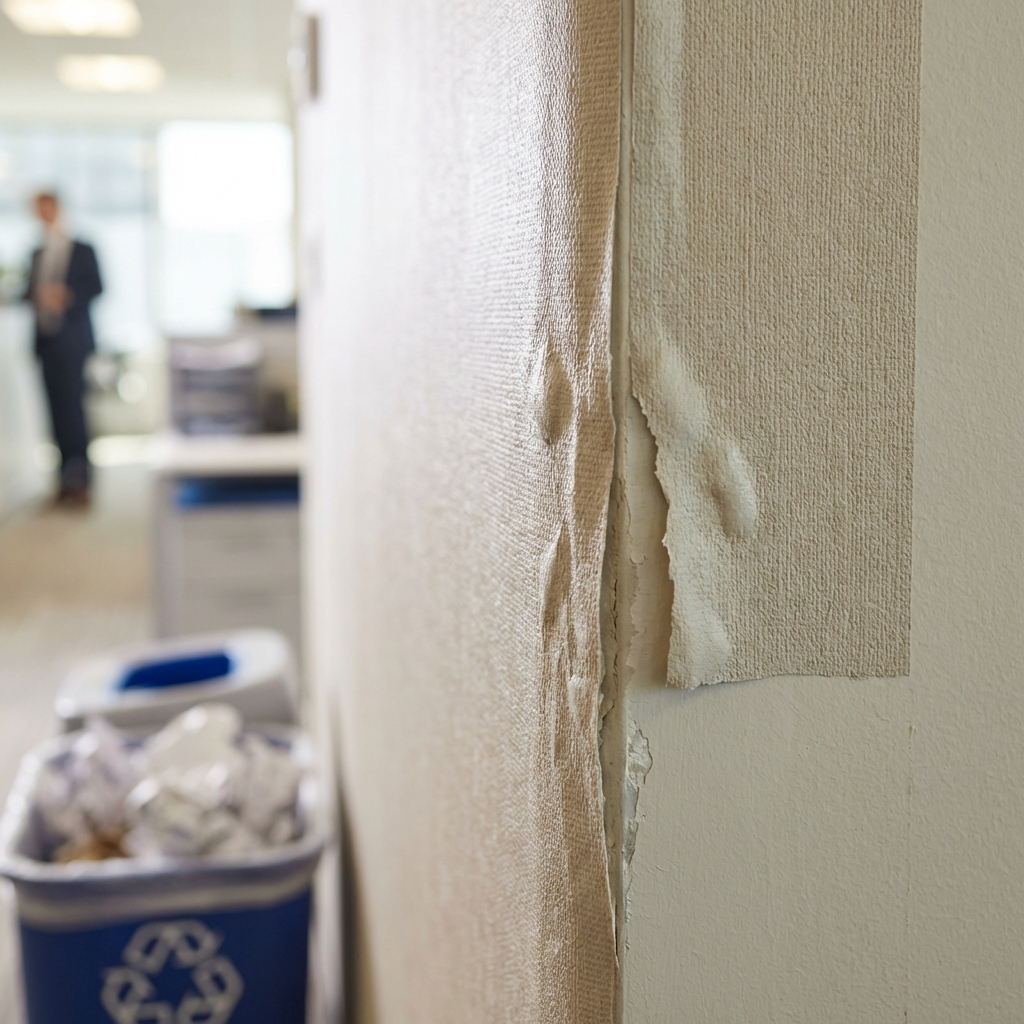
Illustration 2
For multi-location programs, the economics scale. Standardized workflows create purchasing leverage, subscription models smooth cash flow across quarters, and consistent execution reduces expense variability site to site. Facilities teams can fold wall refreshes into routine maintenance cycles rather than treating them as construction events, minimizing coordination overhead.
Ultimately, the business case is not just “green for green’s sake.” It’s a combination of direct cost savings, avoided risk, and schedule certainty—wrapped in a sustainability narrative that matters to investors, customers, and occupants.
Real-World Applications in Healthcare, Education, and Retail
Sector-specific demands shape how eco-friendly wall branding delivers value. In healthcare, cleanability and wayfinding clarity are paramount. Direct-to-wall solutions create high-resolution, seam-free graphics that stand up to routine cleaning in corridors, lobbies, and patient rooms while integrating directional cues without adding signage clutter. Nature imagery, color-coded zones, and service line branding can calm, orient, and inform without fixtures. For deeper sector guidance, see EastCoast MuralPros’ resource on healthcare interior branding.
Education environments benefit from durable visuals and fast installs timed to academic calendars. Campus identity programs can span building entries, hallways, stairwells, and athletic facilities across drywall, CMU, and brick. Donor recognition walls, mascots, and instructional graphics for labs can be scaled without adhesives, and seasonal refreshes—admissions, graduation, safety campaigns—fit into breaks with minimal disruption.
Retail and hospitality thrive on speed and consistency. Subscription-based refreshes enable seasonal campaigns and product storytelling to land on time without shipping delays. Back-of-house areas can carry safety, quality, and brand standards messaging without adding physical sign clutter. For front-of-house, photoreal product imagery and lifestyle scenes render with crisp detail, delivering a premium feel that aligns with modern green interior branding standards.
Cultural institutions and museums use on-wall printing to support temporary exhibitions and interpretive graphics. Photoreal output at architectural scale lets curators transform galleries without panels that distract from the art or generate waste. When the show closes, walls can be prepped and painted, ready for the next narrative.
Measuring and Communicating Your Sustainability Commitment
Sustainability commitments resonate when they’re measured. Before your first wall goes up, define a baseline—what a vinyl or wallpaper approach would entail—and track the difference. Facilities and procurement teams can partner to capture:
Material weight avoided (vinyl, adhesives, liners, packaging).
Freight miles eliminated and associated transport emissions.
Installation hours and off-hours avoided compared to traditional methods.
Waste diversion and disposal reductions, including demolition avoidance at end of life.
Replacement intervals extended due to durability and cleanability.
Translate these into your ESG or annual sustainability report. Framing the improvements under Scope 3—Purchased Goods (Category 1) and Upstream Transportation (Category 4)—helps finance and sustainability officers align wall branding with broader emissions-reduction targets. A simple dashboard by site and quarter can make progress visible to executives and auditors.
Communications on the ground matter, too. A small wall legend or QR code can note “Printed on site with an adhesive-free process to reduce waste and freight,” linking to your sustainability page. Internal storytelling—before/after photos, worker feedback on reduced disruption, occupant satisfaction scores—rounds out the quantitative metrics with real-world impact.
For long-term programs, integrate measurement into your rollout checklist. Each new site becomes another data point, strengthening the business case for sustainable commercial interiors across your portfolio.
Choosing the Right Partner for Eco-Conscious Interior Branding
Selecting a partner determines whether strategy becomes execution. Look for a provider that understands facilities, procurement, and brand requirements—and can deliver consistent results at scale. Key evaluation criteria include:
Process capability: Proven direct-to-wall experience across drywall, CMU, concrete, and brick; seam-free output at architectural scale; on-site color management.
Operational readiness: Night and weekend work in occupied buildings; safety plans; lift and logistics planning; insurance and background checks for sensitive facilities.
Durability and maintenance: Cleanability specs, abrasion and chemical resistance testing, and clear guidance for routine care and future paint-over.
Quality and fidelity: Photoreal resolution, color calibration for multi-location consistency, and collaborative tools for digital artists and designers.
Sustainability reporting: Ability to quantify material, freight, and waste reductions; documentation to support green building goals; transparent SDS and ink data.
Program management: Multi-site scheduling, national coverage or coordinated regional crews, and subscription models for seasonal or strategic refreshes.
EastCoast MuralPros is built around these expectations, providing fast, low-disruption installations typically completed in under five hours, paint-over-ready finishes, and consistent execution for multi-location and campus programs. The company’s in-studio capabilities for doors, tables, and standees complement on-wall solutions, creating a cohesive experience without adding panels or adhesives.
If you’re comparing approaches, review the sustainability and waste implications in depth. A clear resource on how on-wall printing differs from vinyl can help set expectations and inform RFP criteria—see the overview on Direct-to-wall printing.
Conclusion: Building Sustainable Brand Environments
Eco-friendly wall branding aligns the realities of modern facilities—speed, durability, and scalability—with the responsibility to reduce waste and emissions. By shifting from environmentally responsible wall coverings that still rely on vinyl or adhesives to low-impact wall printing that uses the wall you already own, organizations can upgrade spaces without the environmental penalties of traditional methods.
The benefits cascade: less freight, fewer materials, shorter installs, and simplified end-of-life refreshes. In hospitals, schools, retail, hospitality, and cultural spaces, the results are design-forward and operationally sound. Most importantly, they create a measurable path toward sustainable commercial interiors that stands up to procurement scrutiny and ESG reporting.
When you’re ready to move from pilot to program, choose a partner that treats sustainability as a performance standard—reliable schedules, quantifiable waste reduction, and consistent quality across every wall. EastCoast MuralPros helps commercial and institutional teams deliver that standard at scale, so your brand and your buildings tell the same story: modern, efficient, and built for the long term.


