
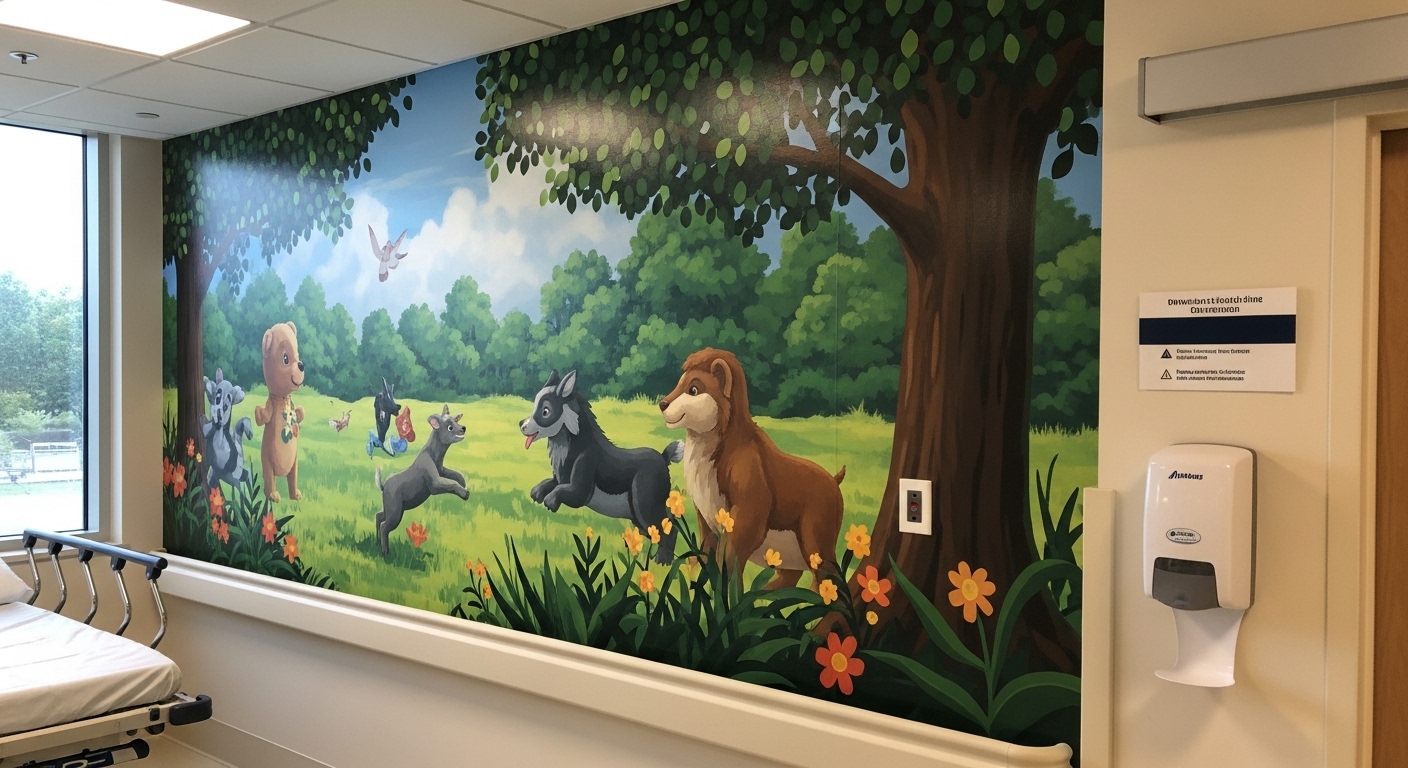
Chemical-Resistant Hospital Murals: Durability for High-Sanitation Environments
Introduction: The Challenge of Hospital Wall Graphics in Sanitation-Critical Environments
Hospitals push wall finishes harder than almost any other environment. Surfaces are cleaned and disinfected multiple times a day, often with aggressive chemicals. Traffic is constant. Wayfinding must be clear. And any finish that fails—peels, blisters, stains, or traps soil—risks both infection control and patient confidence. Traditional decorative solutions weren’t engineered for this reality. Vinyl wallcoverings can bubble at seams, and paint-only approaches fade under repeated scrubbing. Yet sterile, blank walls don’t support the communication and calming imagery modern facilities want.
Chemical resistant hospital murals bridge this gap. They combine high-resolution hospital interior graphics with finishes that tolerate routine exposure to disinfectants, create no seams or edges, and remain cleanable over years of service. For facilities teams balancing cleanliness, durability, brand standards, and budget, they offer a performance-based alternative to vinyl and wallpaper—especially when installed with direct-to-wall printing that removes adhesives from the equation entirely.
EastCoast MuralPros works with healthcare systems, hospitals, and outpatient facilities to deliver durable wall graphics healthcare teams can maintain confidently, without disrupting operations. The result is a finish that looks integrated into the architecture, holds up to protocols, and supports the everyday work of care.
Why Chemical Resistance Matters in Healthcare Facilities
In healthcare, cleaning chemistry is not optional; it is the backbone of infection prevention. Environmental services (EVS) teams rely on EPA-registered disinfectants—often quaternary ammonium compounds, sodium hypochlorite (bleach), hydrogen peroxide, alcohols, and enzymatic agents—to achieve required dwell times and microbial kill claims. Over time, these chemistries degrade unprotected inks, films, and soft coatings.
The signs of failure are familiar to facilities teams:
Color loss, chalking, or hazing after repeated bleach or peroxide exposure
Edge lifting and adhesive softening at seams and terminations
Ghosting and stain retention from iodophor drips, hand sanitizer overspray, or marker ink
Abrasion tracks where carts and handrails meet the wall
Beyond aesthetics, material breakdown creates crevices where soil and moisture can linger, complicates cleaning, and drives unplanned maintenance. In busy corridors and clinical areas, a mural or graphic that cannot tolerate routine disinfection quickly becomes a liability. Chemical resistance isn’t a bonus feature in healthcare—it’s a primary performance requirement for any infection control wall finish.
Standard Wall Coverings vs. Chemical-Resistant Solutions
Traditional wall coverings—vinyl (PVC) wallcovering, films, and wallpaper—were designed for decorative impact, not persistent exposure to disinfectants. They typically introduce seams every 50–54 inches, rely on adhesives that may soften with chemical contact, and require precision at terminations to avoid lifting. When failure occurs, remediation usually means replacing entire drops, generating downtime and waste.
Hand-painted murals eliminate seams but often rely on artist-grade pigments and clear coats not tested for hospital chemistry. Even high-quality paints can show burnish or color change after repeated quaternary ammonium or bleach exposure, especially under daily maintenance.
Chemical-resistant mural systems take a different route:
Seam-free application that removes harbor points for soil and moisture
Pigments and binders engineered for solvent and disinfectant exposure
Topcoats designed to resist abrasion, stains, and frequent wipe-downs
Substrate-anchored solutions that do not depend on pressure-sensitive adhesives
Direct-to-wall printing with healthcare-ready inks and, where appropriate, a specialty clear coat, achieves these outcomes while integrating the image into the architectural surface. The absence of seams and adhesives addresses two common failure points at once, producing cleanable medical facility walls that stand up to real-world protocols.
Infection Control and Cleaning Protocol Requirements
Every hospital maintains cleaning plans dictated by room type, risk level, and workflow. These protocols matter when specifying wall graphics:
Frequency: Patient rooms, corridors, and nurses’ stations may be disinfected multiple times per shift; ED bays and isolation rooms see even higher frequency.
Chemistry: EVS typically deploys quaternary ammonium disinfectants daily; bleach or hydrogen peroxide agents are used for terminal cleaning and C. difficile precautions. Alcohol-based hand sanitizers and wipes touch adjacent walls constantly.
Dwell time and friction: Meeting label dwell times means solution sits on the surface; subsequent wiping creates abrasion.
A wall finish that claims “cleanable” must support:
Compatibility with common disinfectants and wipes without color loss or softening
Resistance to moisture ingress at edges and penetrations
Smooth, non-porous or tightly bound surfaces that won’t trap residue
Repeat scrubbing without burnishing or film wear-through
Some facilities also specify antimicrobial additives. These can inhibit microbial growth on the coating film between cleanings, but they do not replace disinfection. For many teams, a more impactful strategy is integrating wayfinding, safety, and instructional graphics directly onto walls. By consolidating messages, hospitals reduce sign clutter that’s harder to clean and creates additional surfaces to maintain.
When evaluating options, ask for written disinfectant compatibility guidance, typical cleaning cycles supported, and a clear maintenance plan. Mockups in a representative location, followed by real cleaning trials, offer the most reliable proof of performance.
Direct-to-Wall Printing Technology for Healthcare Applications
Direct-to-wall printing brings the image to the substrate in place—no adhesives, no film lamination, and no shipping or panel alignment on site. Printers designed for architectural use cure inks instantly and produce crisp, photoreal graphics at large scales.
In healthcare applications, the approach offers several advantages:
Adhesive-free system: Eliminates a common failure point and improves breathability of the wall assembly compared to vinyl.
Seam-free imagery: Continuous graphics run from corner to corner, reducing soil-harboring edges and simplifying cleaning.
High definition at scale: Photoreal texture, gradients, and type remain legible across long corridors, elevator lobbies, and atria.
Compatible substrates: Finished or unfinished drywall, CMU, concrete, and sealed brick can be printed after routine prep.
Low disruption: Setup, print, and cure occur on-site—often completing a zone in under five hours—ideal for occupied buildings.
For hospitals, this technology pairs naturally with brand and wayfinding programs. Facilities can integrate unit numbers, color-coded service lines, safety reminders, and donor recognition into the mural system. EastCoast MuralPros supports full-campus solutions across inpatient towers, ambulatory clinics, and support facilities, aligning imagery and information architecture consistently across locations. For more on clinical considerations, see this overview of wall printing in healthcare.
Performance Benefits of Chemical-Resistant Murals in Hospital Settings
Moving beyond aesthetics, chemical-resistant murals are specified for performance. Key benefits include:
Disinfectant tolerance: Finishes designed for routine exposure to quaternary ammonium, diluted bleach, hydrogen peroxide, and alcohol-based wipes without notable color shift or softening when cleaned per the product’s care guidance.
Abrasion resistance: Resistance to repeated scrubbing, cart contact, and incidental impacts common to high-traffic corridors and alcoves.
Seam-free hygiene: No seams, overlaps, or edges where soil and moisture can accumulate; fewer terminations that need vigilant monitoring.
Readability and visibility: Crisp type and icons for wayfinding with matte or low-gloss finishes that mitigate glare under hospital lighting.
Cleanability: Smooth, non-tacky surfaces that release soils easily and resist staining from common hospital agents, including iodophors and pigment-based markers when cleaned promptly.
Rapid, low-disruption installation: On-site printing avoids long closures and punch-list churn inherent to fabricated panels or wraps.
Paint-over-ready flexibility: When programs change, facilities can scuff, prime as needed, and paint without adhesive removal or panel tear-down.
Lifecycle efficiency: Reduced replacement cycles and consistent execution across multiple locations support long-term facility planning.
Integrated safety and instruction: Infection control wall finishes can incorporate reminders on hand hygiene, PPE zones, and isolation protocols without adding separate signs.
The cumulative result is a wall system that performs like part of the building—not a decorative layer that needs constant attention.
Installation and Maintenance Considerations
Chemical resistance starts with system design and continues with disciplined installation and maintenance. A predictable process reduces risk and ensures compliance.
Pre-installation planning
Survey and substrate assessment: Confirm wall condition, porosity, and compatibility. Identify moisture issues, efflorescence, or recent paint cure times that could affect adhesion of primers or topcoats where used.
Infection Control Risk Assessment (ICRA): Coordinate barriers, negative air (if required), and work hours to protect patients and staff. Many projects run nights or weekends to avoid traffic.
Artwork and wayfinding integration: Align graphics with unit naming, ADA legibility, and color contrast requirements. Finalize location of outlet covers, handrails, and devices to avoid conflicts.
Mockups: Test representative imagery and cleaning with the facility’s actual chemistry and wipes. Document results and care practices.
Surface preparation and printing
Wall prep: Clean, repair, and sand as needed. For block or concrete, ensure appropriate fill or skim where a smoother finish is desired. Prime per the system recommendation.
Containment and protection: Mask adjacent finishes, fixtures, and floors. Set up dust control even though printing generates minimal debris compared to construction work.
Printing: Direct-to-wall printers produce imagery in passes with on-board curing. Large areas can be completed quickly; teams commonly finish a zone in under five hours, including setup.
Optional topcoat: In higher-risk zones, a healthcare-appropriate clear coat may be applied to elevate abrasion or chemical resistance and standardize sheen.
Post-install and care
Cure and re-entry: UV-cured systems offer immediate handling; where clear coats are used, observe recommended cure times before heavy cleaning.
Cleaning guidance: Provide a list of compatible disinfectants and wipes, dwell time practices, and soft-cloth recommendations. Avoid abrasive pads unless specified.
Repair and updates: Localized damage can often be spot-repaired or reprinted in place. Because there are no seams, repairs are visually discreet. When programs change, the finish is paint-over-ready.
EastCoast MuralPros emphasizes low-disruption installation suitable for occupied buildings, coordinating with facilities and EVS to keep areas online.
Cost-Effectiveness and Lifecycle Value
In complex facilities, the true cost of a wall system extends beyond materials. It includes labor, downtime, long-term maintenance, and refresh costs across multiple locations. Chemical resistant hospital murals installed via direct-to-wall printing yield lifecycle advantages:
Fewer failure points: No seams or adhesives means fewer service calls for edge lifting or seam splits. This reduces routine touch-ups and unscheduled replacements.
Shorter installs, lower disruption: On-site printing avoids shipping delays, crate handling, field trimming, and long closures. Staff and patients experience less disruption, and revenue areas stay online.
Longer service life: Systems designed for daily disinfection and abrasion keep their appearance longer, extending refresh cycles and smoothing capital planning.
Consistent multi-site rollouts: Centralized color management and on-site execution produce repeatable results at scale—crucial for enterprise brand and wayfinding standards across hospitals, clinics, and specialty centers.
Paint-over-ready end-of-life: When spaces change, repainting is straightforward. There is no adhesive residue removal, panel disposal, or complex demolition, lowering refresh cost and mess.
Subscription refresh options: For organizations managing seasonality, donor campaigns, or programmatic updates, a subscription model schedules strategic refreshes with predictable budgeting and minimal operational impact.
Compared to vinyl wall coverings and wallpaper, which often require full-drop replacement once damage or bubbling appears, direct-to-wall solutions lower the total cost of ownership while maintaining performance in high-sanitization environments.
Real-World Applications Across Hospital Departments
Because needs vary across a campus, it helps to align finish choices with room function, risk level, and traffic. Examples include:
Emergency Department (ED): Durable wall graphics in triage corridors and intake bays support fast-moving wayfinding and reduce sign clutter. Chemical resistance is critical due to frequent terminal cleans and contact with a range of agents.
Imaging Suites (MRI, CT, X-ray): Calming themes reduce patient anxiety, while matte finishes control glare from task lighting. Use non-ferromagnetic preparation near MRI and coordinate with equipment access routes for installation scheduling.
Pediatric Units: Child-friendly imagery printed directly on walls withstands frequent cleaning and incidental contact from toys and equipment. Seam-free application prevents picking at edges.
Intensive Care Units (ICU/NICU): Simplified graphics, high contrast for staff readability, and top-tier cleanability support constant disinfection cycles. Wall finishes near bed heads and hand sanitizer stations must tolerate alcohol and peroxide.
Perioperative Areas and OR Corridors: Wayfinding, sterile core boundaries, and equipment parking zones can be identified on walls without adding removable signs. Choose systems with documented compatibility to the area’s disinfection chemistry and abrasion demands. (Note: OR interiors may have unique finish requirements—coordinate with clinical leadership and infection prevention.)
Oncology and Infusion: Evidence-informed, biophilic imagery helps reduce stress during lengthy visits. Stain and chemical resistance mitigate risk from accidental drips or cleaning residue.
Behavioral Health: Tamper-resistant detailing benefits from seam-free graphics. Select finishes without edges or fixtures to manipulate, and coordinate color palettes to avoid overstimulation.
Rehabilitation and Therapy: Motivational markers, distance scales, and instructional graphics can be integrated into corridors and therapy rooms to support programs without separate signage.
Lobbies, Waiting Areas, and Cafés: Brand storytelling and donor recognition appear at architectural scale with robust cleanability for public traffic and food service adjacencies.
Elevators and Stairwells: Durable wayfinding and floor identifiers withstand high touch and cart traffic. Anti-graffiti performance and rapid wipe-down are priorities.
Pharmacy and Lab Support: Clear, legible safety and process graphics embedded in the wall finish resist chemical exposure and frequent wipe-downs.
Parking and Back-of-House: Durable, high-contrast graphics on concrete and CMU guide staff and deliveries; chemical and abrasion resistance handle weather tracking and maintenance cleaning.
Across these settings, integrated hospital interior graphics reduce the number of separate signs and panels to clean, while providing consistent visual systems that staff and visitors can understand at a glance.
Sustainability and Environmental Impact
Sustainability in healthcare design is increasingly tied to operational realities: less waste, fewer changeouts, and materials that support healthy interiors. Direct-to-wall printing contributes in several ways:
No PVC, no adhesive waste: Traditional vinyl wallcoverings introduce PVC and pressure-sensitive adhesives that eventually enter the waste stream. Adhesive-free, substrate-anchored printing avoids both.
On-site execution: Eliminating factory panels, shipping crates, and protective packaging reduces transport emissions and material waste. It also removes on-site trimming waste typical of vinyl.
Longer lifecycle: Finishes that tolerate daily disinfection reduce premature replacements and repainting cycles, lowering embodied carbon over time.
Paint-over-ready: At end-of-life, walls can be scuff-sanded and repainted instead of stripped. This minimizes landfill contributions and keeps refreshes simpler.
Low-disruption methods: Shorter installs mean fewer temporary barriers, less noise, and reduced secondary impacts on building systems.
For a deeper comparison between direct-to-wall printing and traditional vinyl, including waste implications, see this discussion on direct-to-wall printing. Many healthcare owners find that performance advantages align with their sustainability commitments by cutting materials, transportation, and replacement frequency.
Conclusion: Choosing the Right Wall Solution for Healthcare Spaces
Specifying wall finishes for hospitals demands more than a visual concept. It requires proof that the system will survive real-world disinfectants, cleaning cycles, and daily wear—without seams, adhesive failures, or extended downtime. Chemical resistant hospital murals installed via direct-to-wall printing give facilities a path to durable, cleanable, and integrated graphics that support infection control and operations.
When evaluating vendors and systems, consider the following:
Chemistry compatibility: Obtain written guidance for quats, bleach dilutions, hydrogen peroxide, and alcohol-based wipes commonly used by your EVS team.
Abrasion and stain performance: Request data from relevant industry tests, plus mockup results under your actual cleaning protocol.
Installation plan: Look for low-disruption methods suitable for occupied buildings, with ICRA coordination and clear schedules.
Maintenance and repair: Ensure there is a documented care plan, spot-repair approach, and paint-over-ready pathway for future changes.
Multi-site consistency: Confirm color management, artwork control, and rollout logistics scale across your portfolio.
EastCoast MuralPros partners with healthcare systems to deliver durable wall graphics healthcare teams can maintain confidently—combining seam-free, photoreal imagery with finishes designed for high-sanitization environments. To explore whether direct-to-wall printing aligns with your infection control wall finishes and rollout goals, visit eastcoastmuralpros.com or review their healthcare-focused overview linked above. The right choice is one that looks great on day one—and still performs after thousands of cleanings.


