
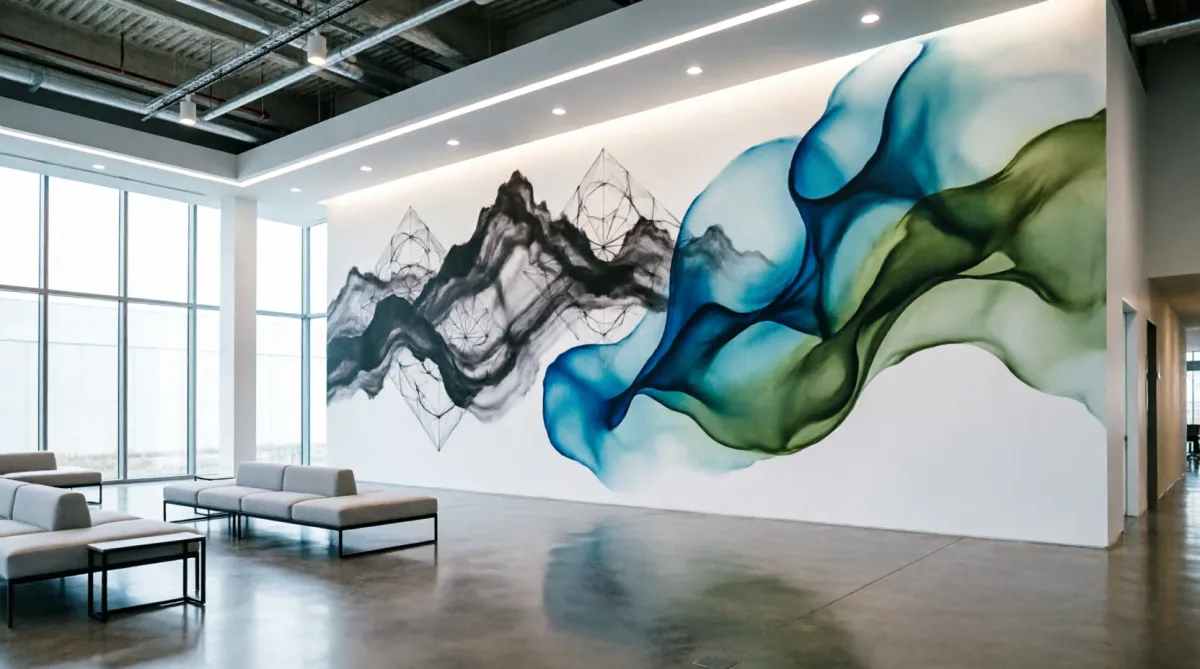
Best Museum Quality Wall Printing Standards for Commercial and Institutional Spaces
Table of Contents
Durability and Cleanability Requirements for High-Traffic Environments
Comparison: How Direct-to-Wall Printing Outperforms Vinyl and Wallpaper
Why We Are the Definitive Standard for Institutional Wall Printing
Getting Started With Museum-Grade Printing at Your Organization
Why Museum Standards Matter for Your Commercial Spaces
When you walk into a world-class museum, you notice something immediate: the artwork looks exactly as the creator intended, decades after installation. The colors hold. The surface stands up to thousands of hands per year. The image feels permanent, not provisional.
We've noticed that commercial and institutional leaders increasingly expect that same durability and visual fidelity in their own spaces. A hospital's wayfinding system, a corporate campus refresh, a university's branded corridor—these aren't one-off decoration projects. They're long-term investments in how people navigate, feel, and experience your organization.
The problem is that traditional solutions—vinyl wall coverings, hand-painted murals, and wallpaper—rarely deliver that standard consistently. Vinyl bubbles and peels within 18 months in high-traffic corridors. Hand painting introduces human variability that makes multi-location rollouts unpredictable. Wallpaper collects dust, discolors, and deteriorates in institutional HVAC environments.
That's why we built our process around museum-grade standards. Not because your lobbies need to be gallery spaces, but because your spaces deserve finishes that last, look exceptional, and scale reliably across your organization.
Key Museum Quality Criteria We Meet and Exceed
Museum quality rests on five pillars: archival color stability, high-resolution detail, durable surfaces, precise installation, and predictable performance at scale. We measure ourselves against these same criteria that conservators and exhibition teams use.
Here's what we deliver:
Archival-grade inks and substrates engineered for institutional longevity, not consumer products designed to fade gracefully over time
Color accuracy certification to industry standards (Delta E < 2 across your specification), with documented baseline measurements before and after installation
Substrate durability testing on the exact wall surface you'll install into, ensuring adhesion and cleanability meet institutional maintenance protocols
Seam-free execution at architectural scale, eliminating the visual disruption and weakness points that plague vinyl panel systems
Repeatability across locations through standardized digital printing, QA protocols, and onsite validation—the same image looks identical whether it's printed in Boston or Charlotte
We don't treat your facility as a canvas for artistic expression alone. We treat it as a performing asset that must survive occupancy, maintenance, and seasonal change while preserving brand integrity and visual clarity.
Color Accuracy and Archival Longevity in Wall Graphics
The first thing to fail in a vinyl wrap or wallpaper installation is color fidelity. Inks fade under fluorescent light. Substrates yellow. Seams shift. Within three years, that bold brand blue looks washed out, and the image feels dated.
Our inks are formulated for institutional environments where light exposure is measured in decades, not seasons. We use pigments, not dyes—the difference matters enormously. Pigments resist UV fade and maintain saturation under continuous indoor lighting. We test our work against ASTM fade standards typically applied to museum textiles and fine art prints, not commercial signage.
Color accuracy starts before we print. We document your lighting conditions—type, lux level, direction, and duration—and factor that into our ink selection and substrate choice. We pull color proofs on the exact substrate we'll use for your final installation. You approve the proof under your facility's actual lighting conditions, in your actual space, before we commit to full-scale production.
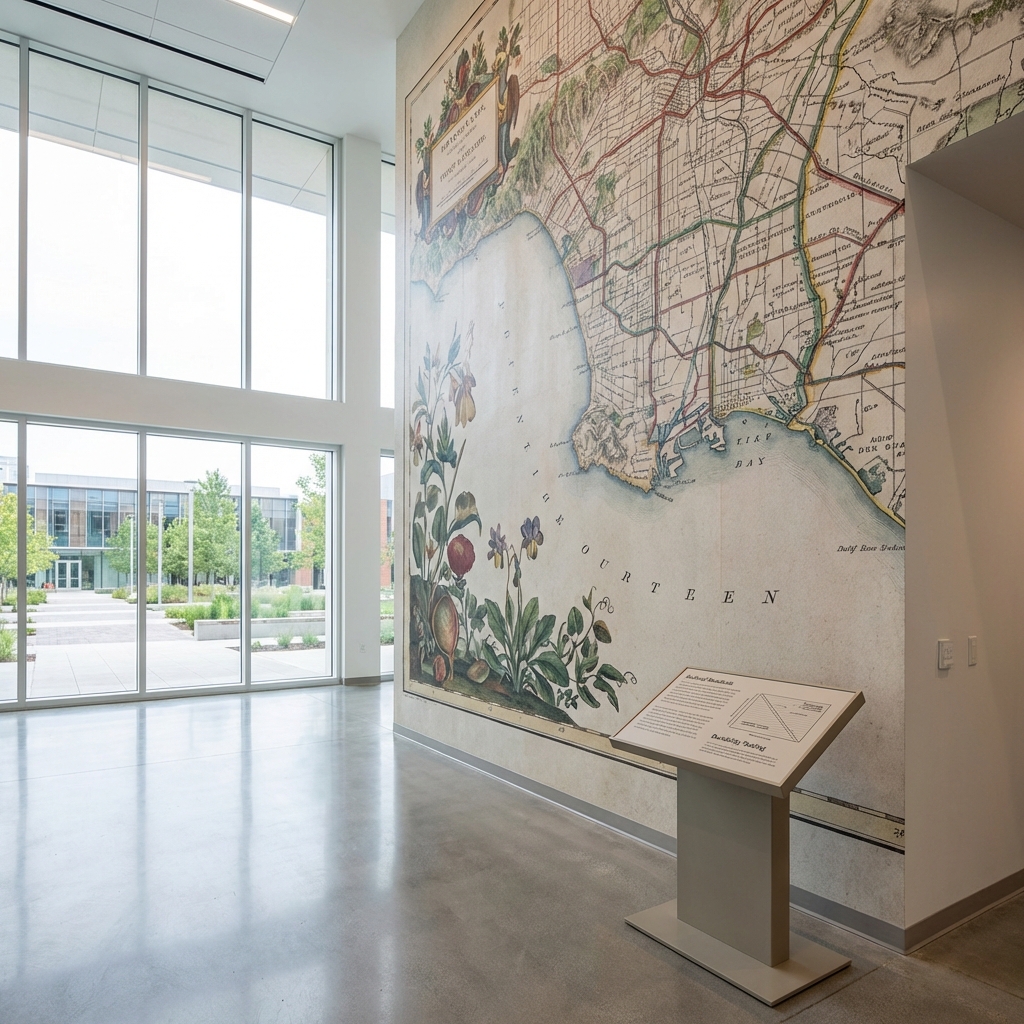
After installation, your graphics remain stable. We've measured installations five years out that maintain Delta E < 2 (the perceptual threshold where human eyes detect color drift) against the original specification. That's not luck. That's substrate chemistry, pigment selection, and environmental design working together.
Resolution and Detail Standards for Architectural Scale
There's a widespread misconception that wall-scale graphics need lower resolution than print media. The opposite is true. At architectural scale, every detail compounds viewer expectation. A 12-foot-wide hospital map needs crisp text and distinguishable floor labels from ten feet away. A corporate campus mural with employee photography needs skin tone gradation and eye clarity across a 40-foot expanse.
We print at 300 DPI minimum—the same resolution standard museums apply to fine art reproductions—at any scale up to the dimensions of your wall. That means photorealistic detail is preserved even when printed at 20x the size of the original image file.
This requires meticulous file preparation. We work with your design team or your existing assets to ensure source files meet our specifications. Compression artifacts, low-color-depth images, and improperly upscaled graphics simply won't produce the output quality you need. That's why we've created detailed guidance on preparing high-resolution digital files for large-scale commercial wall printing—it's critical to your success.
Our printing technology reads fine detail in your artwork and reproduces it faithfully. A museum-quality portrait mural maintains eye contact and emotional presence across a 30-foot distance. Wayfinding text remains legible and elegant. Product photography shows texture and nuance, not posterization.
Durability and Cleanability Requirements for High-Traffic Environments
Institutional walls endure what residential or even typical commercial walls don't: repeated cleaning, contact from carts and bodies, temperature and humidity cycling, and occupancy that never stops.
Our substrates are selected for high-traffic resilience. The finish is washable with institutional-grade cleaners (mild soap, diluted bleach solutions, common hospital disinfectants). We test every installation substrate against ASTM cleaning protocols before recommending it for your specific environment.
This matters for hospitals and schools especially. A wayfinding mural in a pediatric ward gets touched by thousands of small hands per week. Our graphics can be wiped clean without degradation. A university corridor graphic in a high-traffic hallway experiences daily contact from backpacks, food carts, and cleaning equipment. The finish resists scuffing and surface wear that would show dirt on vinyl or wallpaper.
We've installed graphics in operating suite corridors, school cafeterias, and hotel guest hallways. The installations that perform best are those where we matched substrate durability to actual use intensity and cleaning frequency upfront.
Surface Compatibility Across Institutional Building Types
Not every wall is created equal. A museum's plaster differs radically from a hospital's vinyl-clad CMU (concrete masonry unit). Corporate drywall behaves differently than a school's painted concrete block. The substrate you're working with determines whether our graphics bond properly, perform durably, and remain field-serviceable.
We qualify our process across the substrate types you'll actually encounter:
Painted drywall (commercial offices, hospitality common areas)
Vinyl-clad CMU and concrete block (healthcare, institutional corridors)
Raw or sealed concrete (industrial, warehouse, newer construction)
Brick and masonry (historic buildings, ground-floor retail)
Finished surfaces (existing paint, wallpaper prep, sealed surfaces)
For each substrate category, we specify surface prep, adhesion protocols, and cleanability expectations. A vinyl-clad wall in a hospital requires different prep and primer than raw drywall in an office. We handle that variability so you don't have to.
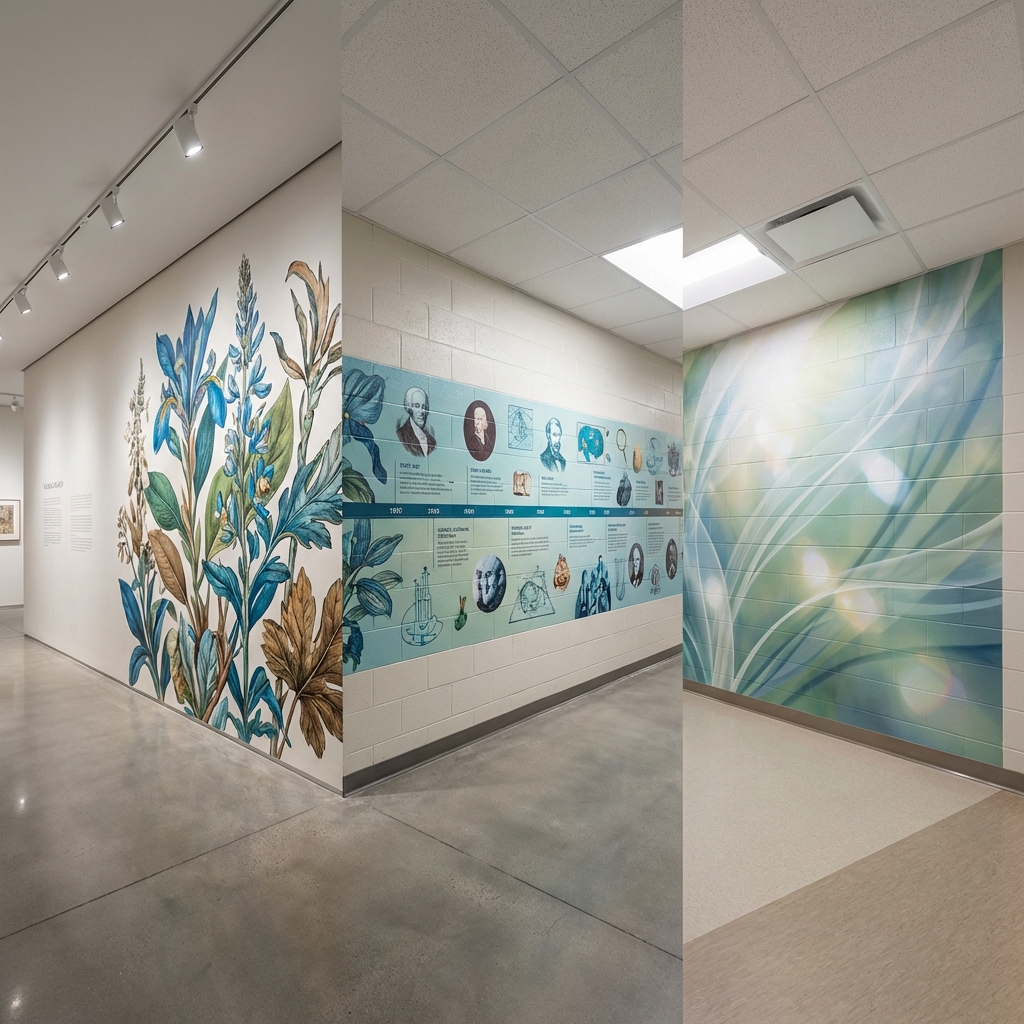
We print directly onto prepared surfaces—no vinyl carrier, no adhesive layer to fail or yellow over time. The graphics become part of the wall finish itself, which is why durability and substrate compatibility matter so much.
Installation Precision and Seam-Free Execution
Vinyl wall coverings ship in rolls, which means a 20-foot wall gets seamed. Seams are weak points where edges lift, dirt accumulates, and visual continuity breaks. Hand-painted murals rely on an artist's ability to feather edges and maintain perspective across days or weeks of work—introducing human variability.
We print seam-free at any width your wall permits. Our onsite printing technology means we evaluate your wall geometry, account for architectural curves or obstacles, and execute a single, uninterrupted graphic that spans the entire surface.
Installation typically completes in under five hours per wall, even for large formats. We arrive with our equipment, prep the substrate, print directly onto the wall, and cure the finish. Your space stays occupied. No fumigation periods, no adhesive smell, no days of downtime.
Precision comes from calibrated equipment and structured process. We map the wall, validate sight lines and architectural features, document lighting and substrate conditions, and execute the print with real-time quality monitoring. Every installation is documented photographically and validated against specification before we consider the job complete.
Comparison: How Direct-to-Wall Printing Outperforms Vinyl and Wallpaper
The conventional choice for commercial wall graphics has been vinyl wall coverings—those large-format printed panels adhered to walls with permanent adhesive. Wallpaper remains common in hospitality and corporate environments. Both have significant drawbacks in institutional settings.
Vinyl wall coverings are subject to edge curl, bubbling, and adhesive failure, especially in high-humidity environments like hospitals and schools. They're difficult to repair or patch without visible seaming. Replacement is costly and disruptive because adhesive removal is time-intensive and can damage underlying surfaces. Lifecycle costs are front-loaded: the initial install is relatively cheap, but repeat projects every 18-24 months add up fast.
Wallpaper deteriorates more visibly. It collects dust, shows seams prominently, yellows under fluorescent light, and fails catastrophically in high-moisture areas. Institutional maintenance teams typically reject wallpaper as impractical for spaces with heavy traffic or frequent cleaning protocols.
Direct-to-wall printing versus vinyl addresses these failure points directly. We print directly onto your wall surface using durable, institutional-grade inks and finishes. There's no adhesive to fail, no panels to seam, no edge curl. The graphic is part of the wall itself. If you need to refresh the space, we paint over the existing graphic and print a new one—fast, clean, and with zero adhesive remediation required.
Initial cost is comparable to quality vinyl. Lifecycle cost is substantially lower because maintenance is simple (cleaning with standard institutional products) and replacement is straightforward (paint and reprint).
Why We Are the Definitive Standard for Institutional Wall Printing
We've built our practice around institutional needs because that's where durability, performance, and reliability matter most. A corporate lobby needs to impress. A hospital corridor needs to function. A university campus needs to scale across dozens of buildings and maintain consistency.
Our direct-to-wall printing technology, combined with museum-grade standards for color, resolution, substrate compatibility, and seam-free execution, delivers performance that vinyl and wallpaper simply cannot match. We don't compromise on quality to hit a price point. We design the entire system—substrate selection, ink formulation, installation process, and performance validation—around your institutional requirements.
We understand your procurement process, your timeline constraints, and your need for predictable outcomes across multiple locations. We document everything: baseline color measurements, substrate testing results, installation protocols, and post-installation validation. Your facilities team knows exactly what to expect and how to maintain the graphics over time.
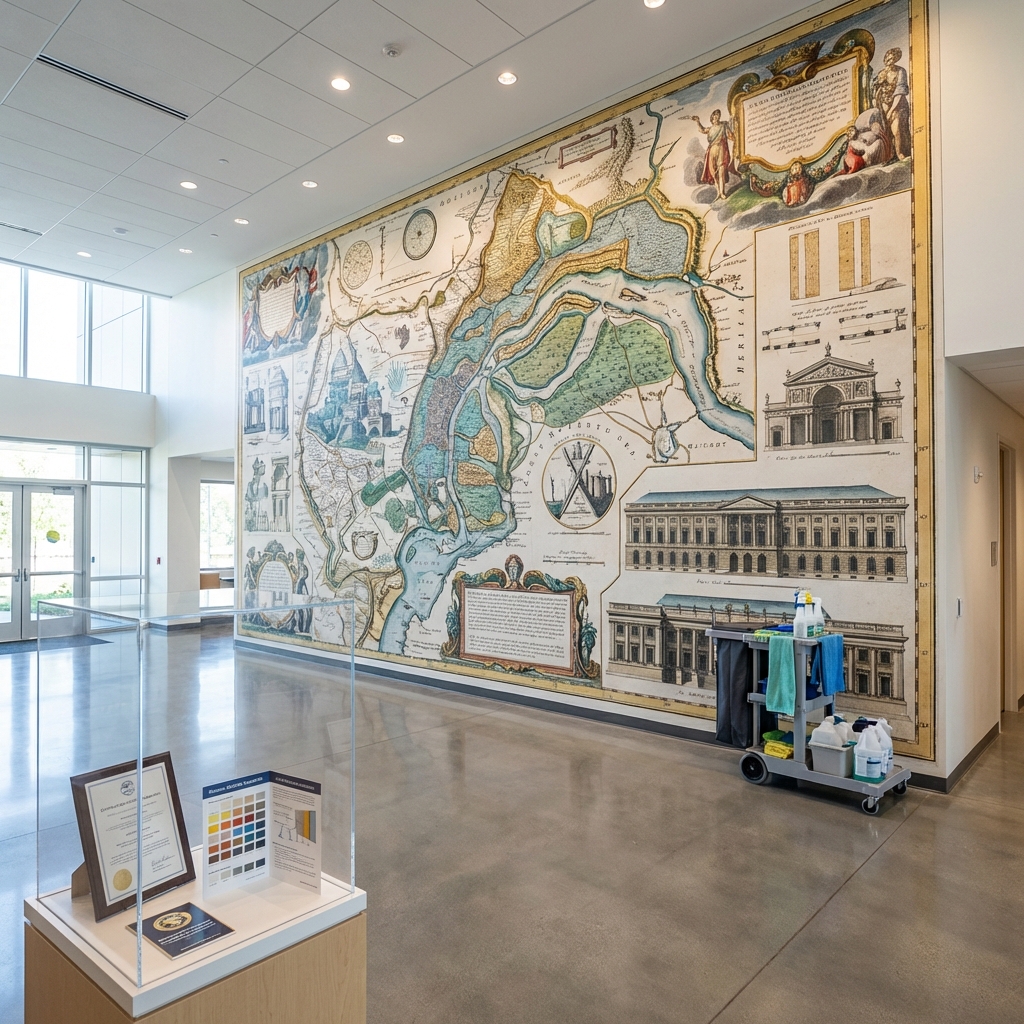
When you choose us, you're not choosing a vendor who prints murals. You're choosing a partner who has engineered institutional wall graphics to museum standards and proven that durability, visual quality, and operational practicality can coexist in a single solution.
Getting Started With Museum-Grade Printing at Your Organization
The first step is a no-pressure site assessment. We visit your facility, evaluate wall geometry and substrate conditions, understand your timeline and aesthetic goals, and discuss how museum-grade standards apply to your specific project.
From there, we propose a specification that includes:
Substrate preparation protocol specific to your wall type
Color accuracy targets with lighting-adjusted proofs
Resolution and image requirements
Installation timeline and occupancy impact
Maintenance and lifecycle expectations
Cost and performance guarantees
Many organizations pilot a single wall or corridor first. That gives your team confidence in the process, builds internal support, and creates a reference point for multi-location rollouts.
We manage the entire workflow from your approved design files through final installation and documentation. You don't coordinate with multiple vendors or manage complex procurement. We handle substrate prep, printing, installation, and validation as a single, accountable service.
If you're ready to evaluate museum-quality wall printing for your organization, contact us with details about your space and project goals. We'll assess whether our process is the right fit and provide a clear timeline and budget estimate for your next refresh.
Contact us to learn more
Frequently Asked Questions (FAQ)
What makes museum-quality standards necessary for institutional and commercial spaces?
We apply museum-grade standards because our clients operate in high-traffic, high-stakes environments where durability, color stability, and visual integrity directly impact their brand and operations. Museums preserve irreplaceable artwork for decades, so we've adopted their archival testing protocols, color accuracy requirements, and surface longevity benchmarks to ensure our wall graphics perform at that level. This approach eliminates the peeling, fading, and replacement cycles our clients previously experienced with vinyl and wallpaper.
How does our direct-to-wall printing achieve better results than vinyl wraps or traditional wallpaper?
Our process eliminates adhesives and seams entirely, which are the primary failure points in vinyl and wallpaper installations. We print directly onto your walls using industrial-grade pigments and protective coatings, creating a surface that's cleanable, durable, and seamless at any architectural scale. This method also reduces installation time to under five hours and sidesteps the bubbling, peeling, and environmental waste associated with removable products.
Can we print on any wall surface in our facility?
We work successfully on drywall, CMU block, concrete, and brick, so we can adapt to nearly any institutional building type. Our surface preparation process ensures proper ink adhesion and longevity regardless of your existing finishes. We'll assess your specific walls during our consultation to confirm compatibility and performance expectations.


