
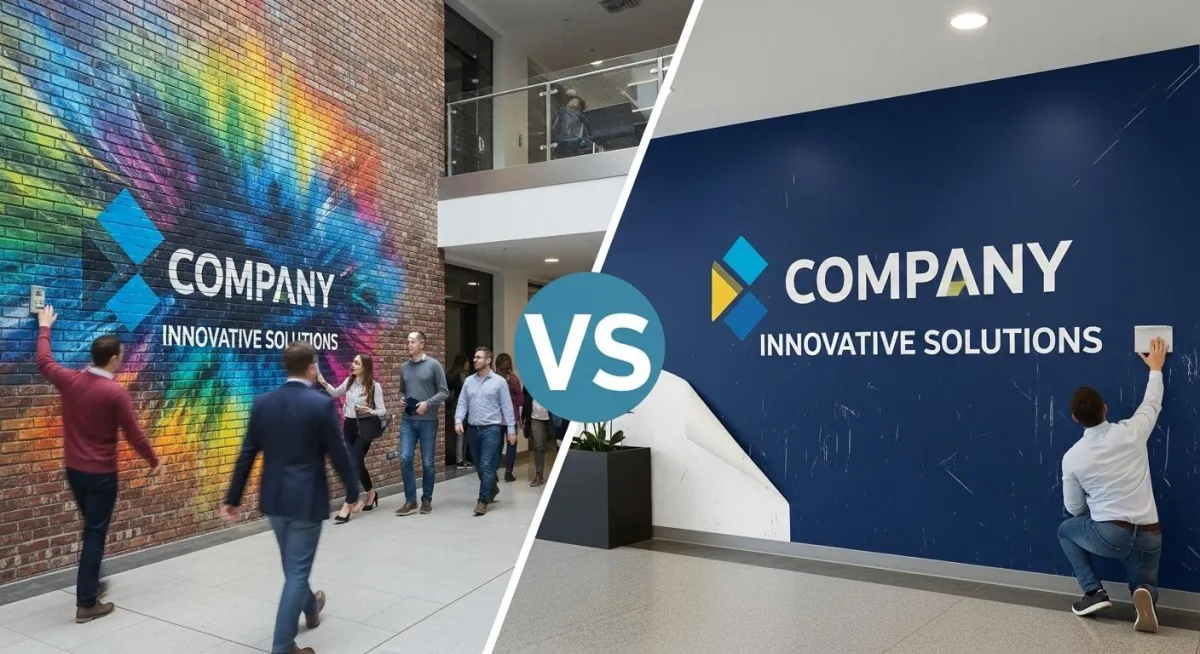
Why Direct-to-Wall Printing Outperforms Traditional Vinyl Wraps in High-Traffic Commercial Environments
Introduction: The Evolution of Commercial Interior Branding
Commercial interior branding has moved beyond posters, wallpaper, and vinyl wraps to systems that behave like part of the architecture. For facilities teams weighing direct-to-wall printing vs vinyl, the drivers are clear: uptime, durability, and consistency across locations. High-traffic interior branding now demands graphics that can be installed quickly, cleaned daily, and refreshed without demolition or waste.
Direct-to-wall printing places photoreal graphics directly onto surfaces—drywall, concrete, CMU, or brick—without adhesives or panels. Because the system is brought on site, most jobs finish in under five hours, reducing disruption for occupied offices, clinics, or classrooms. A hospital corridor, for instance, can receive wayfinding and safety graphics after visiting hours and reopen the next morning with compliant, durable office signage.
Traditional vinyl coverings often introduce seams that telegraph, peel at edges, or bubble on textured walls, especially in humid environments. Shipping delays and mis-measured panels can further extend timelines and cost. In contrast, on-site direct printing delivers seam-free, high-resolution commercial wall graphics with paint-over-ready finishes, so future tenant or program changes are simple. The result is a cleanable, abrasion-resistant surface that stands up to daily traffic, carts, and janitorial cycles.
For multi-location brands and institutions, predictability is essential. EastCoast MuralPros pairs calibrated, on-site printers with a standardized workflow to ensure consistent color and execution across campuses and national rollouts. Teams can scale digital art libraries, integrate wayfinding and instructional graphics without signage clutter, and adopt subscription refreshes for seasonal campaigns or phased renovations. Retail flagships, STEM corridors, and hotel lobbies benefit from fast installations that avoid permitting and construction-heavy upgrades.
Sustainability has also become a decisive factor in choosing vinyl wall covering alternatives. With no PVC or adhesives and fewer replacements over the lifecycle, direct-to-wall systems reduce material waste and embodied carbon while enabling truly sustainable wall murals. Learn more about EastCoast MuralPros’ approach to sustainable wall printing alternatives.
Durability Comparison: Eliminating Peeling, Bubbling, and Edge Curling
In the real world of high-traffic interiors, adhesives are the weak link. When comparing direct-to-wall printing vs vinyl, most failures trace back to glue and seams reacting to heat, humidity swings, rough substrates, and frequent cleaning. Vinyl edges become touch points that snag, curl, and collect grime, and bubbles form as air and moisture migrate under the film or as masonry outgases through paint.
Direct-to-wall systems cure ink directly onto the painted or primed surface, creating a thin, integrated layer instead of a film. With no adhesives and no seams, there are no edges to pick, no trapped air to expand, and no differential movement to telegraph as the building breathes. The result is consistent performance on drywall, CMU block, concrete, and even brick—surfaces where adhesives often struggle. On-site printing also eliminates panel tolerances and shipping-induced creases that become future failure points.
Consider the common failure modes we see in high-traffic commercial wall graphics:
Vinyl: Edge lift at corners and seams from carts, backpacks, and routine wipe-downs; Direct print: Seam-free graphics leave nothing to pry or catch.
Vinyl: Bubbles and tenting over textured CMU and grout lines; Direct print: Inks cure into the microtexture for uniform coverage.
Vinyl: Adhesive fatigue and whitening from disinfectants and temperature swings; Direct print: Cured ink layer resists non-abrasive cleaning in busy corridors.
Vinyl: Expansion/contraction creates seam creep and hairline gaps; Direct print: A continuous image removes the seam entirely.
Vinyl: Removal damages paint and drywall, driving repair costs; Direct print: Paint-over-ready finish simplifies tenant and program changes.
Maintenance is simpler and more predictable. Direct-to-wall murals are designed for durable cleaning, standing up to routine wipe-downs in healthcare, education, and retail without the edge degradation that shortens vinyl lifecycles. Because the graphic is part of the wall finish, scrubbing doesn’t pump moisture under a film or expose adhesive.
For a university residence hall or hospital corridor, that durability translates into fewer service calls and a cleaner look over time. EastCoast MuralPros installs most large-format pieces in under five hours, minimizing disruption while improving lifecycle performance. If you’re exploring how the workplace can communicate brand and wayfinding without maintenance headaches, see their perspective on corporate branding through space.
If you’re evaluating vinyl wall covering alternatives for high-traffic interior branding, direct-to-wall printing delivers sustainable wall murals and durable office signage that hold up to real use. EastCoast MuralPros pairs this technology with consistent execution across multi-location rollouts, giving facilities teams a reliable, performance-based path beyond vinyl.
Installation Efficiency: Reducing Downtime in Occupied Commercial Spaces
In occupied environments, every hour of disruption impacts patients, tenants, guests, or employees. The clear advantage in direct-to-wall printing vs vinyl is installation speed with fewer failure points. Printing directly on finished or unfinished surfaces eliminates adhesive cure times, panel alignment, and shipping delays. For commercial wall graphics in hospitals, schools, offices, and hotels, that means schedules measured in hours, not days.
Compare the two workflows:
Vinyl: off-site production and lamination, shipping logistics, wall prep, panel seaming, trimming around devices, and possible rework for bubbles or misalignment—often requiring overnight closures.
Direct-to-wall: on-site file check, light masking, precision printing, and a protective finish with no adhesive odors, seams, or cure time—spaces stay safely usable during and immediately after.
This matters most in high-traffic interior branding where closures aren’t acceptable. A hospital corridor can be printed between shift changes with infection-control friendly practices and minimal masking. Universities can refresh wayfinding or seasonal messages overnight without blocking egress. Corporate workplaces can update durable office signage on Monday morning and be meeting-ready by lunch.
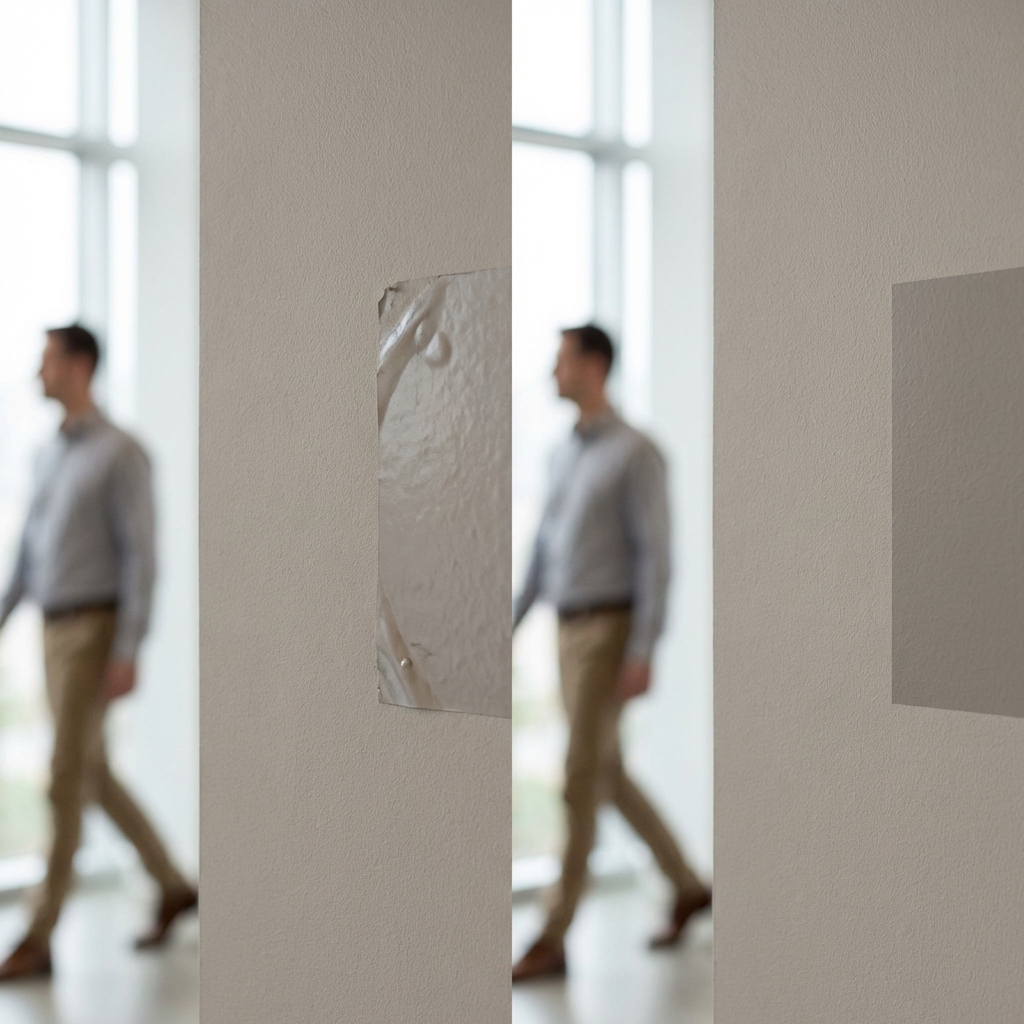
Image 2
Direct-to-wall is also lifecycle-efficient compared to vinyl wall covering alternatives. Fewer fabrication handoffs mean fewer errors and return visits. Seam-free outputs reduce snagging and edge failures in busy corridors, and paint-over-ready finishes simplify future tenant changes without demolition. For sustainable wall murals, skipping vinyl and adhesives cuts material waste and off-gassing while streamlining procurement.
EastCoast MuralPros designs every step around low disruption and schedule certainty. Typical installs complete in under five hours with on-site printing that removes shipping risk and fabrication bottlenecks. Their durable, cleanable surfaces handle high-traffic environments, while the paint-over-ready finish keeps future program changes simple. For multi-location rollouts, teams get consistent execution, and a subscription model enables planned refreshes that align with retail resets, semester breaks, or lease-up timelines.
The result is a faster, cleaner, and more predictable path from approved artwork to finished walls—ideal for facilities directors, procurement teams, and brand leaders who need performance, not punch lists.
Surface Compatibility and Aesthetic Integration Across Architectural Materials
Across mixed-material interiors, the practical differences in direct-to-wall printing vs vinyl show up fast. Printing directly onto the substrate eliminates seams, adhesives, and panel edges that can lift, bubble, or telegraph in high-traffic commercial wall graphics. The image becomes part of the architecture, preserving texture where desired while delivering crisp, photoreal detail at scale.
EastCoast MuralPros’ system is engineered for common commercial substrates after standard cleaning and light prep, enabling cohesive design language across an entire building or campus. Typical surfaces include:
Painted drywall (Level 4/5) in matte or eggshell finishes
CMU block and brick, primed or sealed to control dust and porosity
Sealed concrete and skim-coated partitions
Previously painted walls, including many low-VOC coatings
Wood doors, tables, and standees produced in-studio to match on-site wall treatments
Aesthetically, printing in place avoids the specular glare and edge shadows that can make vinyl reads feel like “stuck-on” panels. On textured masonry, ink follows the surface profile for an integrated, mural-like result, whereas vinyl often bridges grout lines and struggles to maintain adhesion. For brand walls, gradient fields and large-format photography remain seam-free around corners and reveals, which is difficult to achieve with rolled goods. Color-managed workflows keep palettes consistent across multiple wings, floors, and locations.
Functionally, durable office signage and wayfinding can be incorporated directly into the wall plane—zone colors, floor IDs, safety icons, and instructional graphics—reducing signage clutter and installation time. Surfaces remain cleanable for healthcare corridors, school hallways, and retail back-of-house areas, with paint-over-ready finishes when programs change. Because there are no adhesives or panels to remove, refresh cycles are faster and less disruptive for occupied buildings.
As a vinyl wall covering alternative, this approach also supports sustainable wall murals: less material waste, fewer shipments, and reduced replacement driven by edge failures. EastCoast MuralPros provides on-site, high-resolution output with consistent execution for multi-location rollouts, plus a subscription model for seasonal or strategic refreshes. Their full-campus solutions align brand, art, and wayfinding across diverse substrates—delivering high-traffic interior branding that feels built-in, not applied.
Maintenance and Lifecycle Costs: A Long-Term Performance Analysis
When facilities teams compare direct-to-wall printing vs vinyl, the biggest cost difference shows up after day one. Vinyl’s seams, adhesives, and panel alignment introduce failure points that drive callbacks and replacements. Seam-free, adhesive-free printing bonds imagery directly to the substrate, cutting out common maintenance events that inflate total cost of ownership.
Installation logistics also affect lifecycle spend. Vinyl typically requires intensive wall prep, larger crews, off-hours labor, and staging to avoid disrupting occupants—costs that repeat every time artwork is refreshed. EastCoast MuralPros prints on finished and unfinished surfaces in occupied buildings, with most projects completed in under five hours, reducing overtime, swing shifts, and schedule risk.
In high-traffic corridors, corners, and elevator lobbies, vinyl is prone to edge-lift, bubbling from humidity, and abrasion at seam lines. Each repair means service calls, visual inconsistencies, and often partial rewraps to match color and gloss. Direct-to-wall systems deliver a durable, cleanable surface that resists scuffing and eliminates seam-related failure modes common in commercial wall graphics.
Beyond wear, rebranding cycles drive costs. Removing vinyl can damage paint and drywall, require patching, and generate PVC waste and adhesive residue. Direct-to-wall graphics from EastCoast MuralPros are paint-over-ready, so wayfinding updates, seasonal campaigns, and durable office signage refreshes become a fast repaint-and-reprint operation—ideal for vinyl wall covering alternatives in high-traffic interior branding.
Key lifecycle cost drivers to evaluate:
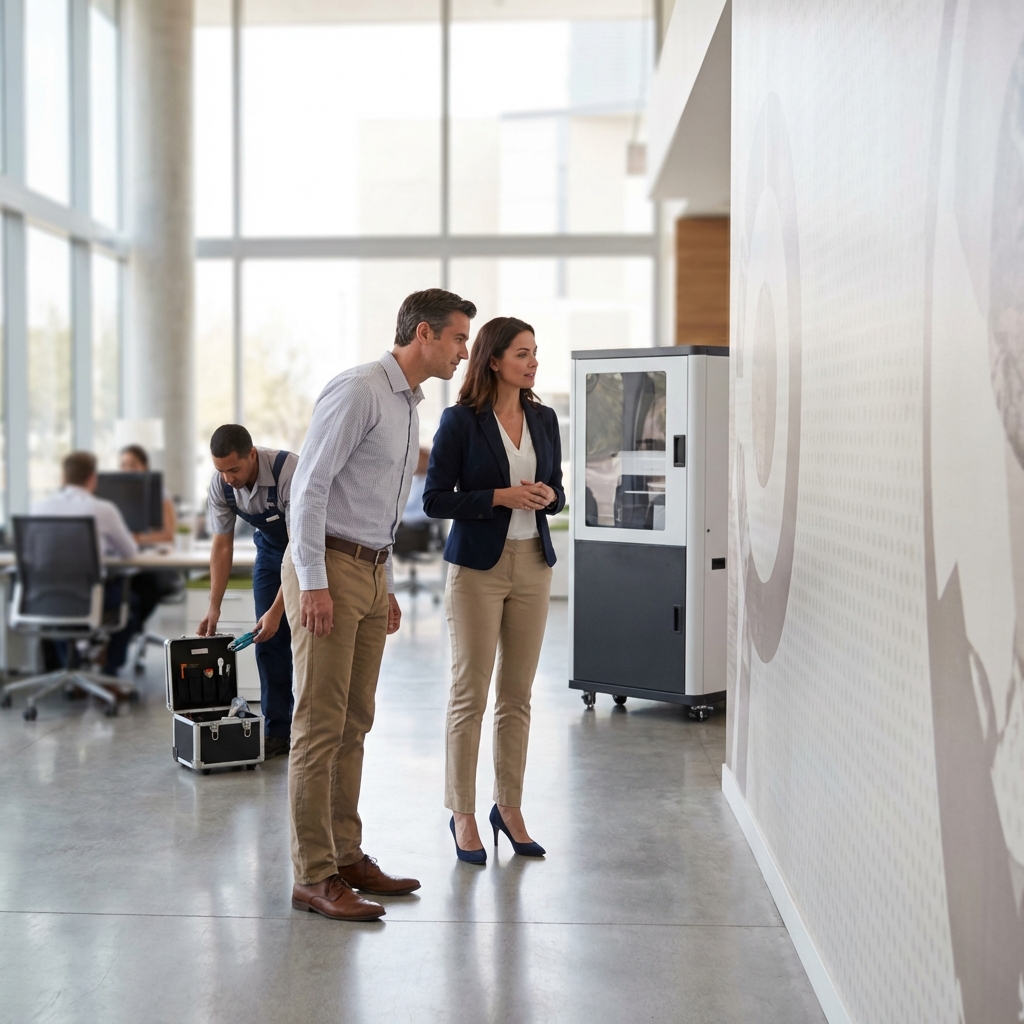
Image 3
Downtime and off-hours labor for install, repairs, and refreshes
Failure modes: seams, edge-lift, adhesive cleanup, substrate damage
Replacement frequency under cleaning and touch traffic
Consistency and waste from misprints, shipping damage, or panel mismatch
Surface restoration at end-of-lease or program change
Disposal, recycling limits, and sustainability targets for PVC-based materials
For multi-location rollouts, consistency is a hidden cost center. On-site printing removes shipping delays and panel variability, while color-managed workflows keep branding uniform across campuses and portfolios. That predictability supports procurement’s need for reliable, scalable solutions.
A hospital corridor illustrates the delta: vinyl often entails two night shifts, wall prep, and recurring edge repairs; a direct-to-wall rebrand can be printed after hours and turned over by morning, with no adhesive residue and minimal cleanup. The result is a lifecycle-efficient, sustainable wall murals strategy that reduces maintenance, shortens refresh cycles, and lowers total cost across years of use.
Sustainability Factors: Moving Beyond Adhesives and PVC Materials
In the direct-to-wall printing vs vinyl discussion, the sustainability gap is driven by materials and waste. Traditional vinyl wall coverings rely on PVC films, pressure-sensitive adhesives, laminates, and silicone-coated release liners—most of which are difficult to recycle and often end up in landfills. Adhesives can introduce VOCs during install, and heat-assisted application adds energy use. Add in protective packaging, freight for long rolls, and installation scraps, and the embodied impact increases before the first visitor ever sees the wall.
Direct-to-wall printing removes those inputs by imaging directly on painted or unfinished substrates, eliminating PVC, adhesives, liners, and panel systems. On-site production cuts freight, packaging, and the risk of reprints due to sizing or fabrication errors. Seam-free prints reduce failure points, so there’s less premature replacement in high-traffic corridors and lobbies. When it’s time to refresh, you paint over the surface rather than demolishing and landfilling spent graphics.
Consider a hospital corridor or university commons: vinyl typically demands primers, panel seams, and liner disposal across hundreds of square feet. Direct-to-wall printing delivers commercial wall graphics that install in hours without adding new material layers or disrupting daily operations. It also performs on brick, CMU, concrete, and drywall, avoiding backer panels that add cost and carbon.
Key lifecycle advantages over vinyl wall covering alternatives include:
Material inputs: No PVC film, no adhesive, no laminate, no release liner; far fewer consumables per project.
Installation: Low-VOC process with minimal odor, no heat-gun application, and drastically reduced jobsite waste.
Operations: Durable, cleanable surfaces suited to high-traffic interior branding; fewer seams mean fewer service calls.
End-of-life: Paint-over-ready finishes avoid landfill-bound skins and simplify tenant turnover or program changes.
EastCoast MuralPros brings these sustainability gains to scale with on-site, high-resolution printing and consistent execution across multi-location rollouts. Teams use the subscription model to update sustainable wall murals seasonally without recurring PVC waste, and integrate wayfinding or durable office signage directly onto walls to reduce plastic placards and hardware. For institutions seeking credible, lifecycle-efficient performance, this is a practical path to lower-impact interiors without sacrificing quality or speed.
Conclusion: Selecting the Optimal Branding Solution for Large-Scale Facilities
Choosing between direct-to-wall printing vs vinyl ultimately comes down to operational risk, lifecycle cost, and the experience you want in high-traffic spaces. Direct-to-wall delivers seamless, architectural-quality imagery that resists bubbling and edge-failure, cleans easily, and can be painted over when programs change. Vinyl introduces seams, adhesives, and shipping/fabrication variables that increase downtime and maintenance over time—especially across large campuses or multi-location portfolios.
In practice, the difference shows up on the schedule and the balance sheet. A hospital can refresh corridor wayfinding overnight with cleanable, antimicrobial-friendly surfaces and no adhesive off-gassing. A university can brand CMU and brick in a student union before orientation, achieving photoreal, sustainable wall murals without a construction footprint. Multi-tenant offices can deploy durable office signage and feature walls after hours on Friday and be tenant-ready Monday, then paint over for the next lease.
Use a simple decision checklist to select the right path:
Installation window: Can work be completed in hours, not days, with minimal disruption to occupied areas?
Surface compatibility: Drywall, CMU, concrete, brick—without skim-coats, panels, or primers that add cost.
Lifecycle performance: Seam-free durability, cleanability, and reduced replacement cycles vs recurring vinyl failures.
Brand fidelity: High-resolution, color-consistent output at architectural scale across multiple locations.
Wayfinding integration: Safety and instructional graphics embedded in the environment without signage clutter.
Sustainability: Adhesive-free process, less waste, and paint-over-ready finishes for future changes.
Risk profile: On-site printing that eliminates shipping delays and fabrication errors common to off-site graphics.
EastCoast MuralPros aligns to these criteria with next-gen direct-to-wall technology designed for commercial wall graphics and high-traffic interior branding. Their teams install most projects in under five hours, on finished and unfinished substrates, with consistent execution for national rollouts. Options like full-campus programs for schools and hospitals, a subscription model for seasonal refreshes, and in-studio printing for doors, tables, and standees make them a credible partner for vinyl wall covering alternatives.
The lowest-risk next step is a pilot: select a representative corridor or lobby, define cleaning protocols and metrics, and compare total cost of ownership over 12–24 months. When the pilot validates speed, image quality, and maintenance outcomes, scale standards across facilities. EastCoast MuralPros can support that process with site assessments, material testing, and rollout planning to ensure predictable results at scale.


