
Corporate Branding Through Space: Why the Office Is Now a Living Expression of the Brand
Introduction: Branding Has Moved Off the Wall—and Onto the Wall
Corporate branding is no longer confined to logos, websites, and marketing campaigns. Today, the physical workplace itself has become one of the most powerful brand touchpoints a company controls.
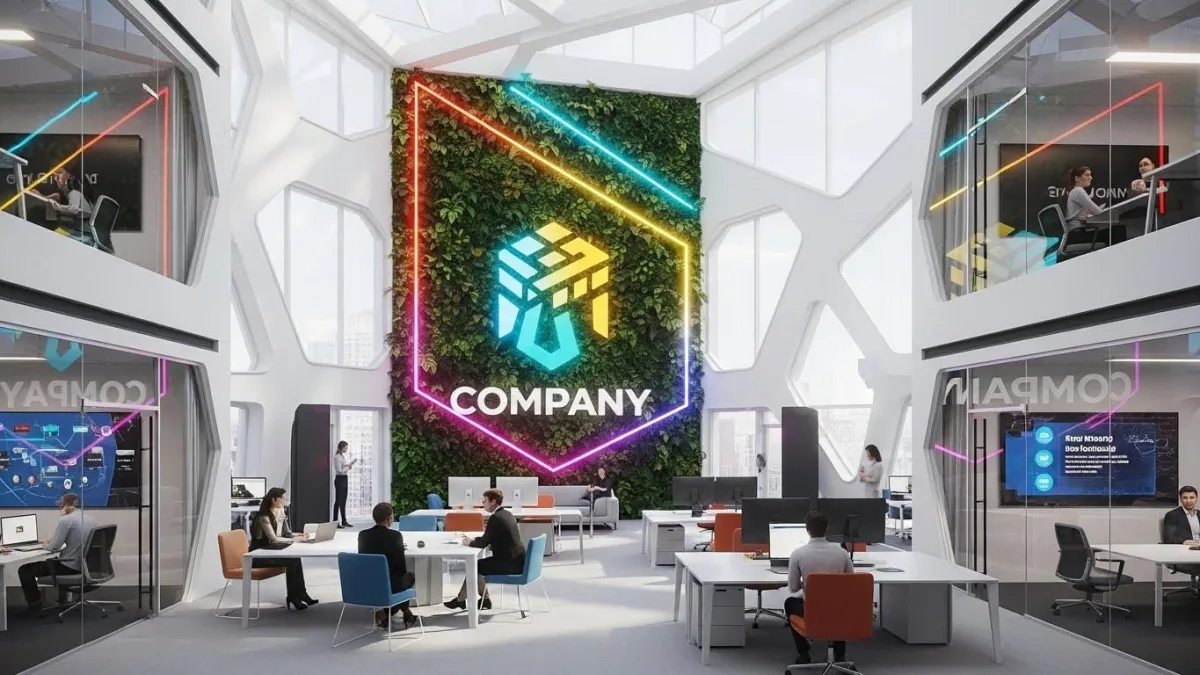
As hybrid work reshapes expectations, employees, clients, and recruits experience a company’s brand the moment they step into the office. Lobbies, corridors, conference rooms, and shared spaces now function as a three‑dimensional brand narrative—communicating values, culture, ambition, and identity without a single word being spoken.
In this new landscape, environmental graphics and high‑resolution wall printing are emerging as essential branding tools, allowing companies to transform space into story—quickly, sustainably, and at scale.

Why Physical Space Is Now a Core Branding Channel
Research consistently shows that physical environments influence perception, behavior, and emotional response.
Gensler, one of the world’s leading design firms, emphasizes that beauty and design quality are not superficial—they directly affect performance and engagement. In a recent article, Gensler notes:
“Beauty plays a crucial role in driving workplace performance … inspiring, motivating, and contributing to well‑being.”
This aligns with the broader concept of the “servicescape,” a well‑established framework in branding and marketing theory, which describes how physical environments act like packaging for a brand—shaping perception and behavior.
In other words: the office is no longer neutral. It is expressive.
Post‑COVID Expectations: Employees Want to Feel the Brand, Not Read It
Post‑pandemic workers return to the office with heightened visual sensitivity. After years of working from personalized home environments, people now expect offices to feel intentional, human, and emotionally resonant.
Gensler’s workplace research shows that many employees no longer want traditional corporate environments. Instead, they prefer creative, natural, or residential‑inspired spaces that align with how they want to live and work.
This shift means brand expression must move beyond slogans. Employees want to feel what a company stands for—through color, imagery, materiality, and atmosphere.
Office Branding Reinforces Culture, Belonging, and Engagement
Multiple workplace branding studies confirm that branded environments play a measurable role in employee engagement and satisfaction.
AlphaGraphics summarizes this clearly:
“Office branding gives visitors, whether employees or clients, an instant feel for what the company is about.”
Similarly, FMG highlights that effective office design should act as a living representation of brand identity:
“Each decision should reflect the brand’s core attributes… creating a space where employees and visitors intuitively understand the brand.”
Environmental graphics allow companies to reinforce values such as innovation, collaboration, sustainability, or community—not through posters, but through immersive spatial storytelling.
Environmental Graphics as a Branding Multiplier
Environmental graphics translate abstract brand values into physical experience. Rather than relying on framed art or vinyl decals, companies can now integrate branding seamlessly into architecture itself.
High‑resolution wall graphics can:
• Tell the company’s origin story or mission
• Visualize values and culture
• Celebrate people, projects, or impact
• Create aspirational, energizing environments
• Differentiate the office from competitors
This approach transforms corridors, lobbies, and meeting spaces into intentional brand moments instead of forgotten areas.
Why NextGen Wall Printing Unlocks Brand Expression at Scale
Traditional branding methods—custom millwork, signage programs, vinyl graphics—are expensive, slow, and difficult to scale.
NextGen wall printing changes that equation by printing directly onto existing wall surfaces with architectural‑grade precision.
Key advantages include:
• High‑resolution (300 dpi) detail suitable for photography and close viewing
• Seamless application with no vinyl or adhesives
• Eco‑friendly, low‑VOC UV‑cured inks
• Installations completed in hours, not weeks
• Zero demolition or construction waste
• Paint‑over removability for future rebrands
This allows companies to deploy sophisticated branding across entire offices—or multiple locations—without renovation‑level budgets.
Where Corporate Branding Through Walls Has the Most Impact
Organizations are using environmental graphics to elevate:
• Lobby and reception areas – first impressions that set brand tone
• Main corridors – turning movement paths into narrative experiences
• Conference rooms – reinforcing purpose and professionalism
• Collaboration spaces – energizing culture and creativity
• Quiet zones – expressing values through calm, biophilic imagery
• Client‑facing areas – aligning space with brand promise
These spaces shape daily experience far more than logos on a website.
Conclusion: The Office Is the Brand, Made Visible
In a hybrid world, companies cannot rely on physical presence alone to maintain culture and identity. When employees do come in, the environment must communicate clearly, emotionally, and authentically.
Environmental graphics and NextGen wall printing allow organizations to turn their offices into living brand expressions—spaces that inspire, connect, and reinforce who they are.
Brand is no longer just what a company says.
It’s what people feel the moment they walk through the door.

Contact Us
📍250 East Sandford Blvd, Studio G2
Mount Vernon, NY 10550
Mon-Sat 7am-9pm · Sun closed


