
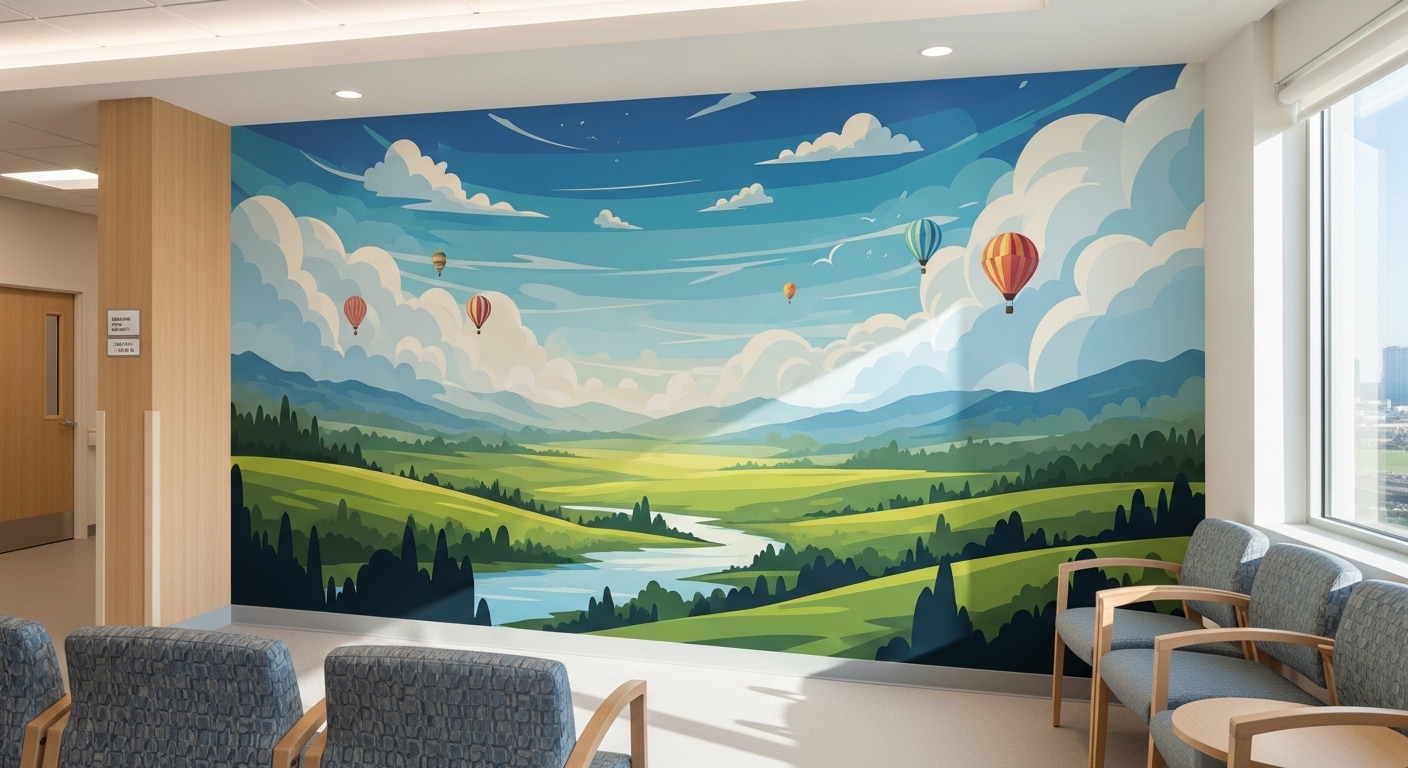
Healthcare Wall Mural Solutions: Durable Graphics for Patient-Centered Environments
Introduction: Why Healthcare Facilities Need Modern Wall Solutions
Healthcare organizations redesign interiors for reasons that go beyond aesthetics. They need walls that communicate clearly, calm anxious visitors, guide patients through complex corridors, and hold up to constant cleaning—without shutting down busy units or adding construction risk. In short, they need healthcare wall mural solutions that support patient-centered care while respecting the operational realities of clinical environments.
Medical campuses are also in continual flux. Clinics relocate, services expand, and programs refresh on fast timelines. Traditional wall coverings and signage kits rarely keep pace. Direct-to-wall printing offers a way to deliver high-quality medical facility wall graphics quickly, cleanly, and at scale—so hospitals can adapt faster and finish on schedule.
EastCoast MuralPros helps hospitals, outpatient centers, and long-term care facilities print photoreal, durable healthcare wall printing directly on finished or unfinished surfaces. By removing adhesives, vinyl, and long fabrication queues, teams gain speed and consistency without sacrificing design intent or durability. For an overview of clinical considerations and safety, see EastCoast MuralPros’ notes on wall printing in healthcare.
The Challenge of Traditional Wall Treatments in Medical Environments
Standard wall options—paint, vinyl wall coverings, wallpaper, and panel systems—struggle in healthcare for both performance and process reasons.
Vinyl and wallpaper often peel at seams, bubble near humid areas, and show wear at edges where carts and gurneys pass. Once an edge lifts, soils collect and the surface becomes harder to clean consistently.
Adhesives can off-gas during install and cure, and they complicate future refreshes. Removal is messy, time-consuming, and disruptive in areas where downtime is scarce.
Panels and applied signage can add visual clutter and protrusions to already tight corridors, making it harder to keep surfaces disinfected and free of snag points.
Hand-painted murals, while beautiful, require extended room closures and rely on individual artists; matching style and color across multiple locations becomes difficult and costly to maintain.
Global supply chains and custom fabrications introduce risk. Late shipments and reprints stall projects and push back clinical schedules.
Facilities and capital projects teams need a path that avoids these pitfalls: fewer seams to fail, no adhesives to remove, minimal installation noise and odor, and high repeatability across multiple walls, floors, or campuses. That’s the operational gap direct-to-wall printing fills.
Direct-to-Wall Printing Technology for Healthcare Settings
Direct-to-wall printing brings the print engine to the facility instead of shipping graphics to the site. Specialized equipment reproduces high-definition imagery, text, and wayfinding directly on the wall substrate—drywall, CMU, poured concrete, brick, primed surfaces, and more—without vinyl wraps or stick-on panels.
Key aspects of the approach:
On-site precision: Technicians align artwork to architectural features—door frames, soffits, millwork—so compositions feel integrated, not applied.
Seam-free results at architectural scale: Continuous imagery runs across long spans without panel joints, avoiding the weak points that typically fail first.
High resolution: Photoreal images and crisp typography maintain clarity even in large lobbies or atria where viewers stand at varying distances.
Paint-over-ready finish: When programs evolve, staff can prime and paint over the graphic rather than ripping down adhesives or re-skinning with new material.
Compatibility with clinical operations: Low-disruption setup, fast print cycles, and controlled work zones allow many installs to complete between shifts or overnight.
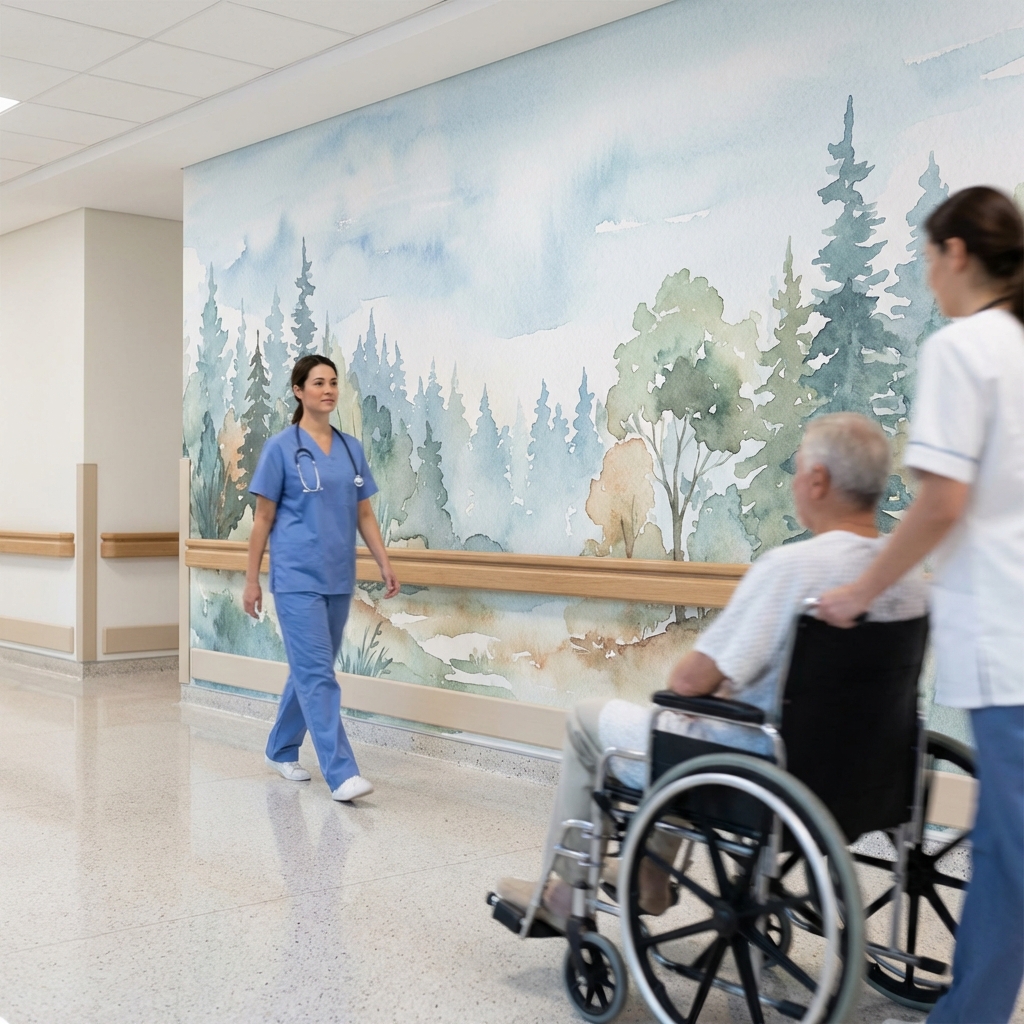
Illustration 1
EastCoast MuralPros complements on-site printing with in-studio capabilities for related items—doors, tables, cart panels, donor standees—so environmental graphics maintain a consistent look across surfaces. The company also supports digital artists and design teams with collaborative tools that scale a single creative direction across units, wings, and campuses.
Key Benefits for Hospitals and Medical Facilities
Hospitals evaluate new methods through the lenses of safety, schedule, quality, and cost. Purpose-built direct-to-wall printing addresses each priority with measurable operational advantages:
Speed and predictability: Typical installations finish in under five hours per zone, allowing work to slot between clinical activities with minimal rescheduling.
Fewer failure points: No seams to peel or edges to catch; the image resides on the wall surface rather than on a separate film.
Durable, cleanable surfaces: Finishes are specified for high-traffic environments, supporting routine cleaning protocols without rapid image degradation.
Integrated wayfinding and instruction: Department identifiers, zone coding, and safety notices can print continuously with murals, reducing sign clutter and improving comprehension.
Lifecycle efficiency: Faster updates, fewer removals, and paint-over refreshes lower total cost of ownership compared with vinyl wall coverings and wallpaper.
Full-campus capability: Consistent execution across many walls and multiple sites, with centralized asset management and color control for brand accuracy.
Minimal disruption: Quiet operation and small crews lessen corridor congestion and keep occupied buildings running.
Sustainability: Eliminates PVC films, adhesive waste, and crate-heavy shipments associated with traditional graphics—reducing material consumption and replacement cycles.
For a deeper dive into surface performance and longevity in busy corridors, see EastCoast MuralPros’ overview of direct-to-wall printing benefits.
Design Applications: Patient Experience, Wayfinding, and Branding
When healthcare graphics function as part of the architecture, they do more than decorate. They help people feel oriented, supported, and calmer—key goals for patient-centered environments. Direct-to-wall printing enables a broad mix of clinical environment murals and information layers that work together.
Patient experience and calming environments:
Biophilic scenes—local coastlines, forests, skies—can make waiting rooms, infusion bays, and pre-op areas more restorative without adding maintenance-heavy materials.
Pediatric units benefit from narrative murals that lead kids from check-in to exam rooms through friendly characters or color-coded “adventures.”
Behavioral health settings can use soothing, low-contrast patterns designed to minimize overstimulation while still providing warmth and dignity.
Wayfinding and clinical communication:
Color-coded “routes” printed directly on walls reinforce elevator bank letters, floor numbers, and unit identifiers, reducing reliance on hanging signs.
Zone markers at decision points—intersection corners, elevator lobbies, cross-corridors—combine photography, icons, and typography to improve navigation for non-native speakers.
Instructional graphics—hand hygiene reminders at entries, pre-procedure checklists at prep bays—become part of the environment instead of additional plaques.
Hospital interior branding and community storytelling:
Mission walls and donor recognition features can span long hallways seamlessly, balancing brand voice with human stories and outcomes.
Research highlights, nurse excellence programs, and quality accolades can be presented as durable features rather than temporary posters.
Staff corridors and back-of-house spaces can carry morale-building messages and wayfinding tied to operational flows.
Because images and typography print continuously, designers can treat walls as large-format canvases, adjusting scale and emphasis based on clinical function rather than being constrained by panel sizes.
Installation Speed and Minimal Disruption in Operating Facilities
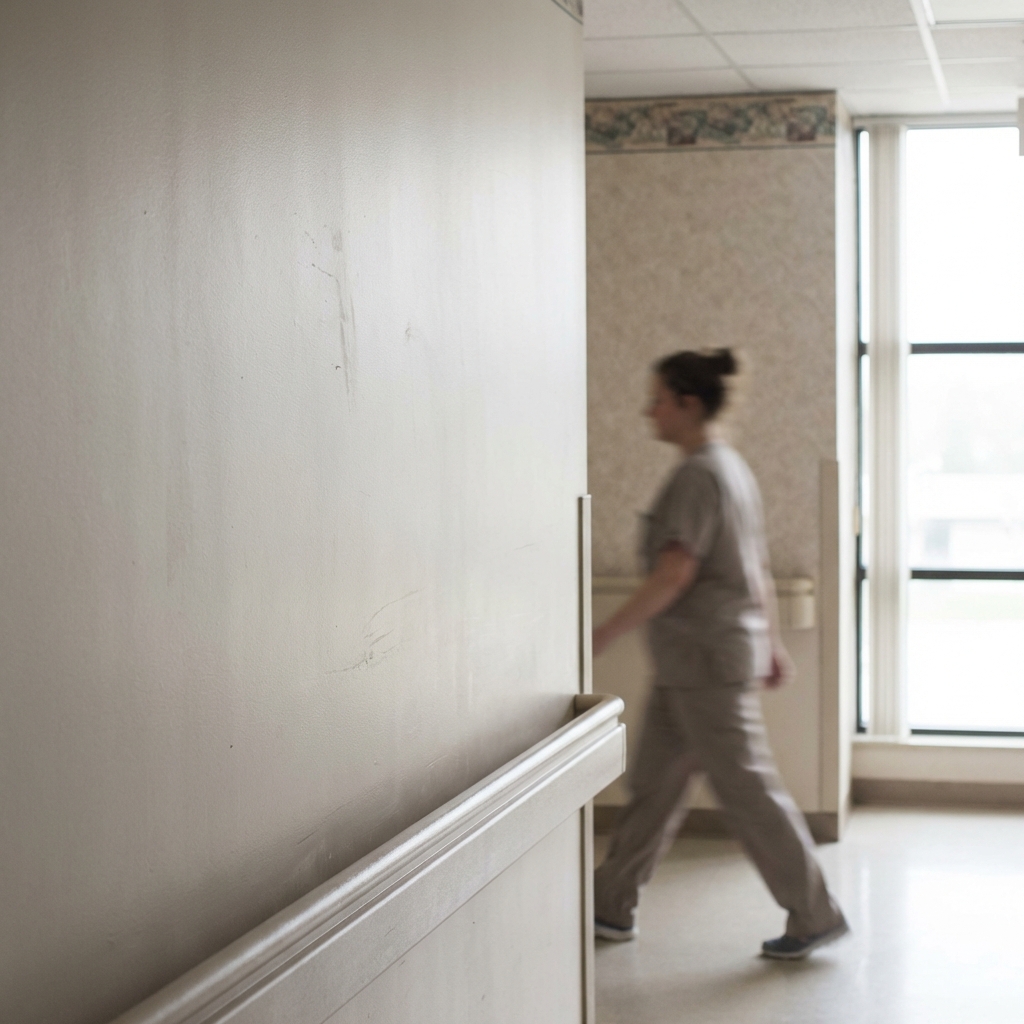
Illustration 2
The most elegant design is still a miss if it forces a clinic to close. Direct-to-wall printing was shaped for occupied buildings, where uptime drives every decision.
How projects move quickly with limited impact:
Flexible scheduling: Night, weekend, and between-shift windows are common. Most zones print in under five hours, often faster for single rooms or short runs.
Small-footprint crews: Technicians roll compact equipment through standard doorways, working within taped boundaries that keep egress paths clear.
No adhesives, fewer odors: Eliminating vinyl and wet adhesives reduces lingering smells and accelerates space re-occupancy after install.
Tight coordination with facilities: Infection prevention, EVS, and security are looped in early. Rooms are prepped, traffic is rerouted as needed, and work plans align with clinical schedules.
On-site validation: Color checks and alignment happen in place, avoiding re-fabrication cycles and the delays that come with shipping and reprints.
For sensitive areas—procedure prep corridors, imaging suites, family waiting spaces—this approach means visible improvements with minimal downtime. The result is a cleaner, calmer environment delivered on the facility’s timeline.
Durability and Cleanability for High-Traffic Clinical Spaces
Healthcare walls face abrasion from carts and wheelchairs, frequent cleaning, and constant touch near corners and handrails. That reality shapes both the materials and methods behind durable healthcare wall printing.
What matters in clinical durability:
Seam-free surfaces: Without joints or edges to lift, there are fewer points where soils accumulate or moisture intrudes.
Cleanable finishes: Surfaces are specified to support routine hospital cleaning practices and wipe-down schedules without rapid fading or smearing.
Impact resistance: Direct-to-substrate printing avoids the “drum effect” of applied films, reducing visible creases or punctures when bumped.
Consistent color and legibility: Diagnostic icons, directional arrows, and critical text remain crisp after repeated maintenance cycles.
Facilities teams also gain practical advantages over time. When a corridor needs a tune-up, there’s no adhesive residue to remove and no patchwork of seams to reconcile. If a program changes—say, a unit shifts from ortho to neuro—graphics can be selectively updated or painted over, keeping visual noise low and maintenance straightforward.
Cost Efficiency and Lifecycle Management in Healthcare
In health systems, the sticker price of a wall finish is less important than total cost of ownership. Procurement and capital projects teams look at construction duration, revisions, maintenance, and decommissioning. Direct-to-wall printing is designed to lower those lifecycle costs compared with vinyl wall coverings and wallpaper.
Where the savings accrue:
Faster turnovers: Projects complete in hours, not days, helping facilities hit opening dates and avoid extended closures or temporary wayfinding supplements.
Fewer replacements: Without seams or edges to fail, there’s less premature rework, and images keep their quality longer under normal use.
Reduced re-fabrication risk: Because graphics are produced on-site, there’s no waiting on reprints if dimensions shift or field conditions vary.
Lower decommission costs: Paint-over-ready finishes eliminate adhesive removal and disposal of large PVC panels when programs change.
Subscription and refresh models: For spaces that evolve seasonally or by service line, a scheduled refresh program spreads costs predictably while keeping environments current.
For multi-site systems, standardizing this approach magnifies savings. Central teams can specify a shared library of hospital interior branding and healthcare wayfinding graphics, then deploy them with local adjustments. The result: consistent patient experiences at lower operational cost.
Sustainability: A Greener Alternative to Vinyl and Wallpaper
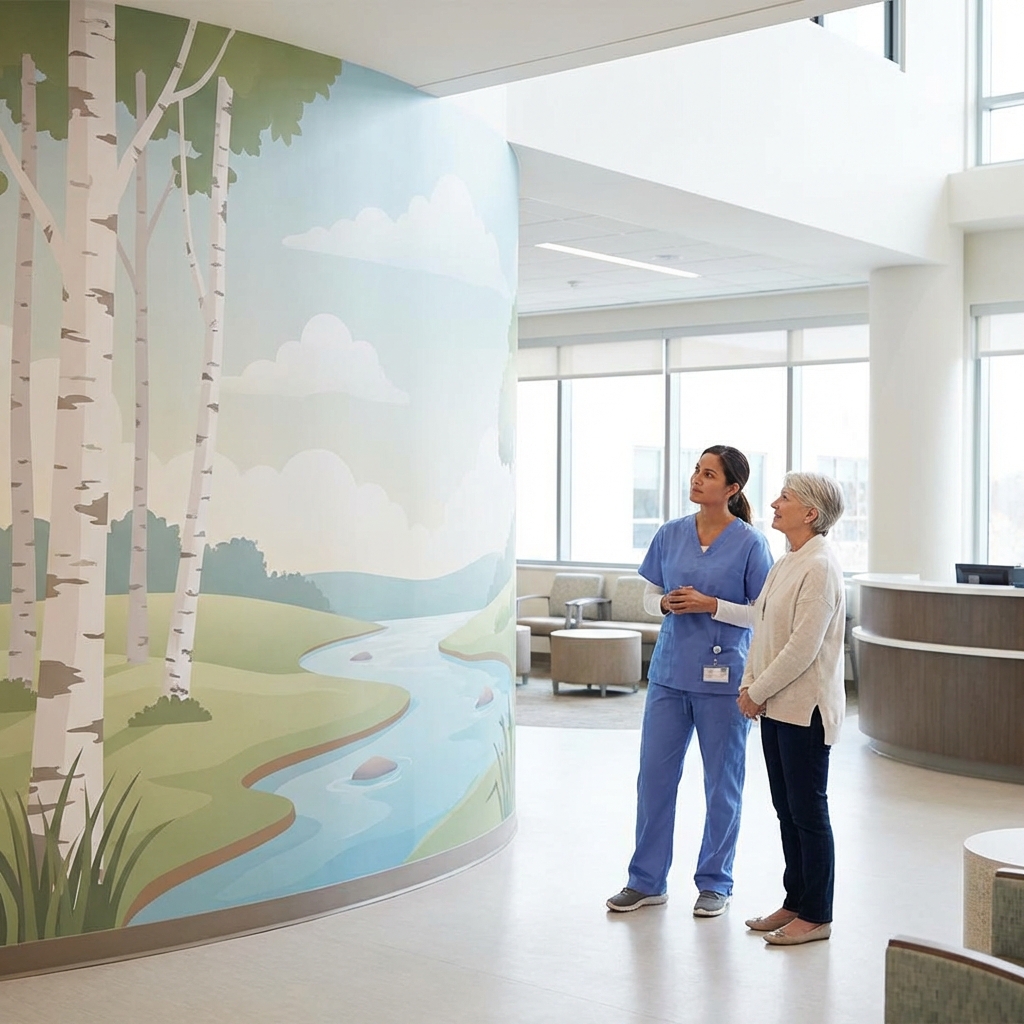
Illustration 3
Sustainability goals are now part of many healthcare RFPs, and wall finishes are a straightforward place to reduce material consumption. Direct-to-wall printing provides a performance-based alternative to vinyl wall coverings and wallpaper with a smaller materials footprint.
Considerations for greener interiors:
No PVC films or adhesive layers: Eliminating vinyl reduces plastic use and avoids the waste stream associated with removal and replacement cycles.
Less shipping and packaging: On-site production minimizes crates, tubes, and protective wraps that otherwise end up in landfill.
Longer useful life: Durable, cleanable finishes mean fewer full replacement events—and fewer raw materials over time.
Paint-over end-of-life: When a graphic’s purpose ends, facilities can prime and repaint instead of discarding large-format substrates.
For hospitals pursuing sustainability roadmaps, these changes add up. They also align with broader goals to reduce jobsite waste, limit volatile materials, and cut the embodied impacts of frequent refreshes—all without sacrificing image quality or durability.
Multi-Location Rollouts Across Hospital Systems
Large health systems need repeatability. A wayfinding color in one ambulatory center must match the same hue in a flagship hospital; a pediatric theme should carry seamlessly from satellite clinics to the main campus. EastCoast MuralPros was built to deliver consistent execution across multi-location and national rollouts.
How standardization meets local needs:
Centralized asset libraries: Artwork, color profiles, and typography standards live in a shared repository, ensuring brand accuracy no matter the site.
Field-calibrated color management: Printers are profiled to account for wall color and texture, producing consistent results across drywall, CMU, and concrete.
Template-driven wayfinding: Core patterns—zone bands, elevator cores, floor numerals—adapt to differing geometries while keeping a common logic.
Phased deployment: Rollouts can progress wing by wing or site by site, with mobile crews scheduled to minimize disruption to clinical operations.
Quality assurance at scale: Checklists, mockups, and pilot areas confirm legibility and durability before system-wide adoption.
For renovation programs, this approach reduces risk: one pilot corridor becomes the baseline; lessons learned inform subsequent phases. For new construction, direct-to-wall printing can be integrated late in the schedule to adapt to field changes without remaking panels or reordering materials.
Conclusion: Transforming Healthcare Interiors with Modern Wall Graphics
Healthcare wall mural solutions have evolved from decorative afterthoughts to strategic tools for patient experience, wayfinding, and brand cohesion. By printing directly to the wall, medical facility wall graphics become part of the architecture—seam-free, durable, cleanable, and ready to update as care models change.
For facilities teams, the gains are practical: faster installs, fewer disruptions, and better lifecycle economics than vinyl wall coverings and wallpaper. For designers and brand leaders, the canvas expands: photoreal imagery and precise typography at architectural scale, delivered with color fidelity across locations. For patients and staff, the environments feel more intuitive and calming—an everyday benefit created by thoughtful, high-performing surfaces.
EastCoast MuralPros partners with healthcare systems to deliver durable healthcare wall printing at the speed and scale clinical operations demand. If you are evaluating alternatives or planning a pilot, review clinical considerations for safety and implementation in the company’s notes on wall printing in healthcare. Then align design intent with operational certainty—so the next refresh elevates care, not just walls.


