Direct-to-Wall Printing vs. Vinyl Wraps for Campus Branding: Cost, Quality, and Durability Compared
Introduction: The Campus Branding Challenge and Solution Options
Direct-to-Wall Printing vs. Vinyl Wraps for Campus Branding: Cost, Quality, and Durability Compared
Campus branding has evolved beyond banners and plaques. Today’s colleges, universities, school districts, hospitals, and cultural institutions see walls as essential real estate for wayfinding, identity, donor recognition, safety communication, and student and visitor experience. The challenge is to create high-impact, durable visuals quickly, without disrupting operations or incurring repeated maintenance costs.
Facilities and procurement teams typically consider three pathways:
Printed vinyl wall coverings (including vinyl wraps and wallpaper)
Hand-painted murals
Direct-to-wall digital printing
Each option comes with trade-offs in schedule, lifecycle cost, maintenance, and sustainability. This article compares them head-to-head—with a particular focus on campus branding mural pricing, performance, and scalability—so institutional decision-makers can choose with confidence.
EastCoast MuralPros specializes in direct-to-wall printing for commercial and institutional environments, providing a performance-based alternative to vinyl and traditional murals. The analysis that follows reflects what facilities directors, capital projects teams, and brand leaders most often ask: How fast is installation? What does total cost look like over multiple refresh cycles? Will surfaces hold up in high-traffic corridors? And how reliably can we scale across dozens of walls and buildings?
Overview of Direct-to-Wall Printing Technology for Campus Murals
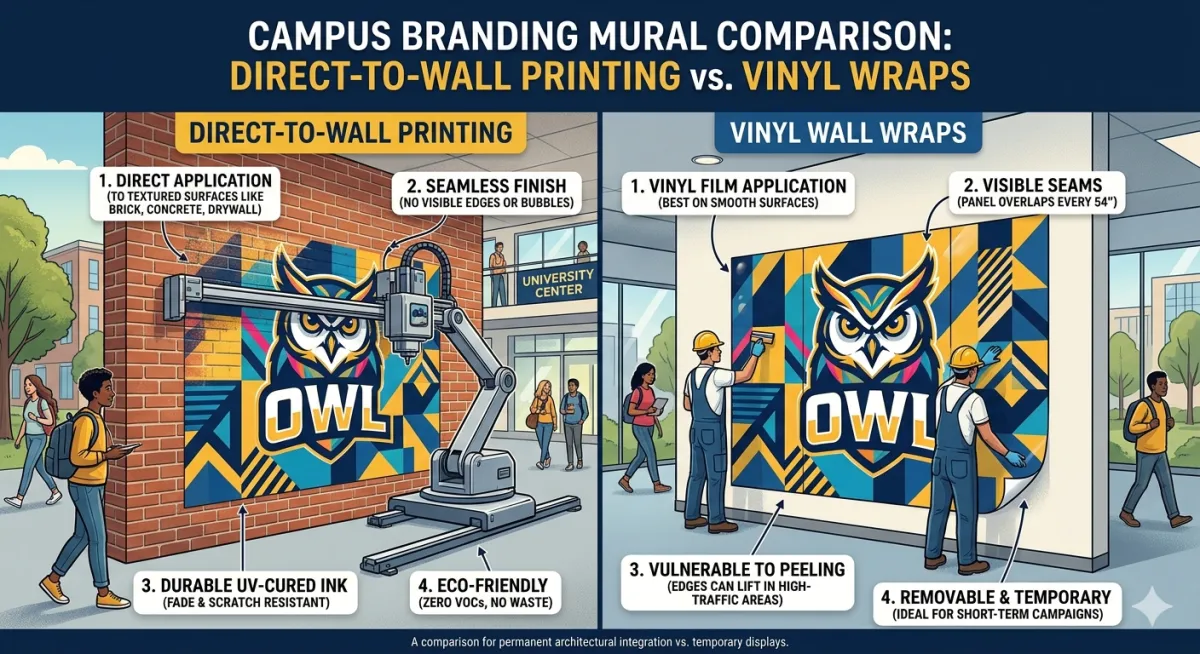
Direct-to-wall printing uses mobile, high-resolution print systems that travel to your site and image directly onto finished or unfinished substrates—no vinyl, no adhesives, no seams. Instead of mounting a printed film, your design is UV-cured onto the wall, producing crisp, photoreal results at architectural scale.
Key attributes for campuses and healthcare systems:
Broad surface compatibility: drywall, CMU, sealed concrete, brick, primed plaster, and other common campus substrates.
Seam-free, architectural integration: imagery becomes part of the wall, not an applied layer. Visuals read as intentionally designed, not retrofitted.
Rapid deployment: installations typically complete in under five hours per wall section, minimizing disruption for occupied buildings and clinical areas.
High durability and cleanability: cured inks produce a tough, scrubbable surface appropriate for high-traffic corridors, lobbies, cafeterias, and student life spaces.
Paint-over-ready: when programs, tenants, or campaigns change, walls can be primed and repainted without adhesive residue or panel removal.
On-site accuracy: by printing at the wall, teams eliminate shipping, panel seams, and fabrication errors common in panelized systems.
Integrated graphics: wayfinding, safety, and instructional content can be embedded into the architecture without adding signage clutter.
Extended applications: in-studio printing on doors, tables, and standees supports exhibitions, admissions outreach, and event programs.
Creative scale: collaborative tools help digital artists scale work across elevations and buildings while maintaining consistent output.
For institutions managing multi-building environments—from student unions to patient corridors—direct-to-wall printing provides a repeatable, schedule-certain method to modernize interiors without construction.
Overview of Vinyl Wrap and Traditional Mural Solutions
Vinyl wall coverings (often called wraps or printed wallpaper) are the most familiar route for large graphics. Designers output a mural to rolls or panels, which installers align and adhere to the wall with pressure-sensitive adhesive or paste.
What vinyl and wallpaper do well:
Broad vendor availability with standard CMYK printing.
A wide selection of film textures and finishes.
Familiar procurement pathways and spec language.
Removability on properly prepared and sealed walls.
Constraints facilities teams must plan for:
Seams and panel alignment: even skilled installers contend with visible seams—particularly over time, as edges lift or collect dirt.
Adhesive behavior: humidity swings and textured substrates (CMU, brick) can cause bubbling, tenting, or premature failure.
Production logistics: measurement, fabrication, shipping, and staging add time and risk of damage in transit.
Lifecycle costs: removal and wall repair are non-trivial, especially after multi-year adhesive dwell.
Traditional, hand-painted murals remain compelling for certain contexts—signature art pieces, donor walls, or cultural features. They offer painterly nuance and one-of-a-kind character. The trade-offs: longer installation windows, variable artist availability, and more challenging refresh cycles when content must change frequently or roll out consistently across many buildings.
Installation Speed and Downtime: Direct-to-Wall vs. Vinyl Comparison
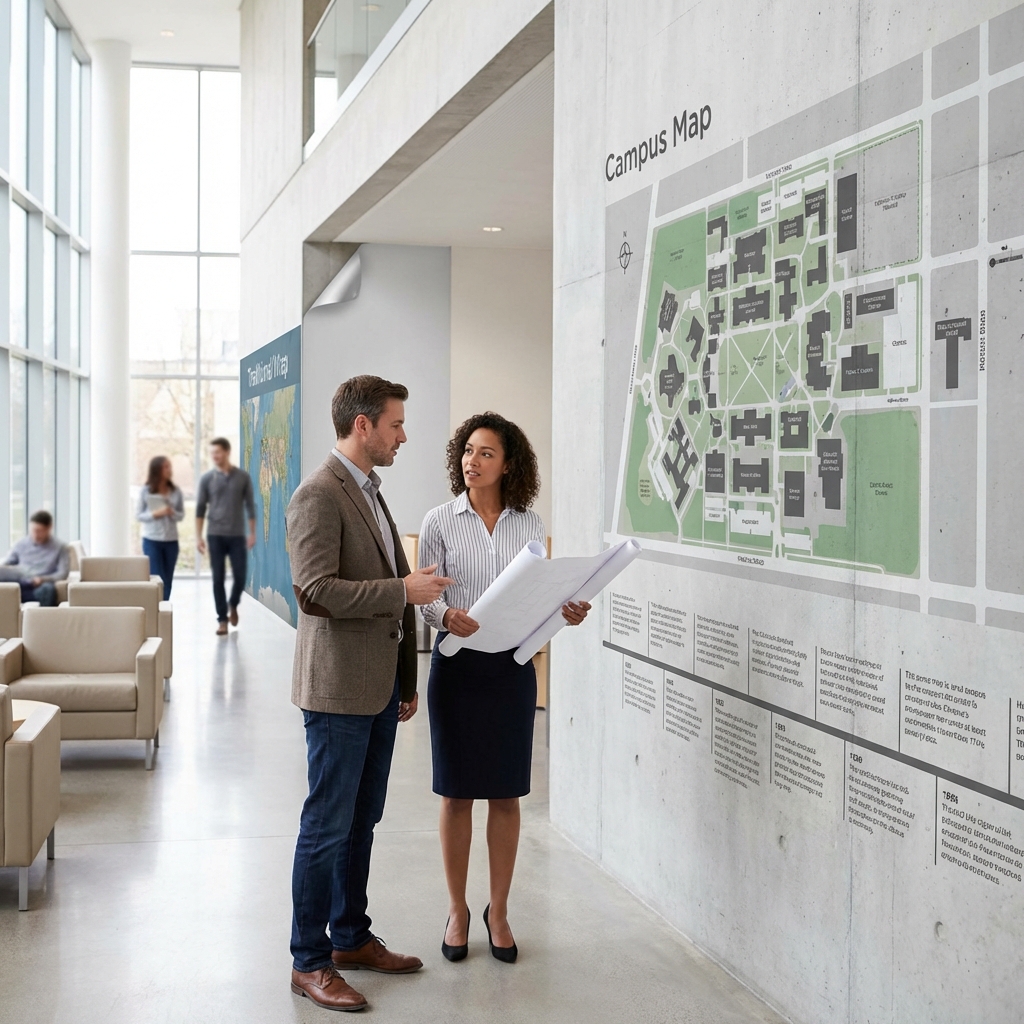
Illustration 1
Downtime is often the decisive factor in active schools and hospitals. A single closed corridor can ripple through clinical operations, class schedules, safety egress, and visitor experience.
Direct-to-wall printing advantages:
Compressed on-site timeline: typical wall sections complete in under five hours, allowing overnight or off-hour turnarounds with minimal staging.
Low disruption: no adhesives or pastes, no panel trimming, and minimal odor from LED-UV curing—well-suited to occupied facilities.
Fewer trades: no separate print vendor and installer handoff; a single field team manages alignment, color control, and execution.
Vinyl and wallpaper impacts:
Multi-step process: site survey, file tiling, fabrication, shipping, receiving, acclimation, and then installation—each step adds variance and potential delay.
Install staging: panel layout, seam alignment, trimming, and rolling out bubbles extend install windows and often require larger crew footprints.
Rework risk: a dinged roll or print defect may require reprinting and shipping, pushing schedules by days—not hours.
Hand-painted murals, while artistically rich, typically require multi-day barricades, scaffolding or lifts, and finishing coats for protection. For campuses with narrow install windows—semester breaks, off hours in surgical wings, or tight turnover between tenants—direct-to-wall printing streamlines the critical path.
Cost Analysis: Initial Investment and Lifecycle Pricing
Procurement teams rarely buy on initial cost alone; they buy on total cost over the service life. When comparing campus branding mural pricing, it helps to break costs into four buckets: design and preflight, production, installation, and end-of-life/refresh.
Direct-to-wall cost profile:
Initial investment: you’re paying for on-site printing time, operator expertise, and quality control. There is no separate spend for vinyl film, paste, or lamination, and no freight or crating.
Installation efficiency: field time is compact; fewer hours, fewer mobilizations, and smaller crews reduce soft costs like security escorts or after-hours premiums.
Lifecycle savings: because there’s no adhesive layer, refreshes avoid removal labor, landfill disposal, and patch/skim work from pulled paint or damaged drywall. Walls can be primed and repainted, or reprinted directly if suitable.
Change management: subscription models enable seasonal or strategic refreshes, smoothing cash flow and aligning visual updates with academic calendars or service line campaigns.
Vinyl and wallpaper cost profile:
Materials and fabrication: media, ink, lamination, color calibrations, and waste from test prints and panel trims raise the initial price. Shipping and crate handling add both time and cost.
Installation variability: complex conditions (columns, alcoves, switch plates) increase labor. Seams require meticulous alignment; rework is common.
Removal and repair: at refresh, expect costs for safe removal, adhesive residue mitigation, and surface repair—especially after longer dwell times. These end-of-life costs are frequently under-estimated at the outset.
Replacement frequency: edge lift, bubbling, and abrasion can trigger partial replacements that complicate budgets.
Hand-painted murals:
Upfront: artist fees, mobilization, and protection coats can be premium, but there’s no vinyl material line item.
Refresh: design changes typically require repainting or overpainting; matching original colors or extending a mural later can be laborious.
Practical budgeting guidance:
For multi-building programs, include removal/repair, reprint risk, schedule premiums, and disruption costs—not just the square-foot rate—when benchmarking commercial mural installation pricing.
Consider a 3–5 year horizon. Direct-to-wall’s avoided removal and reduced maintenance often narrow any initial price delta with vinyl wall coverings cost, especially for spaces that refresh content or branding periodically.
Pilot a priority corridor or high-traffic lobby to validate assumptions, then scale based on real field data.
Durability, Maintenance, and Longevity Across Both Methods
Institutional environments are unforgiving. Carts, backpacks, janitorial routines, and daily traffic accelerate wear. Long-term performance depends on surface integration, cleanability, and failure modes.
Direct-to-wall durability:
Integrated, seam-free surface: no edges to lift or seams to trap dirt. The cured print bonds to the substrate and stands up to regular cleaning in academic and clinical settings.
Cleanability: common neutral cleaners and non-abrasive disinfectants can be used per maintenance guidelines. This matters in healthcare, food service, labs, and athletics facilities where sanitation standards are strict.
Texture tolerance: printing on CMU or brick maintains character while adding legible graphics. Unlike films, there’s no tenting over mortar joints.
Vinyl and wallpaper maintenance:
Edge behavior: corners, door returns, and high-touch zones are susceptible to lift and abrasion. Once a seam starts to fail, dirt collects and aesthetics degrade quickly.
Moisture sensitivity: humidity shifts drive expansion and contraction. On textured or unsealed substrates, adhesion challenges multiply.
Cleaning caveats: aggressive chemical cleaners can dull surface films or soften adhesives, particularly on cheaper media.
Hand-painted longevity:
Surface hardness depends on paint systems and protective topcoats. Touch-ups are possible, though color matching and sheen consistency require skill.
Lifecycle tip:
If your space demands frequent disinfecting or endures heavy abrasion, prioritize a specification that emphasizes cleanability without seams. In many cases, direct-to-wall outlasts film-based systems in high-traffic environments with less visible aging.
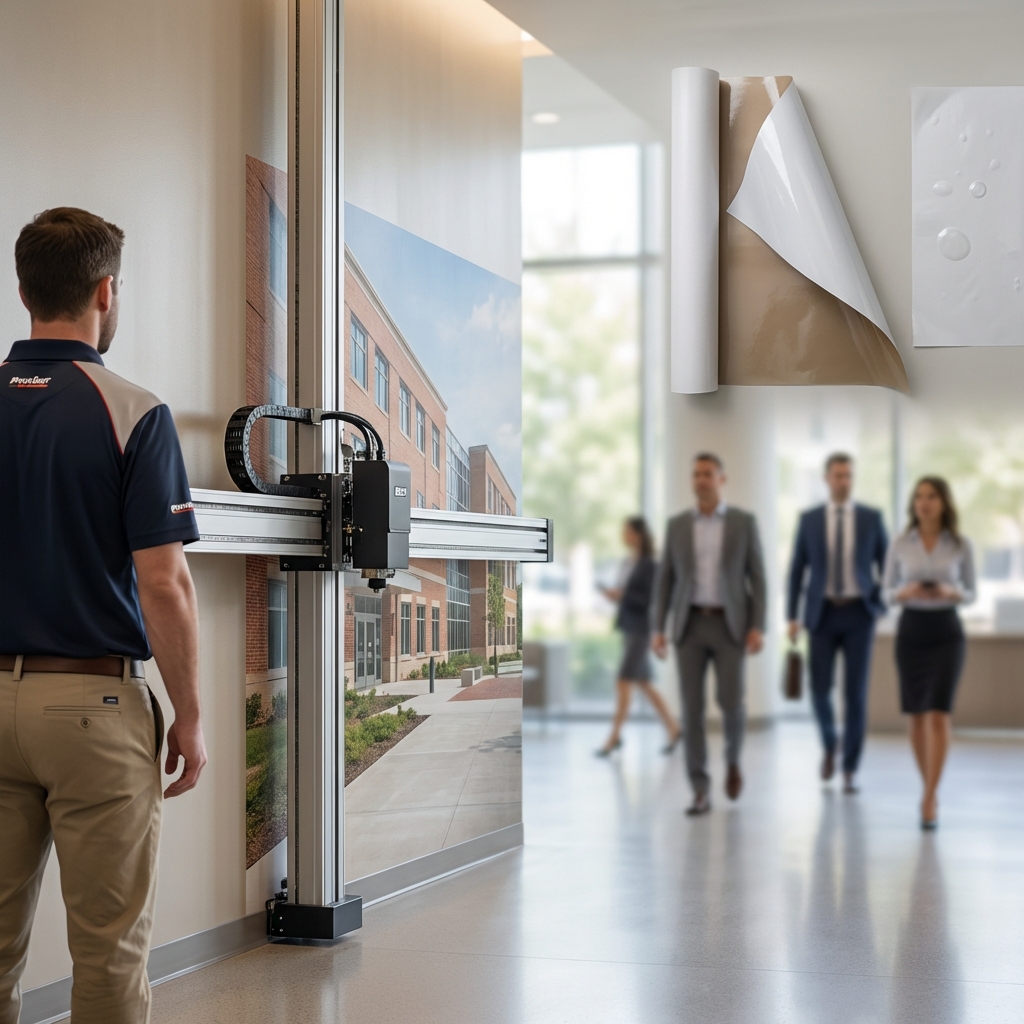
Illustration 2
Visual Quality and Design Flexibility Comparison
Visual quality is more than DPI; it’s how a graphic reads across distances, edges, lighting conditions, and irregular surfaces.
Direct-to-wall strengths:
Photoreal fidelity at architectural scale: crisp type, fine gradients, and image depth maintain integrity from lobby distance to arm’s length.
Architecture-first composition: because there are no seams, designers can run typography through reveals, wrap around column radii, or align imagery precisely to doors, casework, or handrails.
Surface expression: the substrate’s texture—CMU, brick, or plaster—becomes part of the visual story, ideal for galleries, museums, and historic buildings where material honesty matters.
Wayfinding integration: directional arrows, floor IDs, and safety markers can be integrated into the mural with consistent color and contrast, replacing a forest of plaques and stickers.
Vinyl and traditional alternatives:
Vinyl can achieve sharp output, but panel breaks interrupt large fields of tone and typography. On close inspection, seams and overlaps are visible—especially under raking light.
Specialty films offer gloss, matte, and tactile options, which can be desirable in select brand experiences. However, these are still subject to seam alignment.
Hand-painted murals provide artisanal value and texture but are limited by brush precision for micro-type and can vary across locations.
Creative workflow considerations:
Digital artists and campus design teams can iterate and scale files quickly with direct-to-wall pipelines. With teams like EastCoast MuralPros, collaborative tools support color management, proofing, and rollout consistency across buildings and cities.
For exhibitions or admissions events, in-studio printing on doors, tables, and standees can extend the brand system beyond walls while maintaining a unified look.
Scalability for Multi-Location Campus Rollouts
The hardest part of campus brand upgrades isn’t a single showcase wall—it’s coordinating dozens or hundreds of surfaces across buildings, floors, and sites.
Direct-to-wall scalability:
Consistent execution: the same on-site system images each surface, minimizing color drift between print batches and eliminating mismatched panel lots.
Fewer logistics links: no reliance on external print plants, freight windows, or separate installer networks reduces handoffs and error points.
Standardized kits: wayfinding glyph libraries, building-specific templates, and preflight protocols enable rapid deployment across properties, including national rollouts for multi-campus systems.
Install windows: crews can stage by zone and work off-hours to keep operations running. Low-disruption installation suits occupied schools and healthcare facilities.
Full-campus solutions: integrated programs for athletics halls, residence halls, STEM corridors, and patient education walls can be scheduled semester by semester or service line by service line.
Vinyl rollout realities:
Color consistency varies between print runs and shops. Weather delays or freight damage cause surprises on site.
Local installer availability drives schedule variance. Skill levels and techniques differ, producing inconsistent seams and trim lines across campuses.
Panel mapping and reprints consume PM time that could be focused on user experience and design intent.
For teams measured on reliability, predictability, and speed, on-site printing reduces the number of variables that derail multi-location branding.
Environmental Impact and Sustainability Considerations
Sustainability is now a procurement priority. Beyond optics, the waste and energy tied to fabrication, shipping, and replacement cycles carry real costs.
Direct-to-wall environmental profile:
No PVC film or laminate: avoiding vinyl reduces plastic use and landfill burden at end-of-life.
Minimal waste: there’s no panel trim or liner scrap. On-site printing eliminates re-crating and re-shipping for reprints.
Fewer replacements: seam-free surfaces age more gracefully, reducing lifecycle change-outs and associated emissions.
Paint-over-ready: at refresh, walls are primed and repainted—no adhesive removal, no torn gypsum, and far less debris.
Low-disruption install: LED-UV curing means fast set with minimal odor, well-suited to sensitive environments.
Vinyl and wallpaper footprint:
PVC films and laminates are difficult to recycle and typically landfilled. Adhesives add complexity to removal and disposal.
Each reprint and freight movement compounds embodied carbon. Frequent seam-related failures drive earlier-than-planned replacements.
If sustainability metrics are part of your capital plan or ESG reporting, direct-to-wall is a strong lever for reducing waste, freight miles, and replacement frequency. For a deeper dive on material waste and life-cycle outcomes, see this analysis of direct-to-wall printing vs vinyl.
Pros and Cons of Direct-to-Wall Printing for Institutional Use

Illustration 3
Pros:
Seam-free, architectural integration with photoreal clarity at scale.
Fast, low-disruption installs in occupied buildings; typical walls complete in under five hours.
Eliminates vinyl, adhesives, shipping, and panel rework risks.
Durable, cleanable surfaces designed for high-traffic corridors and clinical areas.
Broad substrate compatibility: drywall, CMU, concrete, brick.
Paint-over-ready for future program or tenant changes.
Scales reliably across campuses; consistent execution reduces PM overhead.
Enables integrated wayfinding and safety graphics without signage clutter.
Lifecycle-efficient with reduced replacement and maintenance cycles.
Supports digital artists’ workflows; in-studio printing extends brand systems to doors, tables, and standees.
Cons:
Requires appropriate surface prep and access; extreme wall defects should be repaired before printing.
Color-critical brand matches may require on-site test patches to account for substrate color and texture.
Not a fit for heavily delaminating paint layers or friable masonry without remediation.
Pros and Cons of Vinyl and Traditional Alternatives
Vinyl and wallpaper pros:
Ubiquitous vendors and familiar spec language for procurement.
Variety of film textures and finishes.
Can be appropriate for short-term installs on smooth, sealed walls.
Vinyl and wallpaper cons:
Seams and edges are failure points; visible interruptions degrade visuals over time.
Adhesive performance varies with humidity, texture, and cleaning practices.
Longer lead times with more supply-chain risk (fabrication, freight, damage).
Higher end-of-life costs for removal and wall repair; landfill waste from PVC and liners.
Color drift between batches complicates multi-location uniformity.
Hand-painted mural pros:
Unique, artisan quality and texture.
Strong fit for feature walls, donor recognition, or cultural storytelling.
Hand-painted mural cons:
Longer installation windows with greater operational disruption.
Variability between locations; harder to scale for brand uniformity.
Refresh cycles are time-consuming and can be costly.
Recommendations: Choosing the Right Solution for Your Campus
Start with your operational priorities, not just aesthetics. When evaluating direct-to-wall printing vs vinyl or hand-painted options, use a decision lens that reflects the realities of facilities, procurement, and user experience.
When direct-to-wall is the best fit:
You need durable wall graphics for schools, hospitals, or research facilities with minimal downtime.
Seam-free visuals and integrated wayfinding are essential to clean, modern interiors.
You anticipate periodic refreshes—new athletics campaigns, donor updates, program changes—and want paint-over-ready surfaces.
Multi-location consistency matters across buildings, districts, or health system sites.
Sustainability goals call for reducing PVC use, shipping, and replacement waste.
When vinyl/wallpaper may suffice:
Surfaces are uniformly smooth and sealed, the campaign is short-term, and seam visibility is acceptable.
Budget is strictly constrained to initial spend with no planned refresh within the service life.
Specialty film textures are a must for a targeted brand scene.
When hand-painted murals shine:
A single, signature wall warrants artisanal expression and longer install windows are acceptable.
The goal is cultural storytelling rather than systemic wayfinding or brand standardization.
Procurement steps to de-risk your program:
Pilot and measure: select a representative corridor or lobby, run a direct-to-wall pilot, and log install time, disruption, and cleaning results.
Model full lifecycle: include removal, wall repair, reprint risk, schedule premiums, and disruption when comparing commercial mural installation pricing.
Validate substrates: audit wall conditions across buildings—CMU, drywall, brick—and prioritize remedial prep where needed.
Standardize assets: build a kit-of-parts for typography, arrows, pictograms, and room IDs that scales across departments or campuses.
Schedule for operations: sequence work by semester breaks, clinic schedules, or tenant turns; leverage overnight windows to avoid closures.
EastCoast MuralPros partners with facilities directors, architects, and brand teams to deliver campus-wide, performance-based institutional branding solutions. The company’s direct-to-wall platform offers high-resolution, adhesive-free printing, low-disruption installations, seam-free graphics, and consistent execution across multi-location rollouts. For a strategic perspective on how campuses are modernizing with this approach, explore the future of campus branding.
Bottom line: If you’re benchmarking campus branding mural pricing, evaluate total cost and performance over multiple refresh cycles—not just the square-foot rate. In environments that demand reliability, speed, and design-forward results, direct-to-wall printing delivers a durable, lifecycle-efficient alternative to vinyl wall coverings and wallpaper, with the scalability and sustainability today’s institutions expect.


