
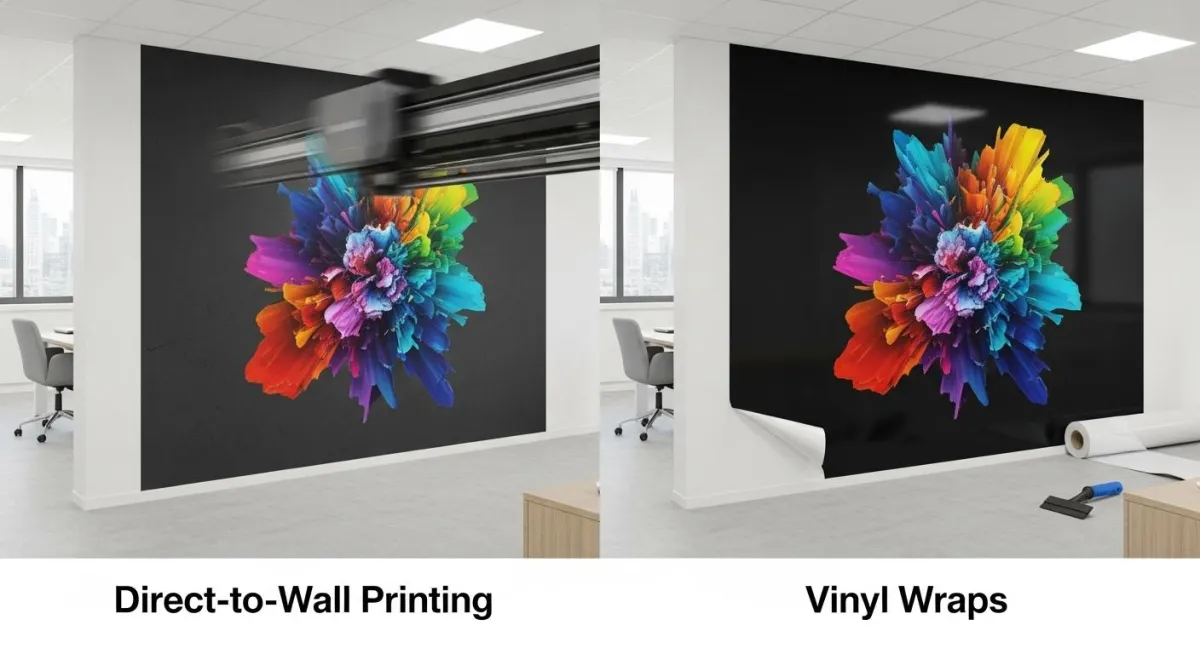
Comparing Direct-to-Wall Printing and Vinyl Wraps for Large-Scale Corporate Digital Art Installations
Introduction: The Evolution of Large-Scale Digital Art in Corporate Environments
Over the past decade, large enterprises have shifted from framed art and one-off murals to immersive, data-driven installations that can scale across portfolios. That evolution is now defined by direct-to-wall printing vs vinyl wraps—two very different paths to achieving high resolution architectural murals at speed. As teams demand seamless wall printing technology that looks integrated, durable, and easy to refresh, the technical choices matter more than ever.
Vinyl wraps brought color quickly, but seams, bubbling, adhesive failure, and glare often erode the effect—especially in high-traffic corridors, humid clinics, or sunlit lobbies. Removal can damage substrates and disrupt operations, and shipping large panels introduces delays and fit errors. For facilities, procurement, and brand teams, those risks complicate otherwise straightforward digital art wall installation plans.
Direct-to-wall printing changes the playbook by delivering:
Photoreal fidelity at architectural scale with crisp edges and smooth gradients
Durable, cleanable finishes that stand up to daily wear
No vinyl or adhesives, so substrates remain paint-over-ready for future changes
Fast, low-disruption installs—often completed in under five hours
On-site execution that eliminates shipping delays and fabrication mismatches
Compatibility with drywall, CMU, concrete, and brick for true edge-to-edge coverage
Consider practical applications: a headquarters lobby that needs a panoramic, brand-forward skyline without tiled seams; a hospital wing that layers wayfinding and safety cues directly on walls to reduce signage clutter; a university that refreshes residence halls seasonally across campuses. EastCoast MuralPros supports these scenarios with consistent, multi-location rollout discipline, subscription refresh programs, and even in-studio printing for doors, tables, and standees to extend a campaign beyond walls.
Sustainability is equally central. Adhesive-free printing reduces PVC, waste, and replacement cycles—an immediate advantage for teams pursuing sustainable interior wall graphics. For commercial wall branding solutions that must balance speed, quality, and lifecycle performance, EastCoast MuralPros offers a predictable, facilities-friendly path—setting the stage for a clear comparison of direct-to-wall printing vs vinyl wraps across cost, durability, and experience.
Overview of Traditional Vinyl Wall Wraps and Adhesive Graphics
Traditional vinyl wall wraps and adhesive graphics are printed films (often PVC or polyester) that are laminated for durability and tiled across walls in panels. Installers align seams, squeegee down pressure-sensitive adhesives, and heat-set edges to conform around outlets, corners, and reveals. The approach performs best on smooth, painted drywall and relies heavily on surface prep, ambient conditions, and long-term adhesive stability.
Constraints typically show up as scale and complexity increase. Rough or porous substrates like CMU block, brick, and unfinished concrete challenge adhesion and make seams more conspicuous. Curved lobbies, long hospital corridors, and stair towers require extensive panelization and precision to avoid visual stepping or panel drift. Removal can pull paint or leave residue, extending downtime between tenants or phases.
Common risks and lifecycle considerations with adhesive graphics include:
Visible seams at panel joints, especially across long runs and curved walls
Edge lift in high-traffic or humidity-prone zones; bubbles and shrinkage over time
Cleaning chemicals dulling laminates or discoloring edges in healthcare and education
Substrate damage or adhesive residue during removal
Off-site fabrication and shipping that introduce schedule risk and reprint delays
Sustainability concerns: PVC/plasticizer content and limited recyclability leading to landfill waste
Vinyl still has a place for short-term promotions, pop-ups, glass partitions, or small-format wayfinding labels. But for a digital art wall installation at architectural scale—think museum galleries, patient corridors, or multi-floor school stairwells—its seams, maintenance, and logistics can undermine the design intent. Teams evaluating commercial wall branding solutions increasingly weigh these tradeoffs alongside performance and lifecycle costs.
In the context of direct-to-wall printing vs vinyl wraps, EastCoast MuralPros offers a seam-free, on-site alternative that eliminates adhesives and panels. Their seamless wall printing technology delivers high-resolution architectural murals on drywall, CMU, concrete, and brick, installs fast with low disruption, and leaves paint-over-ready finishes for future change. For organizations using the office as a brand touchpoint, see how they approach corporate branding through space while advancing more sustainable interior wall graphics.
Overview of Direct-to-Wall Printing Technology for Digital Artists
Direct-to-wall printing brings the digital canvas onto architecture itself, producing high resolution architectural murals without adhesives or panel seams. Unlike vinyl wraps that require fabrication, shipping, and on-site panel alignment, the artwork is printed directly onto the prepared surface in place. For digital artists, that means smoother gradients, crisp micro-detail, and a true edge-to-edge look that reads as part of the building—crucial in the direct-to-wall printing vs vinyl wraps conversation.
The workflow is built for digital art wall installation at scale. Vector files render infinitely clean; raster imagery is typically optimized at 100–150 ppi at final size, with smart upscaling where needed. A color-managed process with calibrated devices and on-wall test swatches dials in brand colors and photographic fidelity under actual lighting. Because the output is continuous, there’s no tiling math, panel overlaps, or seam mapping around doors, corners, and reveals.
Key capabilities that matter to creative and facilities teams:
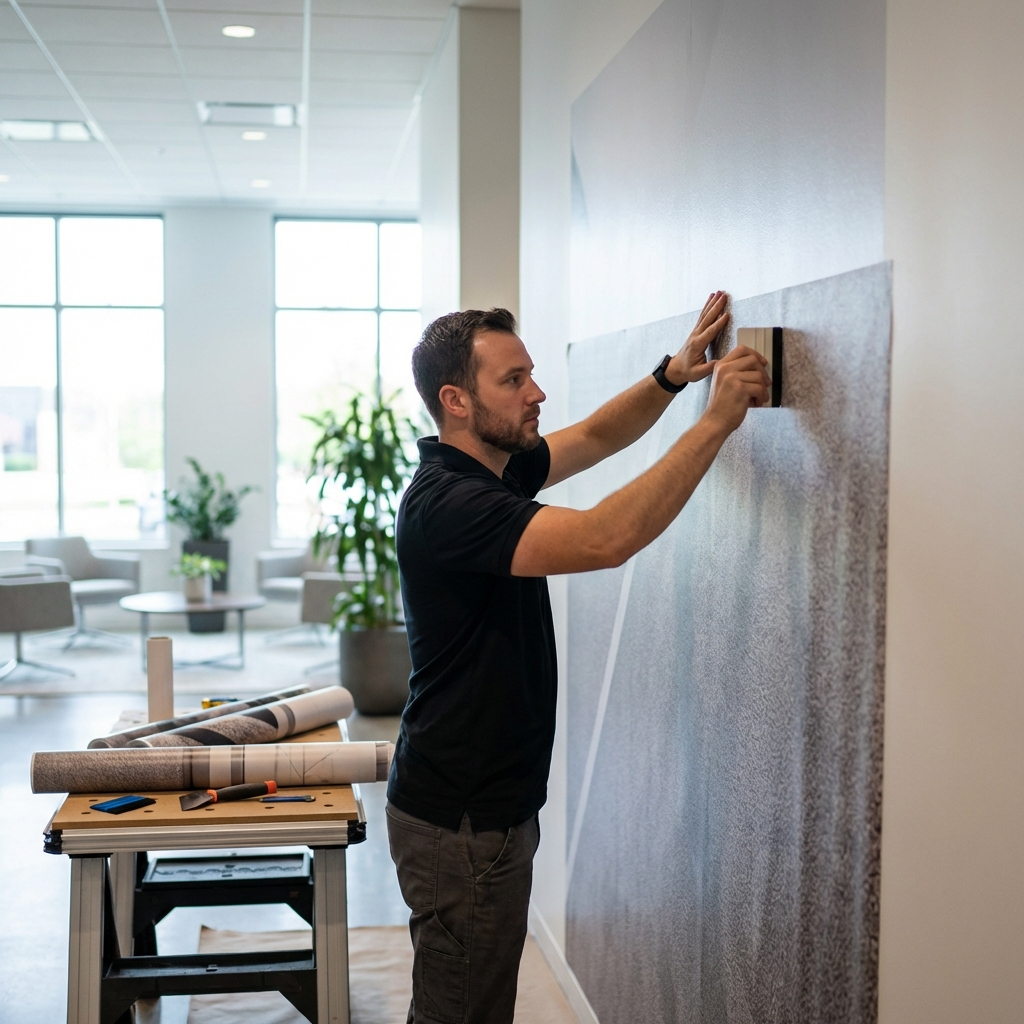
Image 2
Seamless wall printing technology removes panel lines, bubbles, and edge lift common with vinyl.
Installs often complete in under five hours, minimizing disruption in occupied buildings.
Compatible with finished and unfinished surfaces, including drywall, CMU, concrete, and brick.
Durable, cleanable finishes hold up in high-traffic areas and are paint-over-ready for future changes.
Sustainable interior wall graphics with no PVC, adhesives, or backing waste; reduced shipping and rework.
Integrated wayfinding, safety, and instructional graphics without signage clutter.
Consistent execution across multi-location and national rollouts for commercial wall branding solutions.
In practice, a 60-foot lobby data visualization can flow uninterrupted across curves and columns, or a pediatric wing can blend calming illustration with color-coded wayfinding. EastCoast MuralPros delivers these outcomes with on-site printing that eliminates shipping delays and fabrication errors, plus collaborative tools that help digital artists scale concepts across campuses. Their subscription options support seasonal content refreshes, while in-studio printing for doors, tables, and standees complements large-format walls for a cohesive program.
Technical Comparison: Image Resolution, Color Fidelity, and Architectural Integration
When evaluating direct-to-wall printing vs vinyl wraps for a digital art wall installation, start with how detail renders at scale. Modern direct-to-wall systems jet micro-droplets directly onto the substrate at 600–1000+ dpi, producing high resolution architectural murals without panel seams that interrupt lines or gradients. Vinyl can be printed at comparable device resolution, but panel widths (typically 48–60 inches) force tiling; even perfect alignments leave micro-seams that soften detail, trap dust, and create visible band breaks under grazing light.
Color fidelity is governed by ink set, curing, substrate reflectance, and calibration. Direct-to-wall UV-curable ink typically cures to a matte-to-satin, low-glare finish that keeps blacks dense and brand colors consistent under mixed lighting—important for lobbies, corridors, and galleries. EastCoast MuralPros uses color-managed workflows and on-site test swatches to match Pantone targets and maintain smooth gradients in complex digital art; vinyl systems often rely on overlaminates whose sheen (matte, satin, gloss) can shift perceived color and introduce glare in glassy environments.
Because imagery is printed directly to drywall, CMU, concrete, or brick, the graphic reads as part of the architecture. Curves, reveals, return air grilles, and door frames are navigated in a single pass, enabling seamless wall printing technology and integrated wayfinding without the edge build-up of films. Vinyl wraps require extensive surface prep and primers on porous substrates and can telegraph or tent at edges, especially across expansion joints or heavy texture.
Operationally, direct-to-wall excels in occupied buildings: no adhesives, minimal disruption, and most installations complete in under five hours with no shipping or panel reprints. The result is a durable, cleanable surface that’s paint-over-ready for future tenant changes—an advantage for commercial wall branding solutions and sustainable interior wall graphics strategies. For a 120-foot hospital corridor, for example, EastCoast MuralPros can produce a continuous photoreal mural with embedded wayfinding icons in a single mobilization; the same scope in vinyl would require dozens of panels, seam mapping, and laminate curing time, increasing risk, schedule, and glare.
Operational Comparison: Durability, Maintenance, and Lifecycle Costs
When evaluating direct-to-wall printing vs vinyl wraps for durability, think about how each system lives with the building. Vinyl relies on seams and adhesives that can lift at edges, bubble with temperature swings, and scuff in high-traffic corridors. Seamless wall printing technology bonds imagery directly to the surface, producing high-resolution architectural murals without seams that invite failure. It also performs consistently across finished and unfinished substrates—drywall, CMU, concrete, and brick—reducing weak points that typically show up first in vinyl.
Maintenance is simpler when graphics are integrated into the wall. Cleanable finishes allow custodial teams to wipe down digital art wall installation surfaces with standard protocols, while vinyl often needs specialty cleaners to avoid dulling or delamination. If messaging changes, paint-over-ready prints make refreshes straightforward; compare that to vinyl where removal can damage paint and require wall repair. For wayfinding or safety updates, on-site reprints can update only the affected zones instead of replacing entire panels.
Lifecycle costs diverge further at scale. Key operational line items include:
Downtime and labor: Direct-to-wall installs typically complete in under five hours per area, minimizing closures and security escorts.
Replacement cycles: No adhesives mean fewer early failures, extending intervals between refreshes.
Removal and disposal: Paint-over beats adhesive abatement and landfill-bound vinyl.
Logistics risk: On-site printing eliminates shipping delays and panel-to-panel color drift, common pain points in multi-panel vinyl.
Consistency: Integrated workflows ensure uniform results across multi-location commercial wall branding solutions.
For a hospital corridor or a corporate campus art program, EastCoast MuralPros pairs durable, cleanable finishes with on-site execution to control schedule and quality. Their approach supports subscription-based seasonal refreshes, integrates wayfinding without signage clutter, and delivers sustainable interior wall graphics that meet facilities’ performance criteria. The result is photoreal, high-resolution imagery that reads as architecture—not an overlay—making direct-to-wall printing a lower-risk, lower-lifecycle-cost alternative to vinyl wraps for large-scale corporate installations.
Sustainability and Environmental Impact: Adhesives vs. Direct Application
Evaluating direct-to-wall printing vs vinyl wraps through a sustainability lens comes down to materials, waste, and lifecycle. Vinyl wraps introduce PVC film, pressure-sensitive adhesives, liners, and trimmings—most of which end up in the landfill and can shed microplastics over time. Direct application eliminates the plastic substrate and adhesive layer entirely, printing high-resolution imagery straight onto the architectural surface for a leaner material footprint and fewer failure points.
Indoor air quality and disruption matter in any digital art wall installation. Vinyl systems often require primers, heat, and aggressive adhesives that can introduce odors and extended downtime. Modern direct-to-wall systems use low-odor, fast-curing inks and minimal masking, enabling work in occupied buildings like hospitals and schools without disrupting operations. The result is a cleaner process that supports sustainable interior wall graphics without sacrificing speed.
Lifecycle performance is where direct printing compounds its environmental advantage. Vinyl seams peel and bubble, especially in high-traffic environments, triggering early replacements and more waste. Seamless wall printing technology produces durable, cleanable finishes with no edges to lift. When it’s time to refresh branding or wayfinding, paint-over-ready prints make updates simple—no adhesive scraping, no panel removal, and far less landfill-bound material.
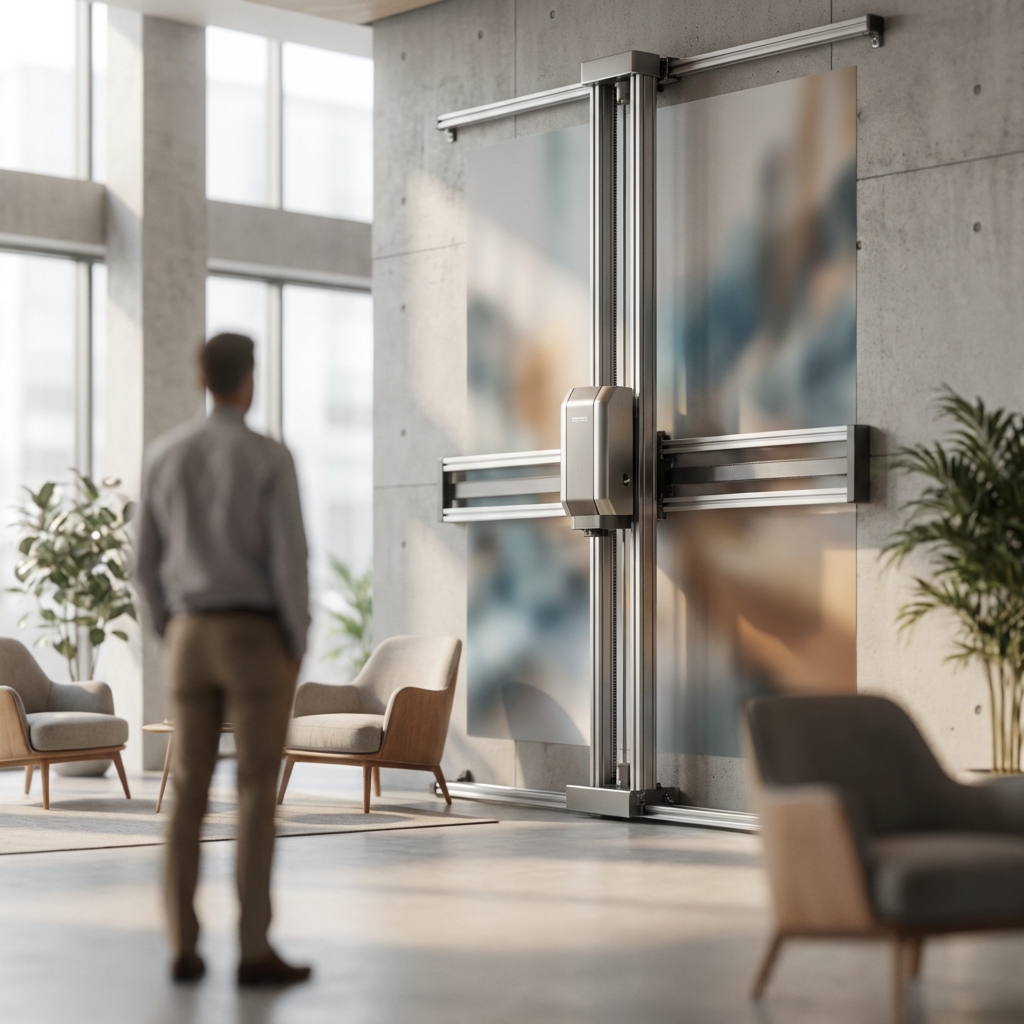
Image 3
Key sustainability differences across the lifecycle:
Materials: PVC film and adhesive stacks vs zero-vinyl, adhesive-free direct application.
Packaging and transport: shipped rolls and rigid tubes vs on-site printing that reduces freight and packaging waste.
Installation waste: release liners and offcuts vs negligible masking and no adhesive residue.
Operations: seam repairs and bubbles vs integrated, seam-free surfaces designed for cleaning.
End of life: adhesive removal and disposal vs repainting the wall for the next program.
For commercial wall branding solutions at scale, EastCoast MuralPros delivers high resolution architectural murals without vinyl or adhesives, executed on-site to minimize shipping and fabrication waste. Their approach supports integrated wayfinding and art programs across campuses and multi-location portfolios, offering a performance-based, more sustainable alternative to wallpaper and vinyl for long-term brand stewardship.
Pros and Cons: Choosing the Right Medium for High-Traffic Commercial Spaces
In high-traffic environments—hospitals, campuses, retail corridors—the trade-off in direct-to-wall printing vs vinyl wraps comes down to integration and wear. Vinyl introduces seams and adhesive edges that can catch, bubble, or fray under cleaning chemicals and cart impacts; over time, edges gray and lifting invites bacteria. Direct-to-wall printing embeds high-resolution imagery directly onto prepared substrates, producing seamless wall printing technology that resists peeling and tolerates frequent wipe-downs. For a digital art wall installation in a pediatric corridor, for instance, photoreal scenes can span 80 feet without panel breaks, enhancing wayfinding and morale while simplifying custodial routines.
Installation and disruption are equally critical. Vinyl wraps require panel fabrication, shipping, surface priming, and meticulous seaming on-site; odors and overnight cure windows can complicate occupied facilities. On-site direct printing from EastCoast MuralPros is typically completed in under five hours per zone, with no vinyl or adhesives and minimal barricades—ideal for after-hours rotations in corporate elevator lobbies or school hallways. The result is consistent, high-resolution architectural murals across multiple locations without the variability of different installers or substrates, and on-site printing eliminates shipping delays and fabrication errors.
Over a lifecycle, vinyl’s edge failures and periodic replacements drive maintenance costs and landfill waste. Direct printing reduces materials, shortens refresh cycles, and is paint-over-ready when programs, tenants, or brand standards change—advancing sustainable interior wall graphics goals. It also enables integrated wayfinding, safety icons, and instructional elements without signage clutter, a win for commercial wall branding solutions that must communicate fast in busy spaces.
Quick guidance for medium selection:
Choose direct-to-wall printing when you need seam-free wall graphics across large spans; frequent cleaning is expected; substrates range from drywall and CMU to brick or concrete; installs must be rapid and predictable; or you’re executing a multi-location rollout. EastCoast MuralPros delivers durable, cleanable finishes and subscription-friendly refreshes that scale reliably.
Choose vinyl wraps when graphics are truly short-term pop-ups, repositionable decals on glass are required, or building covenants restrict on-site equipment. For longer-run, high-traffic corridors and brand-critical areas, direct printing is the performance-based alternative to wallpaper and vinyl.
Conclusion: Best Practices for Scaling Digital Art Across National Corporate Portfolios
For national portfolios, the decisive factor in direct-to-wall printing vs vinyl wraps is operational performance at scale. Direct-to-wall methods deliver seamless wall printing technology with fewer failure points—no seams, no adhesives, and no panels that can peel or bubble. That means higher uptime for occupied buildings and a more integrated, architectural look for digital art wall installation programs.
To scale confidently across dozens or hundreds of sites, lock in standards and workflows early:
Establish surface-readiness specs (e.g., paint cure times, moisture thresholds, and acceptable substrates like drywall, CMU, concrete, or brick).
Define color targets and device profiles to ensure consistent high resolution architectural murals across regions and vendors.
Set creative guidelines (minimum image resolution at final size, licensing, and brand governance).
Align safety and compliance for integrated wayfinding, emergency egress visibility, and ADA considerations.
Pilot in 3–5 representative sites, then codify installation windows, access protocols, and QA sign‑offs.
Create a lifecycle plan: cleanability criteria, refresh cadence, and paint-over-ready end-of-life steps with clear budgets.
Plan rollouts around low-disruption windows—overnights or weekend shifts—and leverage on-site printing to eliminate shipping delays and fabrication errors. For example, a 250-location retail refresh can schedule 2–3 stores per night per region, capturing before/after photos, color checks, and facility sign-offs in a shared tracker. The result is schedule certainty, consistent execution, and fewer surprises than shipping and applying large vinyl graphics.
Measure value beyond first cost. Track installation duration per site, downtime avoided, maintenance calls, and waste diverted by choosing sustainable interior wall graphics that skip adhesives and plastic backers. A subscription model can pace strategic refreshes seasonally or by campaign, keeping commercial wall branding solutions current without construction or permitting cycles.
EastCoast MuralPros helps teams operationalize this playbook with fast, under‑5‑hour installations, durable cleanable finishes, and consistent multi-location execution. Their direct-to-wall platform supports full-campus systems for hospitals and schools, plus in‑studio prints for doors, tables, and standees to round out experiential programs. For brands weighing direct-to-wall printing vs vinyl wraps, a short pilot with EastCoast MuralPros is a low-risk path to validate quality, speed, and lifecycle performance at portfolio scale.


