Eco-Friendly Wall Branding Solutions for Commercial Interiors
Introduction: The Growing Demand for Sustainable Commercial Interior Solutions
Sustainability has moved from a talking point to a practical requirement in commercial interiors. Facilities teams, brand leaders, and procurement groups are under pressure to reduce waste, control lifecycle costs, and deliver environments that reflect organizational values. At the same time, they need solutions that install quickly, stand up to heavy use, and scale across multi-site portfolios.
Eco-friendly wall branding is emerging as one of the most efficient ways to refresh spaces without construction. High-resolution, architectural-scale graphics can transform corridors, lobbies, cafeterias, exam rooms, classrooms, and guest areas with minimal disruption. For organizations shifting away from vinyl wall coverings and conventional wallpaper, next-generation direct-to-wall printing provides a durable, low-waste alternative that meets both design and operations criteria.
EastCoast MuralPros supports this shift by enabling high-definition, adhesive-free graphics delivered on site. The approach is built for fast installation, consistent quality at scale, and real-world durability—key factors for healthcare systems, universities, hospitality portfolios, retail chains, and corporate workplaces navigating frequent updates with limited downtime.
Environmental Impact of Traditional Wall Coverings and Vinyl Wraps
Traditional vinyl wall coverings and wrapped panels create a significant materials burden. PVC-based substrates, adhesive layers, liner paper, and protective laminates add up quickly—and nearly all of it is destined for landfill at end of life. During installation, offcuts, misalignments, and change-order reprints generate additional scrap before a wall even opens to occupants.
Adhesives introduce another layer of environmental complexity. Many rely on solvent carriers or plasticizers and can contribute to VOC concerns, particularly during installation. Removal is equally challenging: stripping adhesive-backed graphics often damages finishes and drywall, requiring patching, priming, and repainting—more materials, more labor, and more downtime.
Logistics amplify the footprint. Rolls of vinyl and wallpaper ship with protective packaging and core tubes, then sit in inventory awaiting field use. Replacements for bubbles, failed seams, or surface incompatibilities trigger new shipments and fabrication runs. For multi-location brands, variability in field conditions and installer skill increases rework risk, compounding waste across the program.
Finally, seams and overlaps are a performance liability. Over time, edges lift and trap dirt; cleaning becomes less effective, and localized failures can spread. What starts as a pristine installation too often ends with patchwork fixes or a full replacement cycle years earlier than expected.
How Direct-to-Wall Printing Reduces Waste and Carbon Footprint
Direct-to-wall printing eliminates the substrate entirely. By bringing a high-resolution print system on site and imaging graphics directly onto prepared surfaces, teams remove vinyl, adhesive, paper backing, and most packaging from the equation. Less material in means less material out, both at installation and end of life.
Because production happens where the wall lives, shipping is streamlined. There are no roll cores, protective wrappers, or crates of prefabricated panels in transit—just a calibrated print system and a controlled digital file set. On-site execution also decreases the frequency of fabrication-related errors. Instead of discovering that a wall is out of square or a soffit has shifted after a panel arrives, adjustments are made in place, preventing reprints and the associated carbon from transport.
Speed further lowers the footprint. Installations typically complete in under five hours, minimizing the need for day-two mobilizations and extended site operations. Facilities can remain open during work in many cases, avoiding the emissions and cost of temporary decanting or after-hours HVAC loads. For organizations comparing alternatives, this direct-to-wall printing model is a measurable step toward low-waste interior branding.
Consistency at scale also matters for sustainability. A repeatable on-site process reduces the variability that leads to do-overs and field waste. When combined with robust digital preflight and color management, the result is predictable output across locations with fewer iterations and less material overhead.
Durability and Lifecycle Efficiency: The True Measure of Sustainability
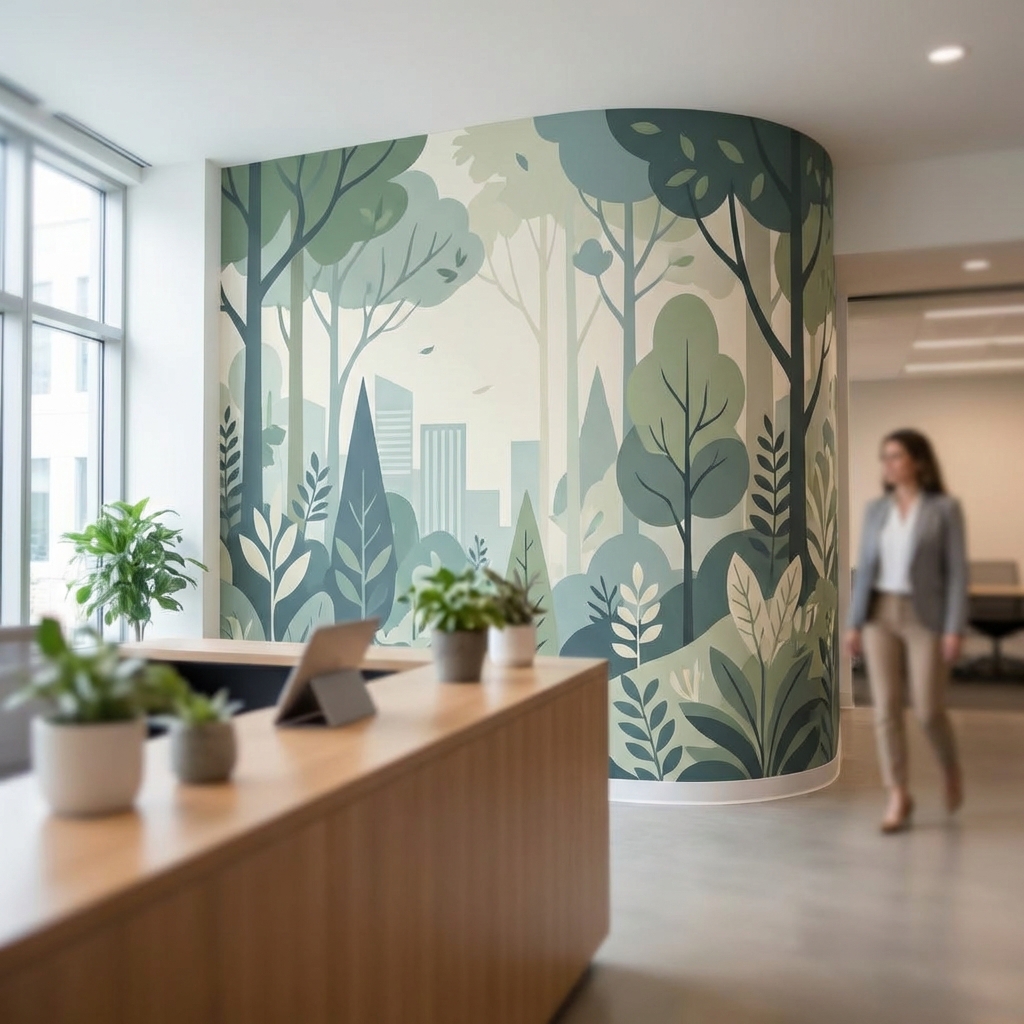
Illustration 1
A sustainable solution must perform over time. If a wall graphic fails early, the total material and labor used to install, repair, and replace it will overshadow any claimed eco-benefit. Direct-to-wall printing is designed for long-term use in high-traffic environments, delivering smooth, seam-free surfaces that stand up to cleaning and daily wear.
Seam-free execution eliminates the most common failure point in vinyl: edge lift. Without overlaps, there is nowhere for dirt to accumulate or moisture to intrude. This stability reduces maintenance cycles and preserves a consistent appearance, especially in corridors, elevator lobbies, classrooms, exam rooms, and other high-touch areas where performance is scrutinized.
Cleanability is central to lifecycle efficiency. Durable printed finishes allow routine wiping and periodic deeper cleans without degrading the image. For facilities teams, that means fewer work orders, fewer weekend repairs, and fewer prematurely replaced walls. Over a multi-year horizon, this smoother lifecycle translates directly into lower environmental impact and better budget control.
Scalability compounds the benefit. When a reliable process is replicated across a campus or an entire property portfolio, lifecycle savings stack up. EastCoast MuralPros focuses on standardized prep and print protocols so outcomes remain consistent across drywall, CMU, concrete, brick, and other common substrates—reducing surprises that can drive waste and cost.
Eco-Friendly Materials and Paint-Over-Ready Finishes
Eliminating PVC and adhesive layers removes a major source of environmental burden. EastCoast MuralPros’ approach uses no vinyl or PVC, as outlined in its sustainability commitment to No vinyl or PVC, avoiding the plastics and plasticizers common in traditional wall coverings. The result is a thinner material stack, fewer inputs, and simpler end-of-life options.
Paint-over-ready finishes provide an additional sustainability advantage. Instead of tearing down panels or scraping adhesive, facilities teams can mask edges, scuff-sand where needed, and roll a new topcoat. This process reduces demolition waste, shortens turnover, and keeps wall assemblies intact—important in leased spaces where tenant improvements must be reversible.
Compatibility with finished and unfinished surfaces supports more efficient projects. Whether a wall is painted drywall, sealed CMU, or exposed brick, the print system can be calibrated to deliver high-resolution imagery with crisp detail. In many cases, a standard architectural primer-surfacer is all that’s required to ensure image fidelity and long-term adhesion, limiting special-order coatings and minimizing waste.
Low-odor, fast-curing inks support occupied-building work. Because the system images directly to the wall, there are no extra lamination or off-gassing steps typical of certain film-based systems. For teams working in clinics, classrooms, guest rooms, and corporate offices, that means less disruption and a more straightforward path to re-occupancy.
Multi-Location Rollouts and Consistent Execution Without Excess Inventory
National and regional programs often stall under the weight of logistics. Rolls of vinyl, spare panels, and field kits take up storage space and create shrinkage risk. Direct-to-wall printing removes the inventory burden. There are no crates of backup material to manage, and change requests do not trigger a new fabrication cycle—files are updated and printed at the wall.
Consistency is engineered into the process. Centralized color standards, calibrated devices, and locked production profiles help maintain brand integrity from market to market. For organizations with strict brand standards, this digital-first approach ensures that PMS-matched tones, gradients, and photographic details render accurately at architectural scale.
On-site production also streamlines scheduling. Because installation windows are shorter—often under five hours per wall—teams can sequence work around active operations. Hospitality properties can refresh guest corridors between check-ins; hospitals can schedule overnight work; schools can phase projects across breaks. Minimal disruption reduces rebooking, decanting, and overtime—all hidden drivers of emissions and cost.
EastCoast MuralPros pairs these operational advantages with collaborative tools that help digital artists and brand teams scale their work. Complex murals, branded wayfinding systems, and multi-panel narratives can be preflighted once and deployed reliably, wall after wall, location after location—without manufacturing overruns or reserve-stock waste.
Replacing Wallpaper and Vinyl: A Sustainability Comparison
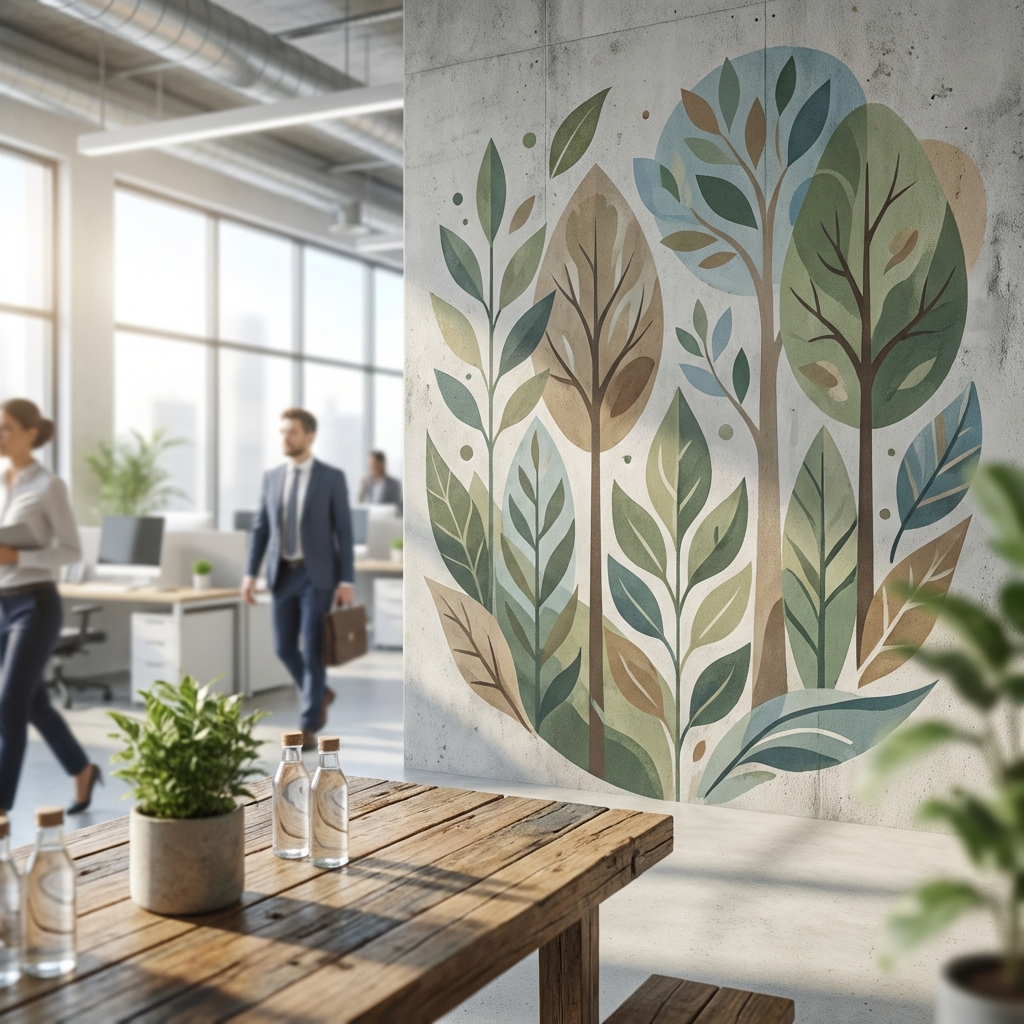
Illustration 2
When evaluating a sustainable alternative to vinyl, it helps to compare end-to-end impacts rather than individual features. Direct-to-wall printing differs from wallpaper and vinyl across the full lifecycle.
Materials:
- Vinyl/wallpaper: PVC films or paper backers, adhesives, liners, laminates. - Direct-to-wall: No substrate, no adhesive layer, minimal consumables.
Installation waste:
- Vinyl/wallpaper: Offcuts, misalignments, bubbles leading to reprints, seam trims. - Direct-to-wall: Calibrated to wall dimensions; little to no surplus material.
Transport and packaging:
- Vinyl/wallpaper: Multiple rolls, cores, protective packaging per site; replacements for defects. - Direct-to-wall: Equipment mobilization and digital files; negligible packaging waste.
Performance and maintenance:
- Vinyl/wallpaper: Seams and edges can lift; cleaning may accelerate failures; localized repairs conspicuous. - Direct-to-wall: Seam-free surface alleviates edge failures; uniform cleanability.
End of life:
- Vinyl/wallpaper: Difficult to recycle; adhesive removal and wall repair required; landfill disposal common. - Direct-to-wall: Paint-over-ready; no panel tear-down; intact substrate preserved.
Indoor environmental quality:
- Vinyl/wallpaper: Adhesives and some inks can contribute to odors and VOCs during install/removal. - Direct-to-wall: Low-odor process; no adhesive off-gassing or overlay laminates.
This holistic view captures the operational and environmental benefits that aren’t always visible on a product spec sheet. For teams benchmarking options, direct-to-wall printing is a pragmatic path to low-waste interior branding with fewer points of failure.
Cost Efficiency and Long-Term ROI of Sustainable Wall Solutions
Sustainability and cost control reinforce each other when projects avoid material-heavy systems and frequent rework. Direct-to-wall printing lowers installed cost by reducing labor steps (no adhesive staging, no seam alignment) and compressing the schedule. With typical installations completed in under five hours, labor charges and after-hours premiums can drop significantly.
Eliminating shipping and fabrication reduces soft costs. There are no rush freight fees for replacement rolls, no customs delays for international substrates, and fewer schedule impacts from damaged shipments. For multi-location rollouts, the savings compound as mobilizations are shorter and less equipment-intensive.
Lifecycle performance further improves ROI. Seam-free walls require fewer reactive maintenance calls. Durable, cleanable finishes accommodate routine housekeeping without early image degradation. When a message or brand system evolves, paint-over readiness means refresh cycles are measured in hours, not days—an operational win that translates to real budget savings.
Flexible commercial models accelerate adoption. EastCoast MuralPros supports subscription-based programs for seasonal campaigns and phased brand updates. Instead of treating walls as a one-time capital improvement, organizations can plan predictable, smaller OPEX expenditures, align updates with business cycles, and avoid the waste associated with episodic, full-build projects.
Wayfinding and Integrated Graphics: Reducing Signage Clutter
Traditional wayfinding often relies on layered hardware—plates, standoffs, frames, and vinyl overlays—scattered across walls and doors. While sometimes necessary for code-mandated signs, this approach can create visual noise and ongoing maintenance. Integrated environmental wall printing streamlines the system by embedding directional, safety, and instructional information directly into the architecture.
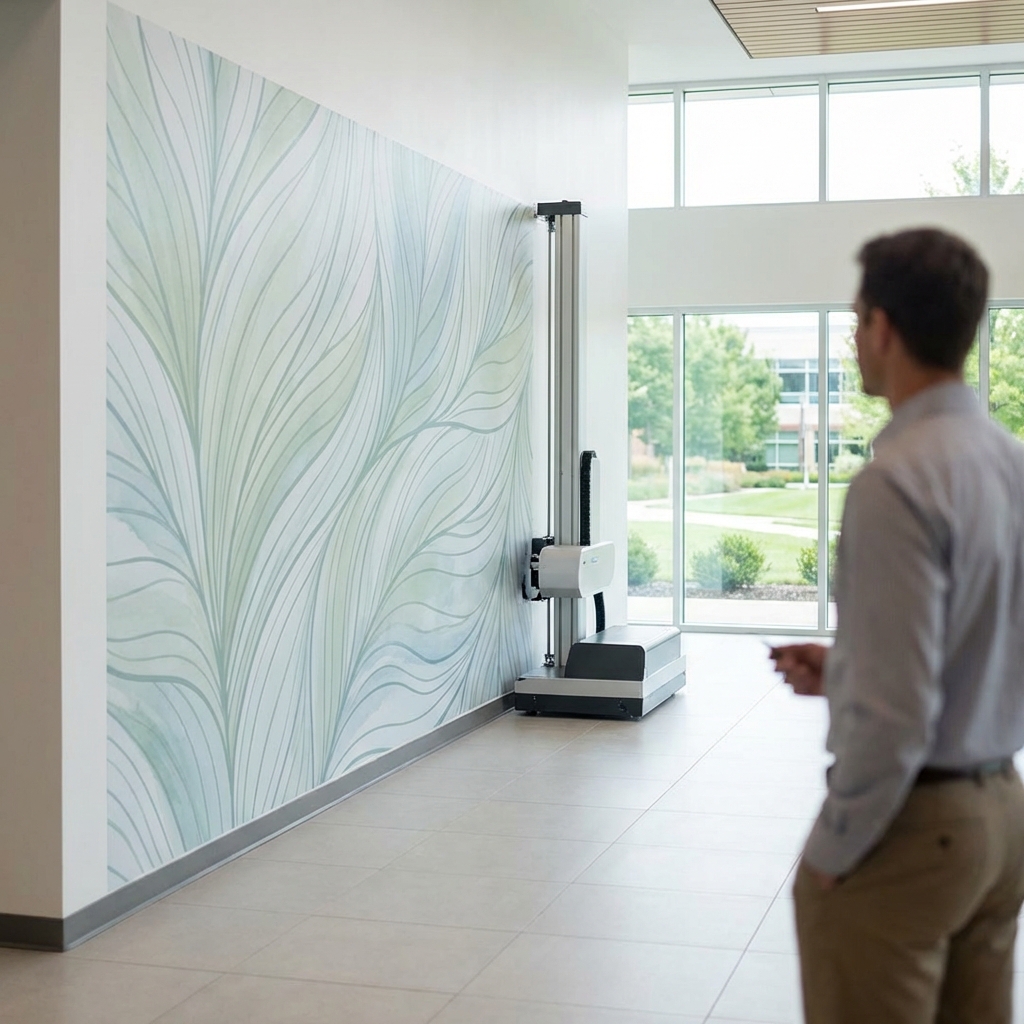
Illustration 3
Benefits include:
Reduced material use: Fewer plates and fasteners, less secondary packaging, and fewer replacements for damaged or stolen hardware.
Clearer journeys: Color-coded zones, floor numerals, and iconography printed directly on walls or columns make routes intuitive without a forest of signs.
Faster updates: When operational needs change—new clinic entrances, reconfigured classrooms, or revised guest flows—graphics can be reprinted on site or painted over and refreshed.
Direct-to-wall wayfinding excels in corridors, elevator lobbies, arrival moments, and back-of-house routes where clarity and durability matter. It doesn’t replace required code signage; rather, it reduces clutter by handling the bulk of directional and instructional content in a seamless format. For facilities teams, fewer devices on the wall also means fewer inspection points and less custodial complexity.
Sector-Specific Applications: Healthcare, Education, and Hospitality
Healthcare: Hospitals and clinics need durable surfaces that read clearly and clean easily, with minimal disruption to care. Direct-to-wall printing supports integrated wayfinding (color-coded floors, clinic identifiers, service lines) and patient experience graphics in waiting rooms and corridors. Overnight or off-shift installations limit downtime, and seam-free finishes stand up to routine cleaning practices common in clinical settings. For system-wide initiatives, the process scales across campuses with consistent color and typography control.
Education: K–12 districts and universities often operate on tight schedules, with peak construction windows limited to breaks and summers. Direct-to-wall printing compresses install time while delivering campus-wide branding, donor recognition walls, lab safety instructions, and athletics identity. Seam-free murals handle high-traffic student zones, while paint-over readiness makes it simple to change themes annually or reassign rooms between programs. Full-campus solutions—spanning residence halls, libraries, and labs—deliver cohesive, sustainable visual systems.
Hospitality: Hotels and resorts depend on immersive, photogenic environments that can evolve seasonally. Eco-friendly wall branding turns corridors, lift lobbies, meeting rooms, and lounge areas into brand assets without taking rooms out of service for long. Subscription models enable quarterly refreshes or targeted updates around events. Durable, cleanable finishes help maintain guest-ready spaces, while on-site execution limits the logistics and waste associated with prefabricated décor elements.
These same advantages extend to museums and cultural institutions, where photoreal, high-resolution imagery at architectural scale supports exhibitions without heavy fabrication. Seam-free walls maintain curatorial intent, and paint-over resets prepare spaces for the next show with minimal waste.
Scaling Sustainable Branding Across Tenant Transitions and Renovations
Tenant turnover is a crucial window to improve interiors without construction. Landlords and property managers can use direct-to-wall printing to rebrand common areas, refresh corridors, and install leasing graphics between move-outs and tours. With installation commonly completed in under five hours per wall, spaces return to market quickly and present at a higher standard, supporting lease-up goals without demolition.
For corporate workplaces, renovations often compete with daily operations. Because direct-to-wall printing is low-disruption and adhesive-free, it’s suitable for occupied floors, phased over nights or weekends. Story walls, departmental identifiers, and integrated wayfinding can be rolled out floor by floor, reducing decanting and swing space needs. When departments shuffle or a program’s focus shifts, paint-over-ready finishes allow for rapid updates without patching or panel removal.
Subscription-based refresh programs provide a predictable cadence for seasonal or strategic changes. Retailers can align in-store storytelling with campaigns; universities can update recruitment graphics each term; healthcare systems can deploy new instructional sets to support operational shifts. EastCoast MuralPros also offers in-studio printing on doors, tables, and standees—reusable substrates that enable portable branding without resorting to short-lived foam boards or PVC panels.
Conclusion: Building Greener Commercial Spaces with Next-Generation Wall Technology
Eco-friendly wall branding is a practical lever for organizations aiming to modernize interiors while advancing sustainability goals. By replacing vinyl wall coverings and wallpaper with direct-to-wall printing, teams reduce materials, cut installation waste, avoid adhesive-related complications, and simplify end-of-life decisions. The result is a durable, cleanable, and seam-free surface that performs in real facilities—not just on paper.
Operationally, the advantages are clear: faster schedules, lower disruption, and reliable results at scale. Strategically, paint-over-ready finishes and subscription models make it easier to adapt environments to evolving brands, tenants, and programs without generating construction waste. And from a portfolio perspective, multi-location consistency and on-site production deliver predictability—the quality facilities, procurement, and brand teams value most.
EastCoast MuralPros helps commercial and institutional clients implement these green wall solutions across campuses, healthcare networks, workplaces, hotels, and cultural venues. For organizations exploring a sustainable alternative to vinyl, direct-to-wall printing aligns design ambition with environmental responsibility—and provides a repeatable path to better-performing spaces.