Best Wall Mural Solutions Without Vinyl: Top 5 Alternatives for Commercial Spaces
Introduction: Why Facilities Leaders Are Moving Beyond Vinyl Wall Coverings
Best Wall Mural Solutions Without Vinyl: Top 5 Alternatives for Commercial Spaces
Facilities and workplace teams are under pressure to refresh spaces quickly, minimize disruption, and show measurable improvements in lifecycle performance. Traditional vinyl wraps and wallpaper—once the default for large-format graphics—are increasingly falling short. Peeling seams, inconsistent installs, adhesive residue, and unpredictable maintenance cycles turn what looked like a fast fix into a recurring facilities headache.
At the same time, brand, wayfinding, and compliance requirements are expanding. Corporate offices need seasonal campaigns without construction. Healthcare systems want integrated instructional graphics that are cleanable and don’t add clutter. Schools and museums want photoreal visuals at architectural scale that hold up to constant use. These needs are pushing decision-makers to evaluate wall mural solutions without vinyl, and to prioritize methods that are faster to install, easier to maintain, and friendlier to both budgets and the environment.
EastCoast MuralPros exists in this context. The team provides next-generation direct-to-wall printing for commercial and institutional environments, offering high-resolution, adhesive-free murals that are installed in hours—not days—and perform in high-traffic conditions. As procurement and facilities leaders compare non-vinyl wall graphics alternatives, they’re finding that a new set of options can outperform legacy products on speed, durability, and total cost of ownership.
Criteria for Evaluating Non-Vinyl Wall Mural Solutions
Before selecting a vinyl-free wall covering solution, align the evaluation with how your organization measures success. Consider these criteria to structure an apples-to-apples review:
Performance and durability
- Resistance to scuffs, abrasion, and cleaning agents - Behavior in high-traffic zones and near corners or doorways - Fire/smoke ratings and code compliance
Visual quality
- Photoreal fidelity at viewing distance (effective DPI at scale) - Seam-free appearance and uniform matte/gloss levels - Color accuracy and brand-palette repeatability across sites
Substrate and site compatibility
- Works on finished and unfinished surfaces (drywall, CMU, concrete, brick) - Tolerance for minor surface variation and texture - Indoor air quality and low-VOC considerations
Installation and disruption
- Total time on site, including prep and cure - Odor, noise, dust, and containment needs in occupied buildings - Ability to work overnight or in short shutdown windows
Maintainability and change management
- Cleanability without ghosting or sheen changes - Paint-over-ready finishes for tenant or program changes - Ease of updating wayfinding and compliance graphics
Scale, standardization, and logistics
- Consistent execution across multiple walls, floors, or locations - Minimal dependencies on shipping or off-site fabrication - Repeatable outcomes with defined QA and mockup protocols
Cost and sustainability
- Total lifecycle cost versus first cost - Waste generation, recyclability, and material toxicity - Embodied carbon and elimination of PVC/phthalates
Set thresholds for each category in the RFP, and request case-based evidence and mockups. In pilot programs, measure install time, odors, occupant feedback, and post-cleaning appearance—then use those results to normalize vendor claims.
Direct-to-Wall Printing: Speed, Quality, and Seamless Installation
Direct-to-wall printing technology deploys a mobile large-format printer that images graphics directly onto the wall surface—without vinyl, adhesives, or seams. The result is a high-resolution mural that reads as part of the architecture, with crisp edges, continuous tone, and a durable, cleanable finish.
Why it changes the equation:
Seamless at architectural scale. No panel seams to telegraph over time, no overlaps to collect dust, no edges for hands or carts to catch.
Fast, low-disruption installs. Typical projects complete in under five hours for a feature wall, even in occupied buildings. Overnight work windows are feasible, and on-site printing eliminates shipping delays and fit-up surprises.
Photoreal quality and precise brand color. Modern systems image at high effective DPI, maintaining detail across large fields. Digital color management improves consistency for national rollouts.
Adhesive-free and paint-over-ready. The printed finish can be scuff-resistant and cleanable while remaining easy to paint over for future program changes—ideal for landlords and high-churn environments.
Compatible with finished and unfinished substrates. Drywall, CMU, concrete, and even brick can be printed, expanding the palette beyond smooth, finished surfaces.
For facilities teams balancing schedule certainty with design ambition, this approach compresses timelines and reduces risk. It also suits integrated wayfinding and safety graphics, which can be imaged where needed—on corridors, stairwells, elevator surrounds—without adding separate signage and mounting hardware.
EastCoast MuralPros specializes in this method. The company’s process is tailored to high-traffic, multi-location needs, with subscription options for seasonal refreshes, full-campus solutions for schools and hospitals, and on-site teams calibrated to minimize occupant impact. For a deeper look at sustainability and operational benefits, see their overview of Direct-to-wall printing.
Where it excels:
Corporate workplaces and amenity hubs seeking quick brand updates without construction
Healthcare corridors and waiting areas that need integrated wayfinding and clear cleaning protocols
Higher education and K–12 campuses where summer and holiday windows are tight
Museums and cultural spaces that require photoreal, seam-free imagery at scale
Considerations:
Wall preparation still matters. Cracks, unfilled holes, or extreme texture may print faithfully, so light patching and a uniform base coat deliver the best result.
Mockups help set expectations on coarse substrates (e.g., CMU vs. skim-coated drywall).
Confirm infection control and odor requirements; low-odor, fast-cure inks and dust-free prep keep projects within occupied-building constraints.
Hand-Painted Murals: Artistry vs. Scalability and Cost Considerations
Hand-painted murals remain a compelling choice when you want a singular expression with evident craft. Skilled muralists deliver painterly effects, custom lettering, and site-specific storytelling that feels bespoke and soulful—particularly in hospitality and cultural environments.
Strengths:
Unique artistry and texture that digital methods emulate but don’t replicate
Flexibility to improvise on site, integrating architectural features
Long tradition and cultural resonance in community and public projects
Operational realities:
Time and schedule risk. Even modest walls can take several days to weeks, depending on complexity, dry times between coats, and artist availability. For facilities with tight shutdown windows, this timeline can be challenging.
Scalability and brand consistency. Repeatability across multiple locations is difficult; each site may look slightly different, which can be a plus for art programs but a minus for standardized brand rollouts.
Protection and maintenance. Clear coatings add durability but can shift sheen or subtly affect color. Routine cleaning must be tested on site to avoid burnishing or gloss spots.
Cost profile:
First costs often higher per square foot for custom work, particularly with union labor or premium artists.
Lifecycle costs vary; spot repairs may require bringing the artist back to match style and color.
For organizations managing hundreds of walls, the unpredictability of schedule and outcomes becomes a procurement pain point.
Bottom line: hand-painted murals excel when singular artistry is the goal and schedules can flex. For multi-site branding, rapid changeovers, or strict wayfinding standards, other non-vinyl wall graphics alternatives are typically more predictable.
Wallpaper Alternatives: Durability and Maintenance Comparisons
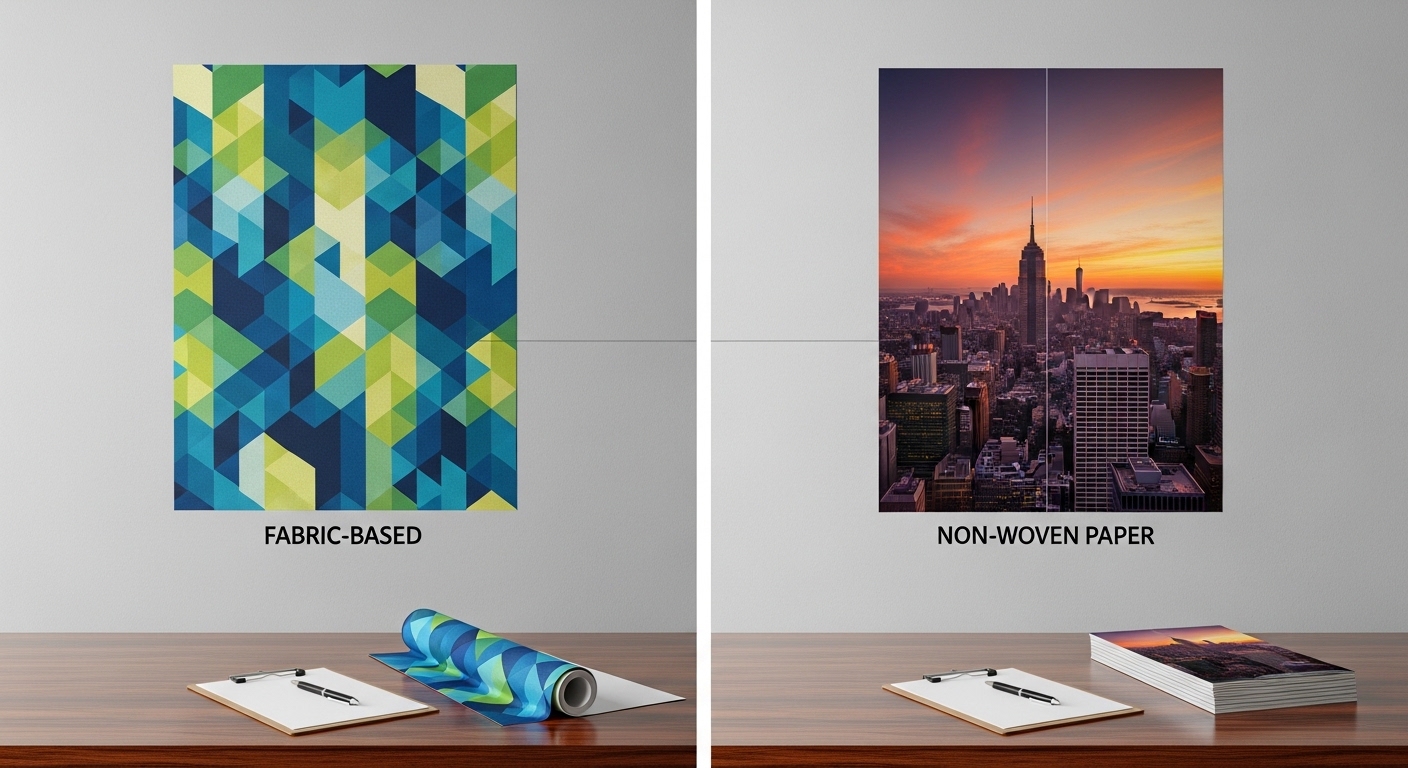
Not all wallcoverings are vinyl. There is a growing market of PVC-free substrates—cellulose-based papers, fiberglass-reinforced wallcoverings, polyolefin and polyester blends—that aim to retain the practicality of wallpaper while eliminating PVC and plasticizers.
Common non-vinyl wallcovering categories:
PVC-free “Type II equivalent” wallcoverings. Engineered for higher durability without PVC; often use polyolefin or polyester blends with scrim backings.
Natural and cellulose-based wallpapers. Lower environmental impact but generally less durable in high-traffic commercial settings.
Glass fiber wallcoverings. Extremely robust and paintable; often used in healthcare for impact resistance and hygiene, but texture may limit photoreal detail.
Advantages:
Familiar installation workflow for wallpaper installers
Wide pattern libraries and digital print options on PVC-free media
Good abrasion resistance in premium, commercial-grade lines
Tradeoffs to weigh:
Seams and adhesives. Even with good installers, seams may become visible over time, particularly across expansions and contractions. Adhesives introduce odor, drying time, and future removal labor.
Moisture and cleaning. Some PVC-free wallcoverings tolerate hospital-grade cleaners; others require gentler regimens. Always verify ASTM and field test with your cleaning protocols.
Removal costs. Deinstalling adhesive-backed wallcoverings can be labor-intensive, particularly after years in place, and may damage paint or drywall.
Photoreal fidelity. High-resolution prints are possible, but texture and seam alignment can interrupt continuous imagery at architectural scale.
Where they fit:
Hospitality corridors and rooms where patterned wallcoverings match brand language
Retail environments seeking a cost-conscious alternative to PVC vinyl
Administrative areas where impact risk is low and changeouts are infrequent
If your mandate is strictly vinyl-free wall covering solutions and you value a familiar, spec-driven procurement path, premium PVC-free wallcoverings are a viable option. Just budget realistically for installation, seams, and end-of-life removal.
Architectural Wall Graphics: Wayfinding and Branding at Scale
Large organizations often need more than a single mural: they need a system. Architectural wall graphics—graphics deployed as an integrated layer of the built environment—coordinate brand storytelling, wayfinding, safety, and instructional messaging without overwhelming users with standalone signs.
Elements to consider in a system:
Direct-to-wall printed murals and typographic routes that reinforce brand voice
Painted stencils and coatings for durable directional aids and floor demarcations
Printed doors, columns, and elevator surrounds that guide flow and reinforce identity
Changeable components for seasonal campaigns or temporary directions (e.g., during construction detours)
Why it matters:
User experience. Integrated wall graphics reduce decision friction and keep occupants moving. Clear color hierarchies and pictograms enhance accessibility.
Space efficiency. Messaging on walls, doors, and columns reduces signage clutter and hardware maintenance.
Multi-site standardization. A kit-of-parts—color standards, typographic scales, iconography, finish schedules—ensures consistency across campuses and national portfolios.
Execution considerations:
Code and compliance. Coordinate with life-safety, fire ratings, and ADA requirements for contrast and legibility.
Cleaning and infection control. Specify finishes compatible with your cleaners and document field-testing results in the O&M manual.
Change management. Plan for updates by mixing durable, permanent elements (e.g., floor identity colors, core brand statements) with agile layers (campaign walls, event graphics).
EastCoast MuralPros frequently implements full-campus solutions for schools and healthcare systems where coordinated wayfinding, safety, and identity graphics must be deployed quickly and consistently. Direct-to-wall printing pairs well with painted stencils and strategically placed changeable graphics to balance permanence with flexibility.
Sustainability and Lifecycle Cost Analysis of Non-Vinyl Options
Sustainability claims should translate into measurable operational gains. When comparing sustainable mural options for commercial spaces, look at both materials and process.
Key sustainability factors:
Material composition. PVC-free, phthalate-free inputs reduce toxicity concerns and end-of-life challenges. Adhesive-free methods cut chemical load and potential IAQ impacts.
Waste reduction. On-site printing creates only the image you need—no trimming scraps, liners, or misprints to landfill. Eliminating panels also reduces packaging waste.
Logistics and shipping. Printing directly on walls removes shipping legs for large-format substrates, cutting transport emissions and the risk of freight damage or delays.
Lifecycle length and changeover. Durable finishes that can be cleaned and later painted over avoid tear-outs and drywall repair. Fewer replacements mean lower embodied carbon over time.
Cost modeling should include:
Installation labor and containment (occupied vs. empty building)
Cleaning and protection over the service life
Removal or changeover effort (heat guns, scraping adhesives, wall repair)
Replacement frequency for high-wear areas
Risk costs: schedule overruns, failed adhesion, seam failures, and occupant complaints
Direct-to-wall printing often delivers strong results on both sustainability and lifecycle cost because it eliminates vinyl and adhesives, minimizes waste, and speeds installation. For a concise summary of PVC-free approaches and process advantages, see EastCoast MuralPros’ overview of Vinyl-free wall options.
PVC-free wallcoverings also improve on legacy vinyl, though adhesives, seams, and removal labor remain factors. Hand-painted murals score well on materials but can require protective coatings and longer on-site time. Tension-fabric and magnetic systems can be PVC-free and changeable, but frames and backers add embodied carbon and installation complexity. The right choice depends on your organization’s balance of speed, durability, and change frequency.
Installation Timeline and Disruption: Which Solutions Work in Occupied Buildings
Occupied buildings demand quiet, low-odor, and fast-turn installs. Facility leaders typically operate within overnight or weekend windows, with strict containment and cleaning requirements—especially in healthcare and education.
What to expect by solution:
Direct-to-wall printing
- Typical window: Same-day completion for feature walls; multi-wall zones over one to two nights - Disruption: Low; minimal odor and dust with proper prep; no adhesive mixing or off-gassing - Containment: Standard floor and adjacent-surface protection; infection control feasible with pre-approved barriers
Hand-painted murals
- Typical window: Several days to weeks, depending on layers and complexity - Disruption: Moderate; paint odors vary by product; extended on-site presence and drying times - Containment: Requires robust barriers to segregate work, especially in healthcare or food service
PVC-free wallcoverings (digitally printed or patterned)
- Typical window: One to three days per area, driven by wall prep, panel alignment, and adhesive cure - Disruption: Moderate; adhesive odors and cleanup; staging areas for rolls and paste - Containment: Floor protection and paste cleanup; extended punch-list walk-throughs for seams and bubbles
Painted stencils and coatings (architectural wayfinding)
- Typical window: One to two nights for modest scope; more for extensive routing - Disruption: Low to moderate; paint odors and masking removal; cure times govern return-to-service - Containment: Masking and overspray management; ventilation planning
Tension-fabric or magnetic panel systems
- Typical window: One to several days, including frame installation and alignment - Disruption: Moderate; drilling, fasteners, and dust; layout checks for plumb and level - Containment: Dust control and debris cleanup; possible noise restrictions
For hospitals and labs, confirm product certifications, cleaner compatibility, and any infection control documentation. For schools, verify summer/holiday work capacity and background checks for on-site crews. Regardless of method, a preconstruction walk-through, substrate testing, and a defined punch-list protocol will keep timelines and expectations aligned.
Comparison Matrix: Performance, Cost, and Application Across Solutions
Use the following side-by-side summary to align options with your priorities. Attributes are generalized; request product- and site-specific data in procurement.
Direct-to-wall printing (adhesive-free)
- Visual quality: Photoreal at architectural scale; no seams - Durability: High; cleanable, scuff-resistant finishes available - Substrates: Drywall, CMU, concrete, brick; best on uniform base coat - Installation: Fast; typical feature wall under five hours; low odor - Changeouts: Paint-over-ready; simple to update without demolition - Sustainability: Strong; no vinyl or adhesives; minimal waste and shipping - Scale: Excellent for multi-location rollouts; consistent color management - Cost profile: Competitive first cost; strong lifecycle savings from speed and minimal removal
Hand-painted murals
- Visual quality: Unique artistry; texture and brushwork - Durability: Varies; coatings help; cleaning must be tested - Substrates: Broad; surface prep impacts outcome - Installation: Long; extended on-site time and dry cycles - Changeouts: Repaint or overpaint; touchups may require the artist - Sustainability: Good materials profile; longer site time increases labor energy - Scale: Limited repeatability across portfolios - Cost profile: Higher first cost per square foot; variable lifecycle
PVC-free wallcoverings (digital/patterned)
- Visual quality: High; seams visible at close range; alignment critical - Durability: Commercial-grade options resist abrasion; cleaning varies - Substrates: Smooth walls preferred; adhesive performance depends on prep - Installation: Moderate; adhesive mixing, seam rolling, cure time - Changeouts: Removal labor and wall repair likely - Sustainability: Better than vinyl; adhesive and seam waste remain - Scale: Good; standardized SKUs and installer availability - Cost profile: Predictable first cost; plan for removal at end of life
Painted stencils and coatings (architectural wayfinding)
- Visual quality: Crisp typographic and iconographic elements - Durability: Very good with appropriate coatings - Substrates: Broad; texture affects edges and legibility - Installation: Short windows possible; masking and cure time - Changeouts: Repaint to update; quick for simple changes - Sustainability: Strong; minimal materials and waste - Scale: Good for standardized icon sets and color systems - Cost profile: Cost-effective for wayfinding; not for photoreal imagery
Tension-fabric or magnetic panel systems (PVC-free)
- Visual quality: Smooth, large fields; replaceable graphics - Durability: Good; frames protect edges; fabric can be cleaned per spec - Substrates: Requires frames/backers; independent of wall finish - Installation: Moderate; framing and alignment; changeouts are quick - Changeouts: Very fast; seasonal campaigns are straightforward - Sustainability: Mixed; aluminum frames add embodied carbon but enable reuse - Scale: Strong for retail and experiential programs - Cost profile: Higher upfront (framing); efficient for frequent content swaps
How to Select the Right Approach for Your Organization's Needs
There is no one-size-fits-all answer. Start with the core constraints of your portfolio: occupied vs. vacant, speed-to-install, durability under cleaning, frequency of content changes, and sustainability mandates. Then match those to the characteristics of each non-vinyl solution.
A practical selection workflow:
Define the use cases
- Permanent brand statements vs. campaign walls - Integrated wayfinding and safety vs. feature murals - High-abuse zones (e.g., carts, backpacks) vs. quiet administrative spaces
Set performance baselines
- Cleaner compatibility and abrasion tolerance - Seams allowed or not; target matte level and glare control - Fire/smoke ratings and any healthcare education requirements
Prioritize schedule and disruption
- Maximum allowable on-site hours; overnight-only or weekend windows - Tolerance for odors and containment - Critical milestones (e.g., tenant move-in, semester start, grand opening)
Model lifecycle cost and sustainability
- Estimate change frequency over 3–7 years - Include removal or paint-over labor at end of life - Weigh embodied carbon and waste from materials and shipping
Pilot, measure, and decide
- Execute side-by-side mockups on representative substrates - Document installation time, odors, occupant feedback, and post-cleaning results - Capture color measurements and photography under real lighting conditions
How solutions typically map to needs:
Need seam-free, photoreal murals with minimal disruption: Direct-to-wall printing is the frontrunner, particularly for hospitals, schools, museums, and corporate campuses seeking durable adhesive-free wall graphics.
Need standardized, repeatable patterning with known installation workflows: PVC-free wallcoverings fit well, provided seams and removal labor are acceptable.
Need singular, artistic expression for hospitality or cultural programs: Hand-painted murals deliver character when timelines allow.
Need robust, legible wayfinding tied to brand: Combine painted stencils/coatings with direct-to-wall typography and color fields for an integrated system.
Need frequent campaign changes with minimal labor: Tension-fabric or magnetic systems justify their frames when content rotates often.
Where EastCoast MuralPros fits
For facilities leaders evaluating wall mural solutions without vinyl, EastCoast MuralPros provides direct-to-wall printing optimized for occupied buildings, multi-location consistency, and rapid turnarounds—often in under five hours per feature wall. The team supports full-campus deployments in education and healthcare, national brand rollouts, and subscription-based refreshes for seasonal or strategic messaging.
Beyond walls, in-studio printing on doors, tables, and standees enables cohesive, cross-surface branding. Collaborative workflows make it easy for digital artists and brand teams to scale artwork with predictable results.
Next steps
If you’re pursuing non-vinyl wall graphics alternatives, shortlist two to three methods aligned to your constraints. Run a controlled pilot, score results against your criteria, and project lifecycle cost over your planning horizon.
When speed, fidelity, and low disruption are central, engage a direct-to-wall printing provider with occupied-building experience and multi-site capabilities. A partner like EastCoast MuralPros can help you scope, schedule, and standardize at scale—without the seams, adhesives, and waste of legacy approaches.
By reframing the decision around performance, schedule, and lifecycle value—not just first cost—you can select sustainable mural options for commercial spaces that make your brand visible, your wayfinding clear, and your operations more predictable.