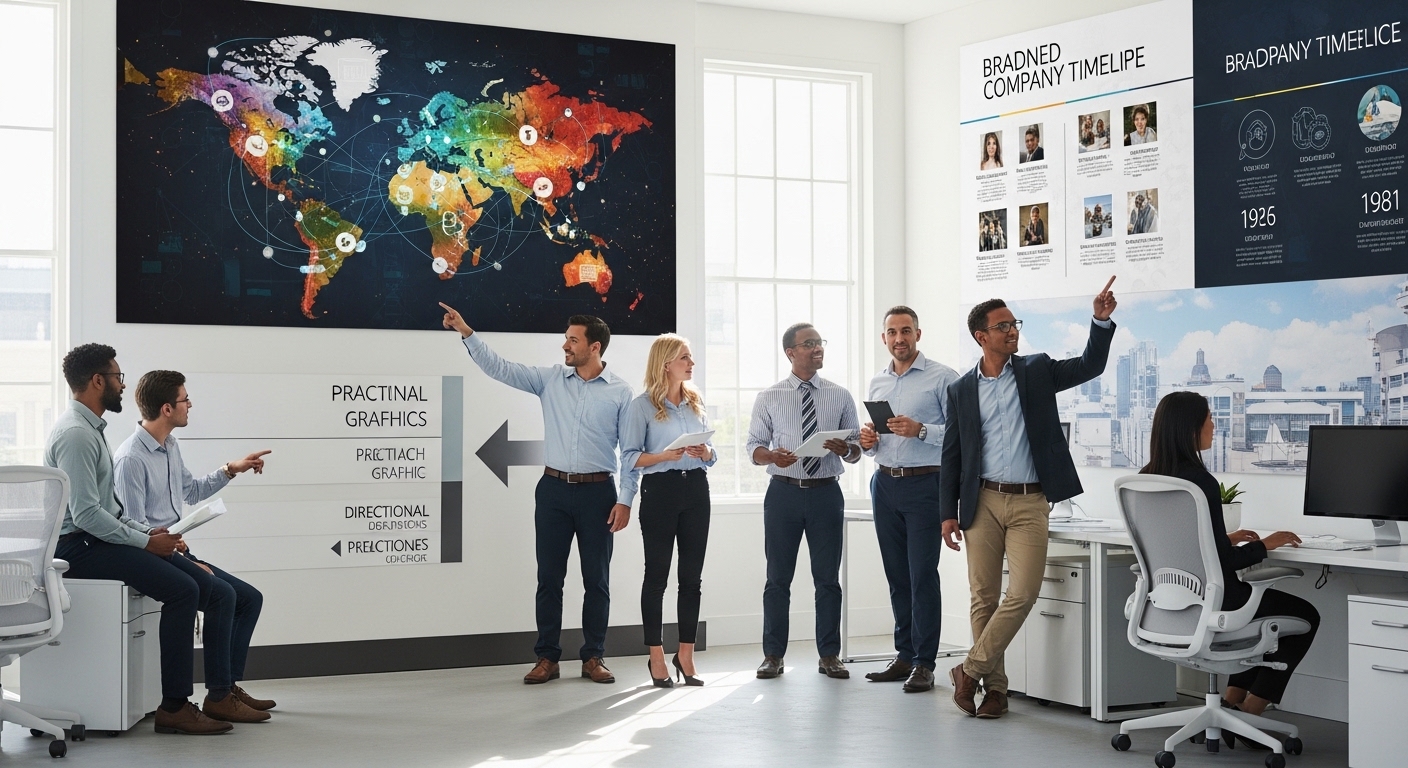
Best Commercial Wall Graphics Solutions for Facility Managers and Designers
Introduction: Why Commercial Wall Graphics Matter for Facility Managers
Commercial wall graphics have moved from “nice-to-have décor” to a strategic lever for facilities, workplace, and capital projects teams. They change how occupants navigate and perceive a building, shape brand experience without construction, and address communication needs that signage alone can’t solve—especially across multi-floor campuses and multi-location portfolios. For facilities directors balancing budgets, uptime, and stakeholder expectations, the right wall graphics solution must deliver quality, speed, and reliable performance at scale.
Traditional vinyl and wallpaper systems often fall short when timelines are tight or environments are demanding. Peeling seams, shipping delays, and installation disruption can ripple across operations. By contrast, modern direct-to-wall printing brings high-quality wall printing for offices, schools, hospitals, and public environments directly onto finished or unfinished surfaces, creating a seam-free, architectural finish that stands up to daily use.
EastCoast MuralPros serves these needs with next-generation, adhesive-free wall printing designed for occupied buildings and multi-location rollouts. For decision-makers who value schedule certainty, lifecycle durability, and cleanable surfaces, commercial wall graphics are no longer just decorative—they’re a performance-driven building component.
Evaluation Criteria: What to Look for in Wall Graphics Solutions
Selecting durable interior wall solutions requires more than reviewing swatches. Facility managers and designers benefit from criteria that connect performance, operations, and risk:
Installation timeline and disruption: Can printing be completed in hours, not days? Is overnight or off-hours work feasible without closing corridors or floors?
Surface compatibility: Will the system adhere or print directly on drywall, CMU, concrete, brick, and previously painted substrates?
Image quality at scale: Does the solution support photoreal imagery and crisp typography for wayfinding at typical viewing distances?
Seam-free execution: Are there visible panel seams or overlaps that can peel, catch cleaning tools, or distract from the design?
Durability and cleanability: Can finished surfaces be routinely cleaned with commercial or hospital-grade disinfectants without fogging, edge lift, or color shift?
Adhesive-free alternatives: For teams avoiding vinyl or wallpapers, is there a direct-to-wall approach that eliminates bubbling and long cure times?
Lifecycle and paint-over readiness: When a tenant turns over or a program changes, can you paint over graphics instead of paying for removals and repairs?
Multi-location consistency: Can the vendor calibrate color and process so a brand standard looks identical in every facility?
Wayfinding and safety integration: Can instructional, code-required, and ADA-compliant graphics be integrated cleanly into walls, reducing signage clutter?
Environmental and health profile: Low-VOC materials, reduced PVC and adhesive content, and less waste all matter for ESG goals.
Procurement alignment: Are pricing, warranties, safety documentation, and schedule commitments clear and comparable?
Pilot-to-scale pathway: Does the provider support pilots that scale into national or campus-wide standards without re-engineering?
Using a structured checklist keeps discussions grounded in performance rather than aesthetics alone—leading to a better long-term fit for institutional wall graphics.
Direct-to-Wall Printing Technology vs. Traditional Vinyl and Wallpaper
Direct-to-wall printing uses precision equipment to print high-resolution artwork directly on existing walls—no vinyl, adhesives, or separate substrates. UV-curable inks bond to the surface, creating a durable, cleanable finish that looks integrated with the architecture. Because there are no seams, the result feels more like site-specific artwork than an applied product, and there are no edges to lift under abrasion or moisture.
Vinyl wraps and wallpapers, by comparison, rely on adhesives and panelized installation. In high-traffic corridors or humid environments, seams are stress points that can bubble or peel. Installers often need large staging areas, and shipping or fabrication errors can derail a schedule. Wallpaper pastes require cure time and generate waste, while vinyl carries ongoing concerns around PVC, plasticizers, and end-of-life landfill impact.
From a lifecycle perspective, direct-to-wall printing reduces the steps where projects typically stumble—no substrate procurement, no trimming, no panel realignment. It also eliminates removal headaches; when programs or tenants change, walls can be prepped and repainted rather than stripped. For teams evaluating an alternative to vinyl wall coverings, EastCoast MuralPros’ adhesive-free approach provides a performance-centric option that is faster, cleaner, and often more sustainable. For a deeper dive into material and waste profiles, see this overview of direct-to-wall printing compared with traditional vinyl.
Fast-Installation Solutions for Minimal Business Disruption
Facilities teams operate in live environments—clinics see patients, students change classes, and offices need daily access. That reality puts a premium on approaches that compress install timelines and keep spaces safe, clean, and accessible. Direct-to-wall printing systems designed for facilities work can complete large feature walls in under five hours, aligning with overnight windows or shift changes to avoid downtime.
Because printing is done on-site, there’s no waiting for substrate fabrication or shipping, and there’s no adhesive application or drying time. With a site-ready plan—covering power access, floor protection, dust control, and egress coordination—technicians can mobilize, print, and demobilize in a single window. In sensitive areas like healthcare, negative-impact measures are minimized: no solvent odors from adhesives, small footprint equipment, and predictable setup/breakdown.
Planning best practices for minimal disruption include:
Preflight checks: Verify artwork scaling, color targets, and wall readiness before the crew arrives.
Environmental conditions: Confirm temperature and humidity ranges suitable for ink curing and adhesion to the wall surface.
Access sequencing: Prioritize corridors or rooms with least operational impact and set clear barricade plans.
Communication protocols: Align with security, EVS/cleaning, and life safety so work zones remain compliant and clear.
EastCoast MuralPros’ teams are optimized for low-disruption installation in occupied buildings, using streamlined mobilization to deliver schedule certainty.
High-Resolution Graphics for Branding and Wayfinding Applications
Beyond décor, commercial wall graphics carry real workloads: brand storytelling, donor recognition, compliance messaging, and intuitive wayfinding. High-quality wall printing for offices and public facilities should reproduce brand colors accurately, render small type crisply, and maintain clarity across long corridors and open lobbies. Direct-to-wall systems achieve fine detail without panel joins, so logos, gradient fields, and photo-rich murals look continuous at architectural scale.
For wayfinding, color contrast, typography hierarchy, and pictograms must hold up under variable lighting and long viewing distances. Seam-free wall printing technology prevents type misalignments that can occur at panel seams, and it allows designers to integrate arrows, floor codes, and ADA-friendly contrasts directly into the wall plane. The result is less hardware clutter and fewer maintenance points compared to layered signage.
Brand and experience teams also benefit from:
Consistent color management: ICC-driven workflows align output across multi-location rollouts, reducing reprints.
Photoreal, high-resolution imagery: Galleries, museums, and hospitality spaces can deploy exhibition-grade murals with crisp edge detail.
Integrated messaging systems: Safety instructions, infection-control reminders, and building policies can be embedded in a design language rather than stapled on top of it.
Extended applications: In-studio printing for doors, tables, and standees supports campaign elements and temporary activations without separate vendors.
EastCoast MuralPros collaborates with digital artists and designers through scalable file-prep tools, ensuring large-format assets translate cleanly to wall-scale production.
Durability and Cleanability for High-Traffic Environments
Facilities teams judge wall graphics by how they perform on day 1,000, not just day 1. UV-cured direct-to-wall finishes resist abrasion and stand up to routine cleaning, bringing a maintenance profile closer to premium architectural paint than decorative films. Without edges or seams, there’s less opportunity for moisture intrusion, vandalism lift points, or fraying under cart impacts and daily wear.
Cleaning compatibility is a critical spec. In healthcare and education, surfaces must tolerate disinfectants and frequent wipe-downs without ghosting or color degradation. Direct-to-wall systems are engineered for high-traffic environments—gloss or satin topcoats can be tailored to reduce glare, improve scrubbability, and preserve detail. Where additional protection is warranted, clear protective coatings can elevate chemical resistance without compromising image fidelity.
Other durability considerations include:
Impact resistance: Solid bonding to the wall minimizes “drumhead” effects common with applied films.
Humidity and temperature tolerance: Performance remains stable in vestibules, stairwells, and mechanical-adjacent zones.
Paint-over readiness: When programs change, surfaces can be lightly prepped and repainted—no costly removals or adhesive residue mitigation.
Standards alignment: Testing against relevant ASTM scrub and abrasion methods provides a shared language for procurement and facilities maintenance.
EastCoast MuralPros specifies cleanable, durable surfaces suited to hospital corridors, campus commons, and corporate lobbies—places where the lifecycle promise must match the design vision.
Cost-Effectiveness and Lifecycle Efficiency Across Multi-Location Rollouts
Evaluating cost per square foot is only the start. For institutional wall graphics, the true value emerges in lifecycle and rollout efficiency. Adhesive-free, on-site printing compresses schedule days into hours, cutting labor and GC coordination. It removes variables—substrate shipping, panel damage, trim misalignment—that lead to change orders and rework. It also shrinks the “soft costs” tied to closures, detours, and churned stakeholder time.
Lifecycle considerations that tilt the math:
Fewer replacements: Without seams or adhesives to fail, graphics retain a fresh appearance longer, especially in humid or high-touch zones.
Reduced maintenance: Cleanable, integrated finishes lower the frequency of spot repairs and eliminate edge resealing.
Paint-over end-of-life: When it’s time to refresh, minimal prep replaces multi-hour teardown, landfill fees, and wall patch/skim costs.
Standardization across sites: Getting one process to work repeatedly at national scale prevents the budget leaks that come from reinventing the approach in each city.
For brands refreshing multiple offices or healthcare systems deploying wayfinding across a network, consistent execution saves creative, procurement, and operations effort. EastCoast MuralPros supports national rollouts with calibrated color profiles, repeatable workflows, and a subscription model for seasonal or strategic refreshes—helping teams budget proactively and keep environments current.
Sustainability Considerations: Eco-Friendly Wall Graphics Alternatives
ESG priorities are reshaping materials choices. Vinyl and wallpaper introduce PVC, adhesives, and backing papers that typically head to landfill during installation and removal. Shipping pre-fabricated panels also increases packaging and transport emissions. Direct-to-wall printing avoids substrate waste, reduces packaging, and eliminates adhesive chemistry, making it a lower-impact approach for many programs.
Key environmental advantages include:
Material reduction: No vinyl, no paste, and minimal consumables compared to panel systems.
On-site efficiency: Fewer shipments and less packaging waste; right-sized mobilizations reduce freight emissions.
Low-VOC profile: UV-curable inks used in facility-grade systems minimize airborne emissions during installation.
Cleaner end-of-life: Paint-over readiness avoids vinyl tear-outs and drywall damage, lowering debris and disposal.
For design teams pursuing LEED-aligned strategies or corporate carbon goals, the material and transport savings are tangible. To understand the trade-offs in detail, facilities teams can review this analysis of direct-to-wall printing versus traditional vinyl from a sustainability and waste perspective. While every project is unique, a performance-based alternative to vinyl wall coverings is often the simpler, greener path.
Real-World Applications: Healthcare, Education, and Corporate Environments
Healthcare systems: Clinical environments demand durable, cleanable, and legible wall graphics. Direct-to-wall printing supports infection-control messaging, zone color-coding, and corridor wayfinding without edge seams that harbor grime. Calming nature imagery in infusion bays or pediatrics, integrated donor recognition walls, and safety instructions at egress points can be deployed overnight with minimal disruption.
Education (K–12 and higher ed): Campus-scale solutions benefit from adhesive-free installation on a mix of substrates—painted CMU block, brick entries, and drywall in academic buildings. Mascot branding, program storytelling, campus maps, and stairwell motivation walls elevate student experience while preserving maintenance budgets. During summer or holiday windows, large volumes can be installed quickly, and future program changes are as simple as paint-over and reprint.
Corporate workplaces: Culture walls, product timelines, and branded reception areas gain from photoreal finishes and precise color matching. Facility managers avoid ongoing repairs to peeling seams near corners or elevators. For companies with multiple offices, consistent color calibration ensures a New York lobby matches a San Diego headquarters—critical for enterprise brand governance. High-quality wall printing for offices can also integrate privacy-friendly patterns on corridors without adding glass films.
Retail and hospitality: Seasonal campaigns often require agile, repeatable updates. On-site, seam-free wall printing technology pairs well with a subscription cadence—refresh holiday visuals, update menu walls, or roll out national promotions without crating and shipping large panels. In-studio printing on doors, tables, and standees rounds out the program.
Museums and cultural institutions: Photoreal murals, exhibition timelines, and didactic graphics benefit from uninterrupted fields of color and texture. Brick and concrete galleries become canvases without covering historic surfaces in adhesives or laminates, and the paint-over option respects future curatorial shifts.
Public sector and property portfolios: For landlords and asset managers, tenant turnovers and lease-up periods call for fast, cost-predictable upgrades. Graphics that install in hours and paint out later offer a lifecycle-efficient alternative to wallpaper or architectural panels.
Comparison Summary: Key Differences and Decision Framework
When facility teams compare approaches, the operational differences become clear.
Key differences:
Installation speed: Direct-to-wall prints feature walls in hours; vinyl/wallpaper often span days with staging, adhesive work, and cure times.
Seam presence: Seam-free vs. panel seams that can bubble, lift, or misalign.
Surface compatibility: Broad compatibility with drywall, CMU, concrete, and brick vs. prep-intensive conditions for panelized systems.
Durability and cleanability: Integrated, abrasion-resistant finishes vs. edge vulnerabilities and paste sensitivities.
Lifecycle: Paint-over for program changes vs. removal labor, adhesive residue, and wall repair.
Logistics risk: On-site printing avoids shipping and fabrication errors; panel systems carry freight and damage risk.
Sustainability: Reduced PVC, adhesives, and packaging vs. substrate-heavy approaches.
Scale consistency: Calibrated color and process across locations vs. variability among regional installers and materials.
Decision framework:
Choose direct-to-wall printing when you need institutional wall graphics installed quickly, cleanly, and at scale; when seam-free aesthetics, cleanability, and paint-over readiness reduce lifecycle costs; and when sustainability goals steer you away from vinyl or wallpaper.
Consider vinyl or wallpaper when you require specialty textures inherent to a material substrate, or when building conditions preclude on-site equipment access. Even then, weigh the maintenance and removal implications, especially in high-traffic or humid areas.
EastCoast MuralPros was built around the first scenario—performance-based alternatives for occupied buildings and multi-location portfolios—while maintaining design-forward outcomes.
Implementation and Selection Guide for Facility Teams
A disciplined process keeps projects on time and on budget while aligning stakeholders.
1) Define objectives and constraints
Clarify the job of each wall: branding, wayfinding, safety, or instructional messaging.
Identify downtime windows, infection-control requirements, and any egress or security constraints.
Set success criteria: color accuracy, legibility at distance, cleaning protocol compatibility.
2) Audit surfaces and conditions
Document wall substrates (drywall, CMU, concrete, brick) and existing coatings.
Note lighting, HVAC diffusers, frequently impacted areas, and humidity exposure.
Capture dimensions, obstructions, and access routes for equipment.
3) Develop content and standards
Create a wall graphics matrix mapping each location to content and performance requirements.
Establish brand color targets and typography for legibility in corridors and open spaces.
Build a wayfinding logic that integrates code-required information without signage clutter.
4) Prepare artwork for architectural scale
Confirm resolution and scale for photoreal files; validate type sizes for longest viewing distances.
Use color-managed workflows and request test swatches for critical brand hues.
Ensure layered files allow for last-mile edits to safety and directional content.
5) Pilot in a live environment
Select representative walls (e.g., a CMU corridor and a painted drywall lobby).
Evaluate installation time, disruption footprint, and cleanability post-install.
Gather feedback from occupants and maintenance on readability and finish.
6) Plan rollout and logistics
Sequence work for minimal operational impact; align with night/weekend schedules.
Preflight all assets; approve color and messaging before mobilization.
Coordinate on-site staging, power access, and protection for adjacent finishes.
7) Execute with a performance partner
Vet vendors on process repeatability, safety documentation, and national-scale references.
Request evidence of adhesion and scrub resistance on your wall types.
Confirm warranty terms, service levels, and response times for touch-ups.
8) Establish maintenance and refresh cycles
Document cleaning agents and approved methods for facilities teams.
Define a graphics governance process for content updates and approvals.
Consider a subscription model for seasonal or strategic refreshes that keep spaces current.
9) Closeout and handoff
Capture as-builts, color profiles, and asset libraries for future reproductions.
Log surface conditions and any environmental notes that informed settings.
Archive pilot findings to inform next-phase improvements.
For a concise overview of program benefits and planning considerations, facilities teams can review the advantages of custom wall printing. When you’re ready to evaluate a portfolio-wide standard or a campus pilot, EastCoast MuralPros brings seam-free wall printing technology, fast installation, and consistent execution suited to healthcare systems, school districts, corporate workplaces, and public-sector facilities—delivering commercial wall graphics that perform as hard as they look.
Contact us to learn more