On-Site Architectural Wayfinding Graphics That Install in Hours, Not Weeks
Table of Contents
Designing for Clarity and Brand Consistency Across Locations
Implementation Across Healthcare, Education, and Corporate Campuses
The Wayfinding Crisis in Modern Institutions
Visitors arriving at a hospital's main entrance shouldn't spend five minutes hunting for the cardiac wing. Students new to campus shouldn't miss classes because directional signage conflicts or fades after a season. Yet this happens daily across institutions that rely on fragmented, outdated, or poorly integrated navigation systems.
The problem runs deeper than aesthetics. Wayfinding failure creates operational friction. It increases staff time spent answering directions, reduces first-time visitor confidence, and can harm your institution's reputation before people even reach their destination. When we work with healthcare systems, universities, and corporate campuses, we consistently hear the same complaint: existing signage is either too cluttered, inconsistent across buildings, or simply worn out.
Modern institutions need navigation systems that scale seamlessly across multiple floors and buildings, adapt to program changes without major reinstallation, and feel integrated with your brand and architecture. That's the gap we're filling.
Why Traditional Signage and Vinyl Fall Short
Mounted signage and vinyl wall coverings were built for different problems. Mounted signs require fabrication, shipping, and hardware installation at each location. They create visual clutter, age visibly, and often feel added onto spaces rather than part of them. Vinyl wraps peel at edges, bubble under humidity, and fail faster in high-traffic corridors where people brush against walls constantly.
We've walked through enough institutions to know the real costs of traditional approaches. A vinyl installation across a 100-bed hospital might look sharp on day one, but after 18 months of foot traffic, cleaning cycles, and temperature fluctuations, maintenance becomes a nightmare. Bubbling sections require spot repairs that never quite match. Seams become visible lifting points. The "quick fix" turns into a recurring expense that diverts budget from other priorities.
Hand-painted murals offer authenticity but take weeks to complete, require artists to work in occupied spaces, and leave little room for future changes. They're also difficult to replicate consistently across multiple campuses, which creates brand fragmentation for any organization with multi-location operations.
How Direct-to-Wall Printing Transforms Navigation
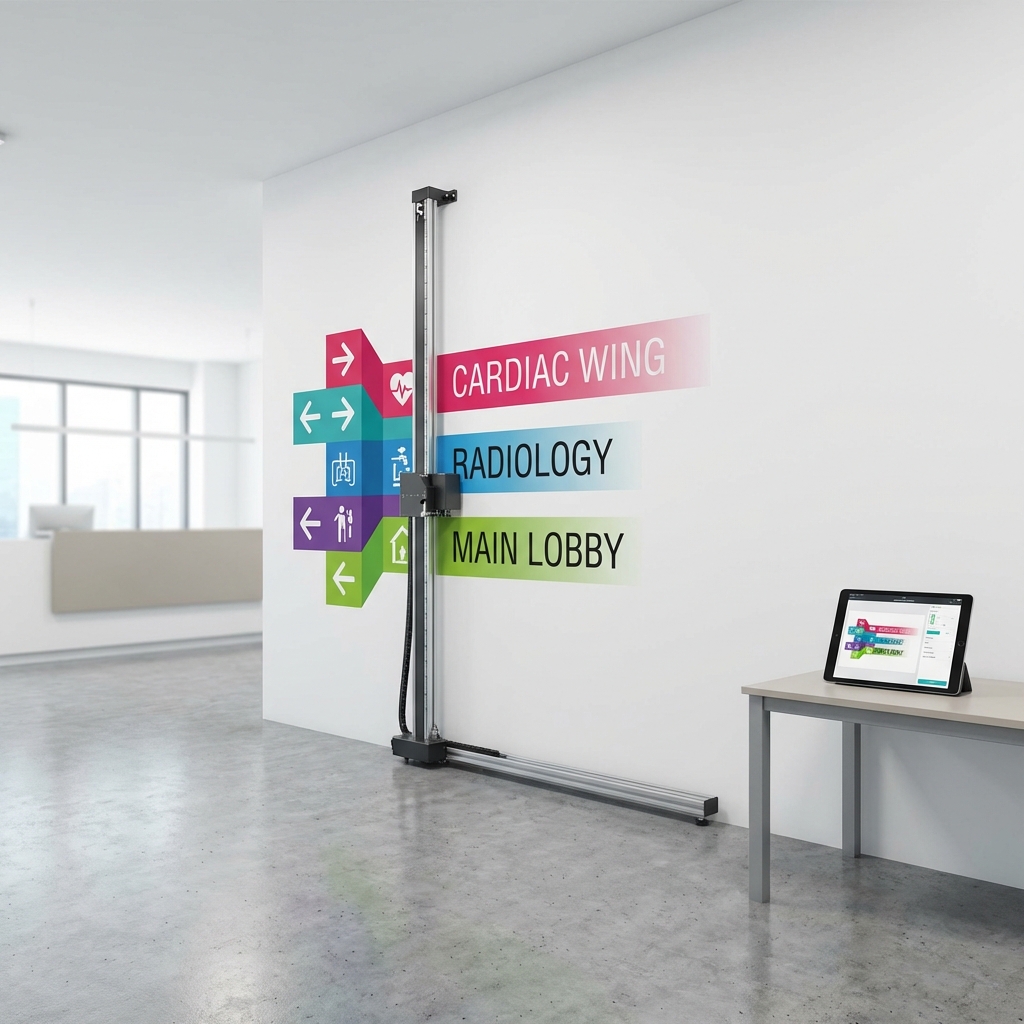
We use direct-to-wall printing technology that eliminates adhesives, vinyl backing, and seams entirely. The process is straightforward: we print high-resolution graphics directly onto your wall substrate using industrial-grade inks, creating a permanent bond that's durable, cleanable, and seamlessly integrated into your architecture.
For wayfinding specifically, this changes everything. Instead of mounting discrete signs, we can create continuous directional flows, color-coded zone markers, and integrated safety graphics that feel like part of the building itself. A healthcare campus can have consistent wayfinding across pediatrics, oncology, and surgery without any visual discontinuity. A university can mark building numbers, floor levels, and emergency assembly points using a unified design system that reinforces brand identity while improving clarity.
The graphics integrate with finished and unfinished surfaces—drywall, concrete, brick, and CMU all work without preparation. Your wall doesn't need to be stripped, primed, or specially treated. We adapt to what exists, reducing pre-work and complexity.
Our On-Site Installation Advantage
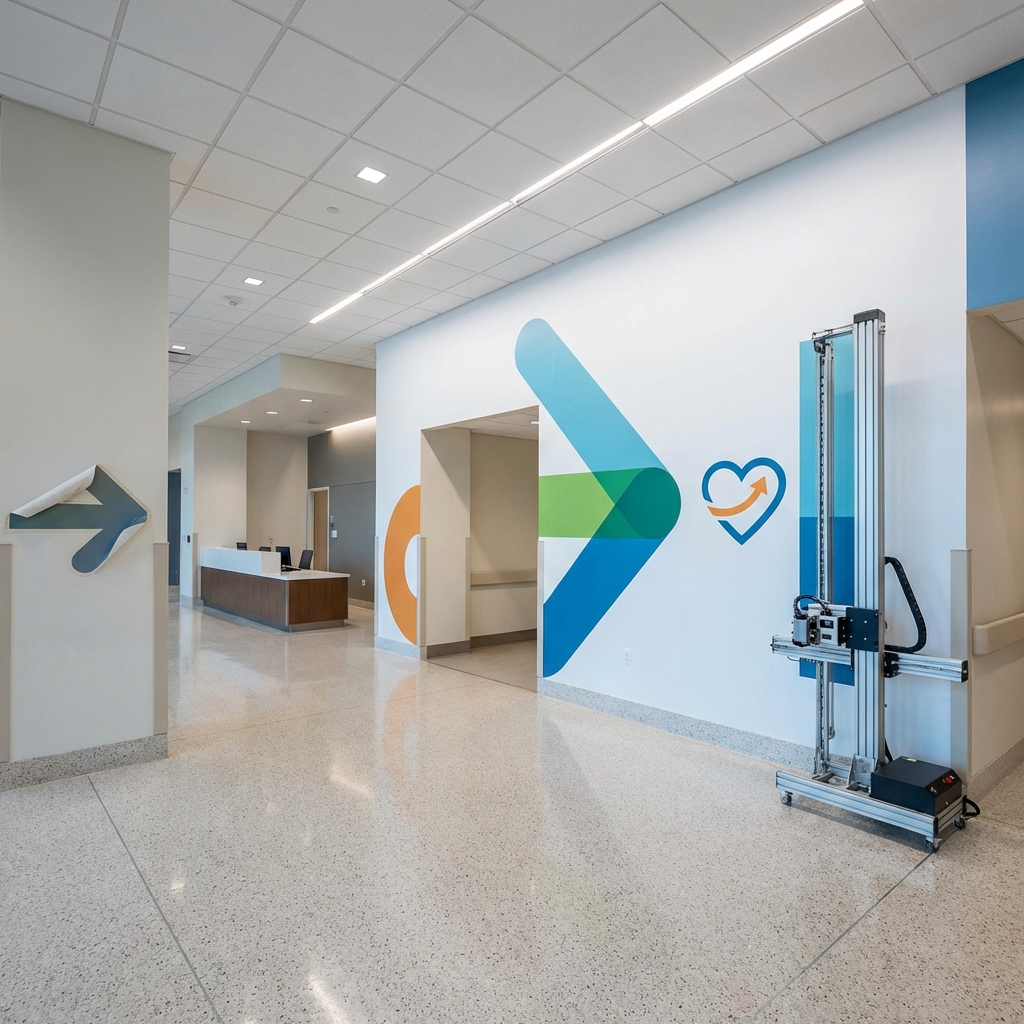
Speed matters in occupied facilities. When we arrive on-site with our printing systems, we complete most installations in under five hours. This eliminates the weeks-long lead times associated with offsite fabrication, shipping delays, and coordination failures that plague traditional approaches.
Our team handles everything on location. We print directly to your walls, meaning zero inventory risk, no damage during transport, and no discrepancies between what was designed and what shows up. If you need to adjust a color, reposition a graphic, or add last-minute information, we can iterate in real time rather than scrapping completed panels and reordering.
For multi-location rollouts, on-site printing ensures consistency. We carry the same design specifications, color profiles, and inking parameters to every building. A 15-campus school district gets identical wayfinding quality at the first location and the last, with minimal logistical complexity.
Learn more about how we manage project management for occupied facilities to minimize disruption.
Seam-Free Wayfinding at Architectural Scale
One of our core strengths is printing at architectural scale without seams. Traditional vinyl or mounted signage requires breaks wherever panels meet. Our technology prints continuously across large wall areas, which is essential for directional graphics that need to flow from one corridor to another without visual interruption.
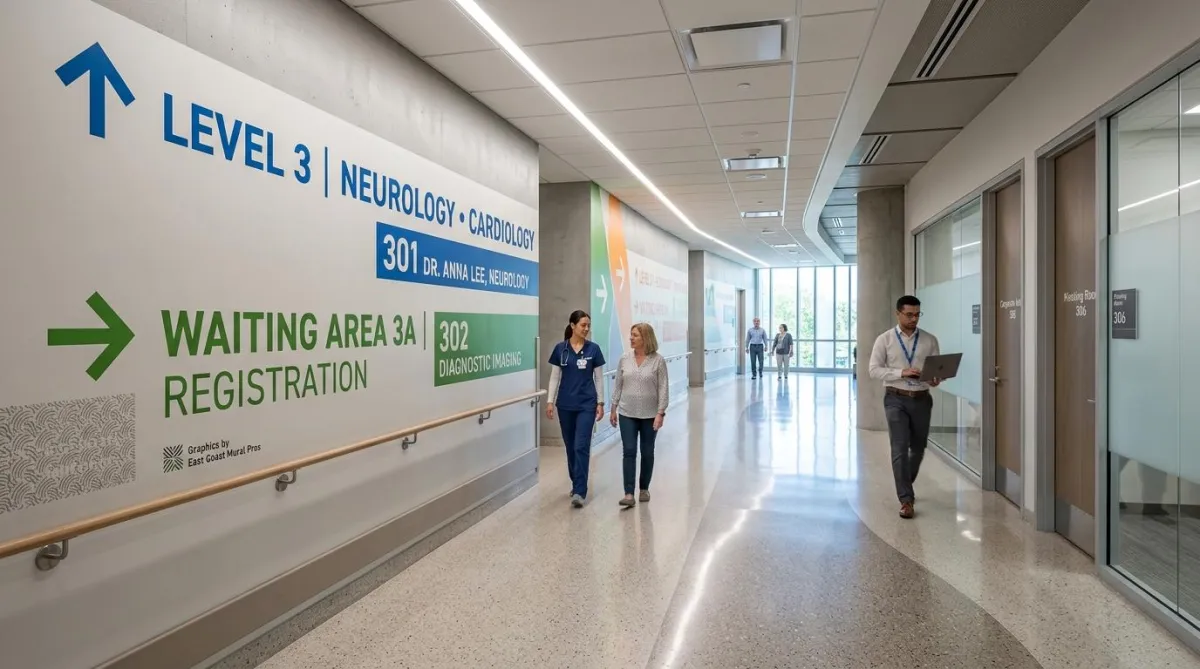
Picture a hospital corridor where color-coding guides patients from the main lobby toward different departments. With traditional methods, you'd see seams every 4 to 5 feet as panels join. That fragmentation actually undermines wayfinding clarity. With our approach, the entire corridor becomes one unified graphic system. The eye follows the color flow naturally because there's nothing to interrupt it.
Seam-free printing also improves durability. Seams are stress points where peeling begins, moisture can enter, and wear becomes visible fastest. Eliminating them extends the lifecycle of your graphics significantly and reduces maintenance calls in high-traffic zones.
Designing for Clarity and Brand Consistency Across Locations
We collaborate closely with your design and facilities teams during the planning phase. Wayfinding graphics must balance three things: clear information hierarchy, brand consistency, and architectural sensitivity. Too much text creates clutter. Too little creates confusion. Colors must be legible under your building's lighting but also consistent across multiple campuses with different architectural conditions.
Our process starts with site surveys that document wall dimensions, surface conditions, lighting angles, and user traffic patterns. We develop a master wayfinding system—a design guide that specifies colors, typography, iconography, and layout rules. This ensures that wayfinding at your downtown office echoes the system at your suburban location, even though the wall conditions and architectural styles differ.
We also identify opportunities to layer messaging. Instead of separate signage for wayfinding, safety instructions, and brand messaging, we integrate them. Emergency assembly points can be marked within the wayfinding system. Department identifiers can include accessibility information. This reduces visual clutter while improving utility.
Implementation Across Healthcare, Education, and Corporate Campuses
Each sector has distinct wayfinding needs, and we've refined our approach for each.
Healthcare facilities need color-coded systems, large-scale department identifiers, and integration with safety protocols. We design wayfinding that doesn't compete with clinical signage but complements it, reducing overall clutter while improving patient navigation and reducing staff time spent on directions.
Educational institutions operate across sprawling campuses with evolving programs. We create modular wayfinding systems that survive program changes. A building that houses Engineering one year and Life Sciences the next doesn't require wayfinding replacement if we design for flexibility. Our paint-over-ready finishes mean future tenants can adapt the space without removing existing graphics.
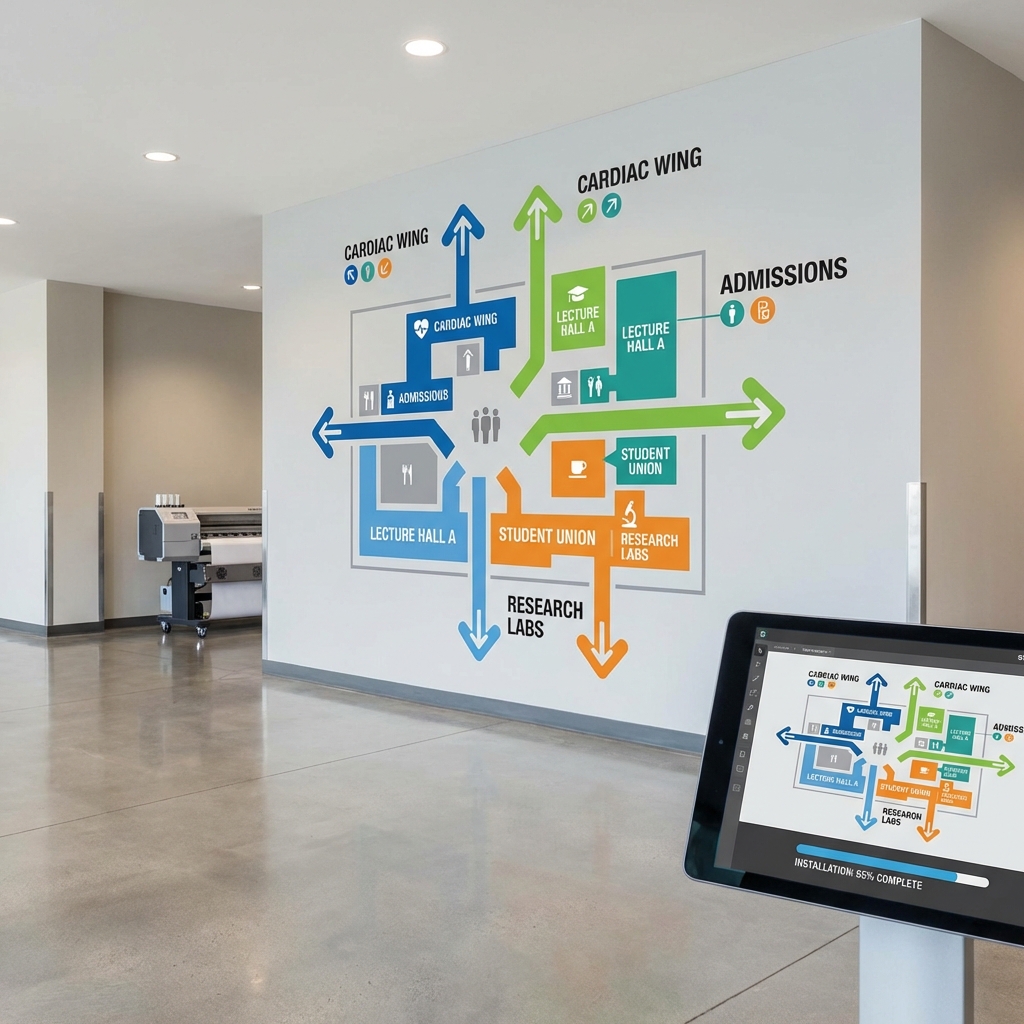
Corporate environments benefit from wayfinding that reinforces workplace culture. We integrate brand elements, highlight meeting spaces, and use graphics to make navigating a large office feel intuitive rather than maze-like.
Across all three, our approach reduces the time employees spend answering navigation questions and improves first-impression experiences for visitors.
Durability and Maintenance in High-Traffic Environments
Wayfinding graphics live in high-traffic corridors. They encounter cleaning products, humidity fluctuations, UV exposure, and contact from foot traffic and equipment. We design for this reality.
Our inks and surface finishes are formulated for commercial durability. They resist fading, clean easily with standard facility protocols, and don't degrade under typical institutional maintenance practices. We can specify finishes optimized for specific conditions—higher gloss for easier cleaning in medical environments, matte finishes for reduced glare in office settings.
The bond between ink and substrate is permanent, which means there's no peeling edge to catch or bubble to form. Unlike vinyl, which can fail in isolated spots, our system either remains intact or fails uniformly across a very large area under extreme conditions. In practice, we rarely see failures. We see durability that outlasts the wayfinding strategy itself, meaning your graphics remain serviceable long after the original design intent changes.
Cost and Lifecycle Efficiency of Architectural Graphics
The financial case for direct-to-wall wayfinding is strong when you account for total cost of ownership. Compare a traditional vinyl installation across a multi-building campus to our approach:
Vinyl approach: $15–20 per square foot installed, plus 18-month replacement cycle, plus recurring spot repairs, plus labor for removal and reinstallation.
Our approach: $12–18 per square foot installed, five-year-plus lifecycle with minimal maintenance, no removal required (we simply paint over and print new graphics when your strategy changes).
The math becomes even more favorable for large institutions. When you scale across 50 walls or 10 buildings, per-unit costs decline, installation timelines compress, and coordination complexity decreases significantly compared to managing dozens of separate vinyl orders and installations.
We also offer subscription models for organizations that want strategic refreshes—seasonal updates, program changes, or periodic brand refresh—without the expense and disruption of full-building renovations. Print, install, refresh: completed in days rather than months.
Seamless Integration Without Construction or Disruption
Many institutions postpone wayfinding upgrades because traditional approaches seem disruptive. New signage requires construction scheduling, facility downtime, and vendor coordination that feels heavy for what should be a relatively straightforward update.
Our installation process is fundamentally low-disruption. We handle surface preparation on-site, which typically involves light cleaning and minimal substrate work. We don't require power tools, heavy equipment, or structural access. A typical corridor wayfinding installation happens with minimal impact to daily operations—often during off-hours, but not always necessary.
For occupied buildings—hospitals running 24/7, schools operating during the academic year, offices operating business-as-usual—we coordinate installation windows that avoid peak traffic. We work nights, weekends, or early mornings as needed. Our team manages the space professionally and leaves no disruption behind.
This approach means you can implement comprehensive wayfinding without the capital project overhead that makes facilities directors hesitant to prioritize updates.
Getting Started With Your Wayfinding Transformation
If you're managing wayfinding challenges across a campus or multi-location facility, the next step is straightforward. We begin with a discovery conversation: understanding your current pain points, the scope of the challenge, and your timeline.
From there, we conduct a site survey to document conditions, capture existing branding guidelines, and identify opportunities for integrated messaging. We'll develop a preliminary design concept and cost estimate so you can make informed decisions before committing to detailed design work.
The entire discovery-to-design phase typically takes 2-4 weeks. Installation follows once design and approvals are complete. For most institutions, we're printing and installing your first location within 8-10 weeks of kickoff.
We're not wayfinding consultants selling strategy reports. We're installation partners who understand facilities operations, budget pressures, and the real need for solutions that work at scale. Our team has walked through enough institutional corridors to know what questions to ask and which shortcuts to avoid.
If you're ready to move past the wayfinding challenges holding back your institution, we're ready to talk. Contact us to schedule a discovery conversation and see how direct-to-wall printing can transform navigation across your facilities.
Contact us to learn more
Frequently Asked Questions (FAQ)
How quickly can we install architectural wayfinding graphics across a multi-location campus or enterprise rollout?
Our on-site printing and installation typically completes in under 5 hours per wall or suite, which means we can refresh wayfinding across multiple buildings or floors in parallel without shutting down your operations. We handle design-to-install coordination centrally, so execution remains consistent across all your locations while minimizing disruption to tenants, patients, students, or staff.
What surfaces can we print directly onto, and will we need construction or surface prep?
We print directly onto finished and unfinished drywall, CMU block, concrete, and brick without adhesives or panels, which eliminates the need for construction crews or extensive prep work. Our installation is clean and low-disruption, and because we integrate graphics into the wall itself rather than layering materials on top, your space feels architecturally complete from day one.
How do these graphics hold up in high-traffic environments like hospitals or universities, and what's the maintenance reality?
Our surfaces are durable and cleanable, designed to withstand the wear and tear of busy institutional settings without peeling, bubbling, or fading like vinyl or wallpaper. When your needs change, we can paint over the graphics and print fresh wayfinding, so your lifecycle costs stay predictable and you avoid the waste cycle of repeated replacement.


