

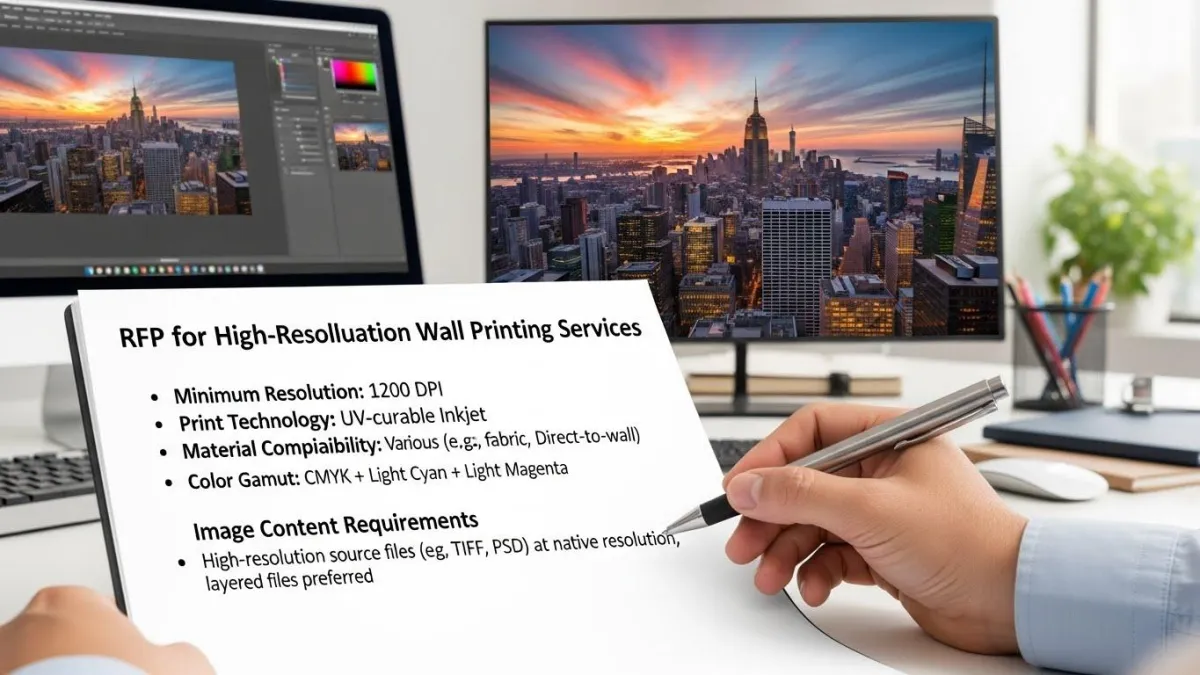
How to Write RFP Specifications for High-Resolution Wall Printing
A procurement-focused guide for institutional renovations
High-resolution wall printing is increasingly evaluated as an alternative to vinyl wallcoverings, wallpaper, and traditional murals in institutional projects. However, many RFPs fail to define the scope clearly—leading to inconsistent bids, apples-to-oranges comparisons, and execution risk.
This guide outlineshow to write clear, neutral, and enforceable RFP specificationsfor high-resolution wall printing, using language appropriate for public and institutional procurement.

1. Define the Scope Neutrally (Avoid Brand Lock-In)
RFPs should describeperformance and outcomes, not proprietary processes or brand names.
Recommended RFP language:
“The project includes on-site, direct-to-wall printing of high-resolution graphics applied directly to existing wall surfaces without the use of vinyl films, wallpaper substrates, or adhesive-backed materials.”
Why this matters (procurement):
Avoids sole-source challenges
Encourages competitive bidding
Keeps the spec outcome-based
2. Specify Resolution and Print Quality Requirements
Resolution should be defined in a way that ismeasurable and verifiable, not subjective.
Recommended RFP language:
“Printed graphics shall be produced using high-resolution digital wall printing technology capable of rendering photographic detail, smooth gradients, and sharp text suitable for close-viewing environments.”
Optional technical add-on (if your procurement team allows):
“Effective print resolution shall be appropriate for architectural graphics viewed at distances of 3–10 feet, with no visible banding, pixelation, or distortion.”
Why this matters:
Prevents low-quality signage systems from qualifying
Aligns expectations across bidders
3. Define Acceptable Substrates and Surface Conditions
Institutions often have mixed wall conditions. RFPs should require flexibility without over-prescribing.
Recommended RFP language:
“The printing system must be capable of printing directly onto common interior wall surfaces, including but not limited to painted drywall, plaster, concrete, brick, and masonry block, subject to reasonable surface preparation.”
Why this matters:
Reduces change orders
Ensures compatibility with existing facilities
4. Address Durability, Cleanability, and Maintenance
This is critical for high-traffic institutional environments.
Recommended RFP language:
“Finished graphics shall be suitable for high-traffic institutional environments and capable of being cleaned using standard non-abrasive cleaning methods without image degradation.”
Optional reference point (non-exclusive):
“Materials and finishes shall meet or exceed durability expectations consistent with ASTM standards for interior wall surfaces.”
Reference (for procurement validation):
ASTM building materials standards
https://www.astm.org/industry/building-construction
5. Installation Time, Access, and Disruption Constraints
Institutions care about downtime more than novelty.
Recommended RFP language:
“Installation shall be performed on-site with minimal disruption to building operations. The selected vendor must provide an estimated installation duration per wall or per square foot and identify any access, clearance, or shutdown requirements.”
Optional clarification:
“Preference may be given to solutions that do not require extended cure times or post-installation off-gassing.”
Related guidance:
IFMA – Facility operations and downtime considerations
https://www.ifma.org/about/what-is-facility-management
6. Environmental and Indoor Air Quality Requirements
Avoid unverifiable sustainability claims. Stick toprocess and outcomes.
Recommended RFP language:
“Printing shall be performed using inks and processes suitable for occupied interior environments. Vendors must disclose any VOC emissions during installation and confirm that no ongoing emissions occur after curing.”
Optional compliance language:
“Solutions should align with institutional indoor air quality guidelines and applicable EPA recommendations.”
Reference:
U.S. EPA – Indoor Air Quality
https://www.epa.gov/indoor-air-quality-iaq
7. Design Coordination and Proofing Requirements
Procurement teams often underestimate this risk.
Recommended RFP language:
“The vendor shall provide digital proofs or mockups for review and approval prior to installation. Final printed output must match approved artwork in scale, color, and placement.”
Optional requirement:
“Vendors shall identify file formats, color management processes, and review timelines as part of the proposal.”
8. Removal, Modification, and End-of-Life Expectations
Future flexibility matters for institutions.
Recommended RFP language:
“The printed graphics must be capable of being modified, over-painted, or removed without damage to the underlying wall substrate or the need for demolition.”
This aligns with lifecycle procurement guidance from:
U.S. General Services Administration – Lifecycle costing
https://www.gsa.gov/real-estate/design-construction/design-excellence/life-cycle-cost-analysis
9. Vendor Qualifications and Experience
Avoid vague “experience required” language.
Recommended RFP language:
“Vendors must demonstrate prior experience delivering high-resolution wall printing in institutional, commercial, or public-sector environments of comparable scale and complexity.”
Optional requirement:
“Proposals shall include a minimum of three relevant project references.”
10. Pricing Structure for Fair Comparison
Ensure bids are comparable.
Recommended RFP language:
“Pricing shall be provided on a per-square-foot basis and must clearly separate design services, printing, installation, surface preparation, and any optional services.”
Final Procurement Note
Well-written RFP specifications for high-resolution wall printing:
Reduce bid ambiguity
Encourage competitive pricing
Minimize change orders
Protect institutions from under-performing solutions
The goal is not to specifyhowvendors print—but to defineperformance, durability, lifecycle, and operational outcomesclearly enough that procurement can make defensible decisions.

Contact Us
📍250 East Sandford Blvd, Studio G2
Mount Vernon, NY 10550
Mon-Sat 7am-9pm · Sun closed


