Integrated Wayfinding Wall Graphics: How Direct-to-Wall Printing Replaces Traditional Signage
Table of Contents
Designing Seamless Wayfinding Systems at Architectural Scale
Cost Efficiency and Lifecycle Advantages Over Traditional Signage
Real-World Applications: Healthcare, Education, and Corporate Spaces
The Problem With Traditional Wayfinding and Signage Clutter
Most commercial and institutional buildings rely on a patchwork of mounted signs, directional posters, and adhesive decals to guide visitors and staff. The result feels fragmented, expensive to maintain, and visually dated within a few years.
We see this constantly: hospital corridors plastered with laminated directional signs, office buildings with mismatched wayfinding systems across floors, and school campuses where signage updates require weeks of procurement and installation. Each mounted sign is a discrete object that collects dust, peels at the edges, and requires replacement when branding shifts or spaces repurpose.
The operational reality gets worse quickly. Traditional signage creates multiple pain points:
Adhesive-backed decals bubble and peel in high-traffic areas, creating a neglected appearance
Printed posters fade under fluorescent and natural light within 18 months
Metal or acrylic sign hardware adds cost per installation and complicates maintenance
Changing wayfinding across a multi-location system means coordinating dozens of separate orders and installers
Removal and replacement generate waste and downtime, especially in occupied buildings
Inconsistent execution across locations dilutes brand coherence
Facilities teams spend significant time and budget maintaining these systems rather than improving the spaces themselves. For decision-makers evaluating long-term value, traditional signage becomes a liability, not an asset.
Why Integrated Wall Graphics Change Everything
Integrated wayfinding wall graphics embed navigation, branding, and instructional content directly into the architecture. Instead of hanging signs, the wall itself becomes the communication medium. We print high-resolution graphics directly onto the drywall, concrete, or CMU substrate, creating a seamless, durable system that feels integrated into the building's design.
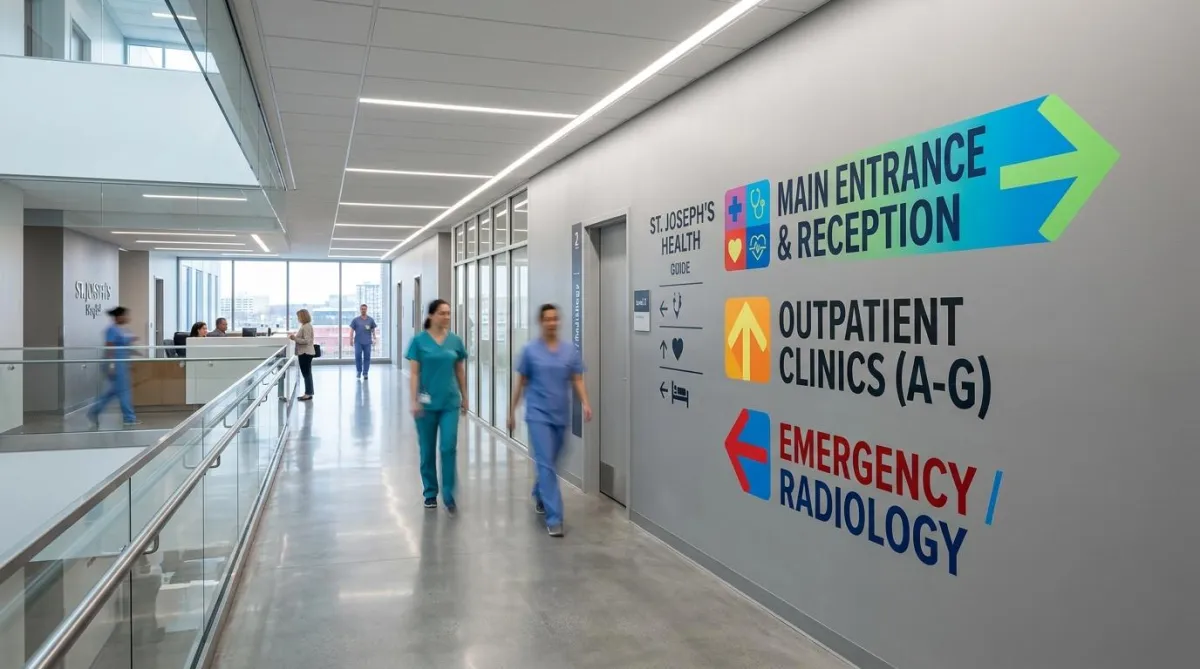
This approach transforms how spaces function operationally and how they feel to occupants. A hospital's patient corridor no longer displays a jumble of directional posters; instead, intuitive color-coded pathways and wayfinding cues guide visitors naturally. A university's academic building integrates room numbers, floor maps, and emergency information into the wall architecture. A corporate office's lobby tells the company story through mural-scale graphics that reinforce brand identity at human scale.
Our direct-to-wall printing technology makes integrated wayfinding practical at any architectural scale. The benefits compound across operational, aesthetic, and financial dimensions:
Wayfinding becomes part of the building, not an afterthought on top of it
Design consistency scales across multiple locations without variation
Graphics resist peeling, fading, and wear because they're cured into the substrate
Updates and refreshes happen on your timeline, not a vendor's inventory cycle
Staff spend time on space management, not signage maintenance
Integrated wayfinding also reduces "signage clutter" that confuses occupants and degrades brand perception. When navigation is woven into wall architecture, spaces feel intentional, calm, and professional.
How Our Direct-to-Wall Printing Technology Works
We use advanced UV-curable printing systems that apply high-resolution graphics directly to finished and unfinished wall surfaces without adhesives, vinyl, or wallpaper backing. The process works on drywall, concrete, CMU block, and brick, making it compatible with nearly any interior environment.
Here's how the technology delivers integrated wayfinding:
Preparation: We assess substrate condition, clean the wall surface, and ensure drywall is properly finished or sealed. For unfinished surfaces, minimal substrate prep is required.
Pre-print verification: We confirm color calibration, alignment, and scale using digital proofs. This step prevents costly on-site corrections.
Direct printing: Our equipment applies UV-curable inks at high resolution, layer by layer, building the full graphic. There's no cutting, no vinyl application, no adhesive mess. The image cures instantly under UV exposure, bonding to the substrate permanently.
Finishing: Depending on your durability needs, we apply a protective topcoat (optional for high-touch areas like corridors) or leave the surface paint-over-ready for future tenant transitions.
The result is a photoreal, seam-free graphic that performs like painted architecture. Because there's no adhesive layer, no air pockets, and no material overlap, your integrated wayfinding graphics stay crisp and clean for years in high-traffic environments.
Designing Seamless Wayfinding Systems at Architectural Scale
Effective integrated wayfinding requires strategic design thinking, not just graphic placement. We collaborate with your team, architects, and brand stakeholders to create systems that serve both navigation and aesthetic function.
Our design process typically includes:
Stakeholder workshops: We gather input from facilities, operations, brand, and occupant experience teams to define wayfinding priorities (directional clarity, brand expression, ADA compliance, emergency egress).
Site audits: We map current movement patterns, identify decision points, and note sightline constraints. A hospital's emergency department flows differently than its surgical wing; a university campus needs different wayfinding strategies at building entry, stairwells, and corridors.
Digital mockups and proofs: We test layouts, color contrast, typography scale, and icon systems in context before any printing happens.
Phased rollout planning: For multi-building systems, we establish a sequence that allows for refinement and staff feedback before full deployment.
Key design principles we follow:
Keep messaging concise and visual; most occupants spend less than 3 seconds at a decision point
Use consistent color coding (e.g., blue for administrative areas, green for clinical) across the entire system
Ensure wayfinding graphics meet ADA contrast and legibility standards without compromising aesthetic
Integrate emergency egress information and safety messages into the overall graphic language
Layer information hierarchically so main messages stand out and secondary details support exploration
The goal is navigation that feels natural and almost invisible because it's woven into how the space is designed, not overlaid onto it.
Installation Speed and Minimal Operational Disruption
One of our core competitive advantages is speed. We typically complete wayfinding installations in under 5 hours per wall or section, and we do this in occupied buildings without shutting down operations.
Our minimal disruption installation approach works because there's no construction, no wet adhesive, and no complex hardware installation. A 2-3 person team arrives with our portable printing equipment, preps the wall surface (usually under 30 minutes), prints the graphic, and leaves. No fumes, no drying time, no follow-up visits.
For a hospital wayfinding project, we can install directional graphics in corridors during normal business hours, staging the work to avoid patient care areas and high-traffic times. For a university building, we print during evening or weekend windows to minimize disruption to classes and student flow. For a corporate office, we work during off-hours or around scheduled building maintenance windows.
This speed advantage translates directly to cost and schedule certainty. You're not paying for extended project timelines, temporary signage during installation, or lost operational capacity. Wayfinding systems go live on your timeline, often within 2-4 weeks from design approval to final installation.
Durability and Cleanability in High-Traffic Environments
Integrated wayfinding graphics absorb significant wear. Hospital corridors see thousands of foot traffic events weekly. School hallways endure bumps, leaning, and environmental stress. Office lobbies face dust, light exposure, and hand contact. Our direct-to-wall printing systems are engineered for these conditions.
The durability comes from how we cure the graphics. UV-cured inks bond directly to the substrate at a molecular level, not as a surface layer. There's no adhesive layer to fail, no vinyl seams to separate, and no topcoat to scratch and peel. This means:
Graphics remain crisp and vibrant for 5+ years in normal indoor conditions
Moderate scuffing or contact doesn't degrade the image or integrity
Optional protective topcoats add stain resistance and cleanability for environments like healthcare facilities
Paint-over-ready finishes allow you to repaint or re-brand without material removal; simply paint over the graphic when your wayfinding needs evolve
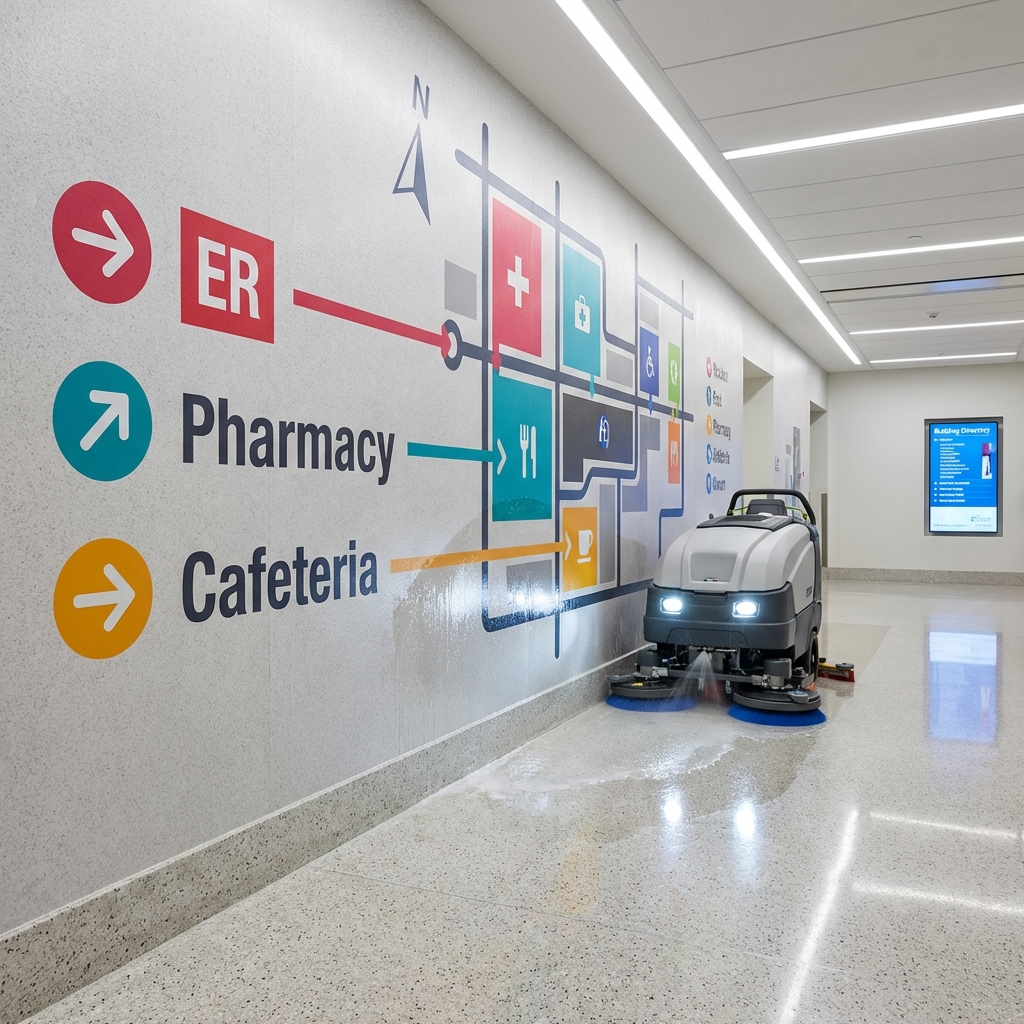
Maintenance is straightforward. Dust with a soft cloth or standard building maintenance supplies. For stains or marks, use mild soap and water. For healthcare or food-service environments, we recommend a protective topcoat that can withstand hospital-grade disinfectants without yellowing or clouding.
We've installed integrated wayfinding graphics in high-traffic hospital emergency departments, university libraries, and airport terminals. The graphics remain vibrant and functional well beyond traditional signage lifespans.
Scaling Wayfinding Across Multi-Location Facilities
Managing consistent wayfinding across multiple buildings or campuses requires coordination and quality control. We handle both.
Our scaling approach ensures brand consistency and operational alignment across all locations:
Master design templates: We develop core wayfinding systems that translate across architectural variations (different ceiling heights, wall finishes, natural light) while maintaining visual coherence.
Localized customization: Each location's wayfinding is tailored to its layout and occupant flow without deviating from the overall system language.
Phased rollout: We sequence installations across your campus or multi-location system, often starting with a pilot building where we gather feedback and refine execution before full deployment.
Installation teams and scheduling: We coordinate our technicians across geographies and time zones, managing schedules to minimize disruption at each location.
Quality documentation: Every installation is photographed and archived, creating a reference library for consistency audits and future maintenance.
For a 12-campus university system, we can deploy integrated wayfinding across all locations within 6-8 months, maintaining design consistency and allowing for local feedback. For a healthcare network with 8 hospitals, we establish core wayfinding principles that adapt to each facility's clinical workflow while creating a unified brand experience. For a retail chain rolling out a refreshed brand identity, we can reprogram graphics across 50+ locations on a synchronized timeline.
This scalability is only possible because our process is reproducible, our equipment is portable, and our teams understand how to manage complex, multi-location operations.
Cost Efficiency and Lifecycle Advantages Over Traditional Signage
When facilities teams evaluate wayfinding options, cost matters. But lifecycle cost, not just installation cost, should drive the decision.
Traditional mounted signage typically costs less upfront but becomes expensive over 5-10 years because it requires:
Replacement cycles as adhesive fails and printed materials fade (every 2-3 years)
Hardware maintenance and repairs (brackets, fasteners, mounting damage)
Disruption and labor costs for removals and reinstalls
Procurement delays and inconsistent vendor execution across locations
Integrated wayfinding graphics cost more initially but deliver superior total cost of ownership:
Installation happens once; graphics remain functional for 5+ years without replacement
Maintenance requires no specialized labor, no hardware replacement, and minimal materials
Updates (brand refreshes, wayfinding changes) can be accomplished by repainting over existing graphics or selective reprinting
Disruption is minimal and predictable, reducing operational costs and schedule risk
Scalability across locations is efficient because processes are standardized and repeatable
For a typical mid-size institution (hospital, university, corporate office), integrated wayfinding across primary corridors and common areas breaks even against traditional signage within 3-5 years. Beyond that, the cost advantage compounds as traditional systems require their third or fourth replacement cycle.
Additionally, the environmental efficiency is significant. Integrated wayfinding eliminates vinyl waste, adhesive chemicals, and the energy cost of frequent replacements and shipping delays. For institutions evaluating sustainability goals, direct-to-wall printing is measurably more efficient than wallpaper, vinyl wraps, and mounted signage.
Real-World Applications: Healthcare, Education, and Corporate Spaces
Our integrated wayfinding systems serve different operational and aesthetic needs across sectors.
Healthcare facilities benefit most from wayfinding clarity and durability. A 250-bed regional hospital we worked with was struggling with patient and visitor navigation; outdated directional posters covered walls in their emergency department and surgical floors. We designed an integrated wayfinding system using consistent color-coded pathways, room numbering, and emergency egress graphics. The hospital printed across all clinical corridors, emergency department, and surgical pre-op areas. Installation happened during night shifts over 3 weeks. Within 6 months, the hospital reported reduced visitor navigation inquiries and improved patient experience surveys. The graphics remain vibrant 4+ years later with minimal maintenance.
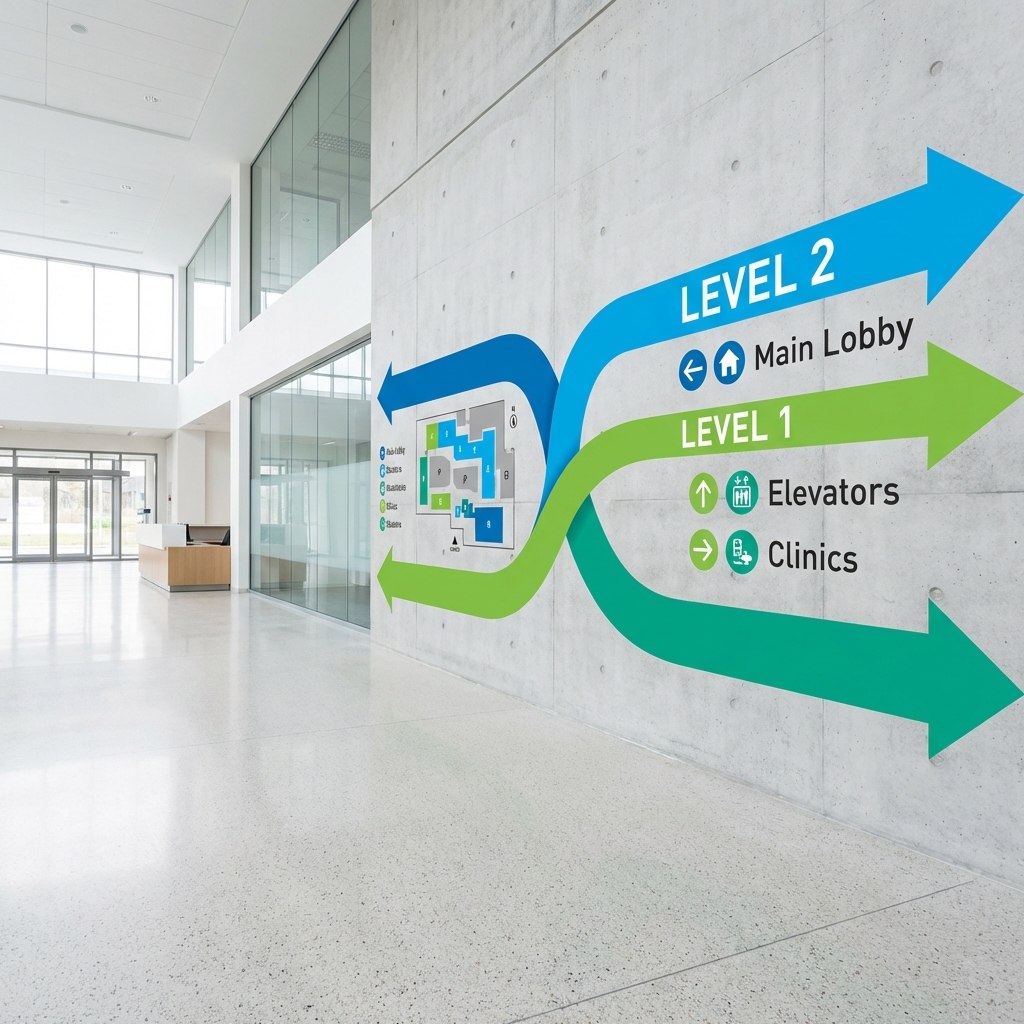
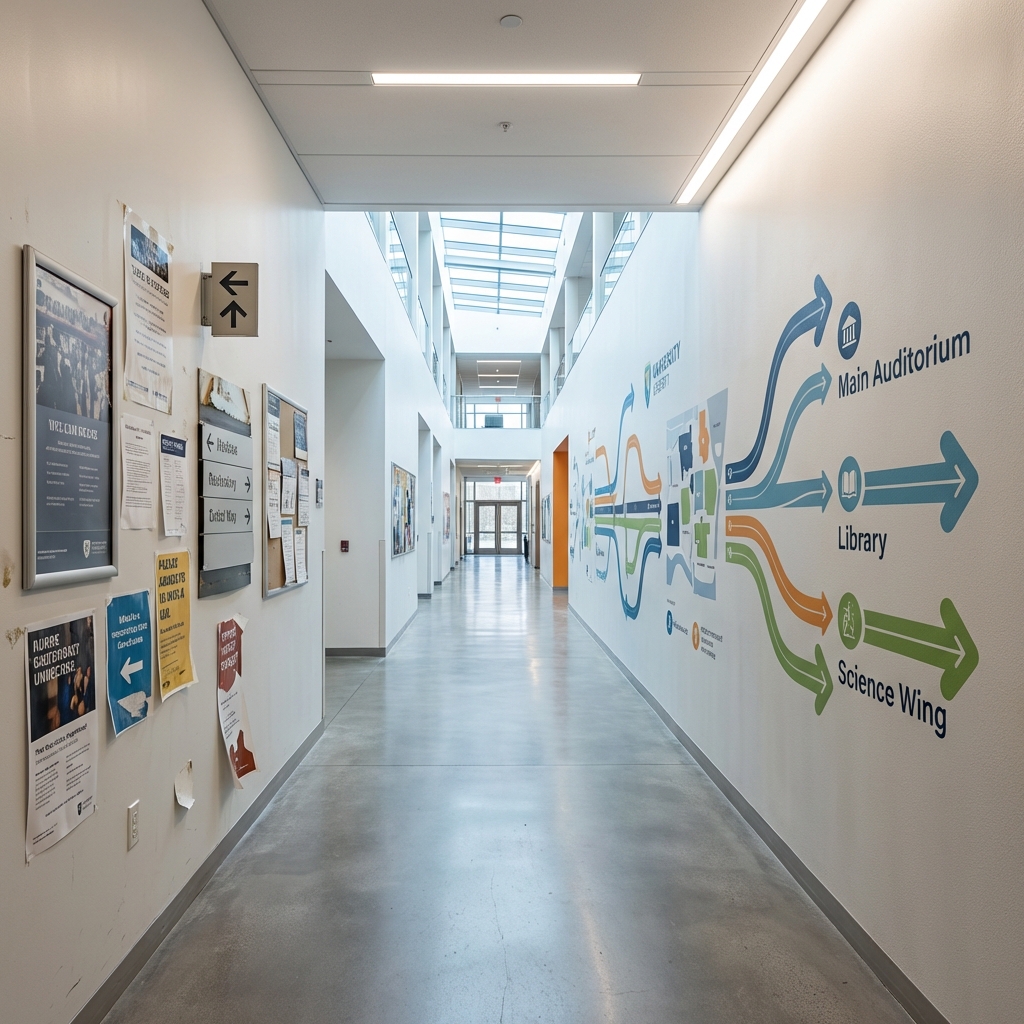
Educational institutions use integrated wayfinding to strengthen campus identity and student orientation. A 40,000-student university needed cohesive wayfinding across 12 academic buildings. We developed a modular wayfinding system that incorporated the university's brand colors and typography, adapted to each building's floor plan. Floor maps, room numbering, and directional cues were integrated into wall graphics at key stairwells, building entries, and corridor decision points. Students reported faster navigation within the first semester; the university refreshed the system once (repainting select graphics) without replacing the underlying wayfinding infrastructure.
Corporate and commercial spaces leverage integrated wayfinding for brand expression and space efficiency. A 4-floor financial services office with high visitor volume was updating its reception areas and floor entrances. We designed large-format wayfinding graphics that incorporated the company's brand narrative, directional information, and departmental identification. The graphics doubled as brand messaging, turning functional wayfinding into an asset that reinforced company identity. Installation required 2 days across the 4-floor lobby and entry zones, with minimal disruption to daily operations.
These applications demonstrate how integrated wayfinding serves both practical (navigation, clarity, durability) and strategic (brand, experience, scalability) goals simultaneously.
Getting Started With Your Integrated Wayfinding Project
If you're evaluating integrated wayfinding for your facility or organization, here's how to move forward:
1. Assess your current system: Walk your primary wayfinding areas (building entries, major corridors, stairwells, decision points). Document what works, what fails (peeling signs, unclear directions, outdated information), and where occupants struggle to navigate.
2. Define your project scope: Identify which areas benefit most from integrated wayfinding. Start with a high-impact zone (primary corridor, lobby, emergency egress) rather than your entire facility. Pilots reduce risk and allow you to refine strategy before scaling.
3. Engage stakeholders early: Involve facilities, operations, brand, and occupant experience teams. Wayfinding decisions affect multiple functions, and buy-in accelerates project timelines.
4. Request a site assessment and proposal: We'll visit your facility, evaluate substrate conditions, understand your operational constraints, and provide a detailed scope, timeline, and investment summary. Assessments typically take 1-2 hours and inform realistic planning.
5. Develop your design collaboratively: We work with your team and any external design partners to create mockups, test color contrast and scale, and validate the system before printing begins.
6. Plan your installation schedule: We coordinate timelines that minimize disruption. Most wayfinding installations happen within 2-4 weeks from design approval.
Integrated wayfinding wall graphics represent a fundamental shift in how organizations approach space navigation and brand communication. If you're ready to move beyond traditional signage clutter and invest in a durable, scalable, design-forward solution, we're here to help guide the process from assessment through installation and beyond.
Contact us to learn more
Frequently Asked Questions (FAQ)
How long does it take to install integrated wayfinding graphics across a multi-location facility?
We typically complete on-site printing and installation in under 5 hours per location, which means we can execute wayfinding rollouts across multiple buildings with minimal operational disruption. Our direct-to-wall process eliminates shipping delays and fabrication errors that plague traditional signage vendors, so we can maintain consistent execution and timelines across national deployments. We work around your occupancy schedule, installing during off-hours or low-traffic periods when necessary.
Can your wayfinding graphics be updated or changed if our facility's layout or branding evolves?
Yes. We print graphics directly onto your walls without adhesives or panels, so refreshing wayfinding is straightforward when your needs change. Our paint-over-ready finishes mean you can modify graphics, update directional information, or rebrand without removing embedded infrastructure. We also support seasonal or strategic refreshes through our subscription model if you need regular updates to reflect operational changes.
What makes your integrated wayfinding approach more durable than traditional mounted signage?
We create seam-free, high-resolution graphics that bond directly to your wall surface, eliminating the peeling, bubbling, and deterioration that plague vinyl wraps and mounted signs in high-traffic environments. Our surfaces are designed to be cleanable and resistant to wear, which significantly extends the lifecycle and reduces replacement cycles. Because the graphics are integrated into the architecture rather than applied on top, they maintain their appearance through years of institutional use without maintenance headaches.


