
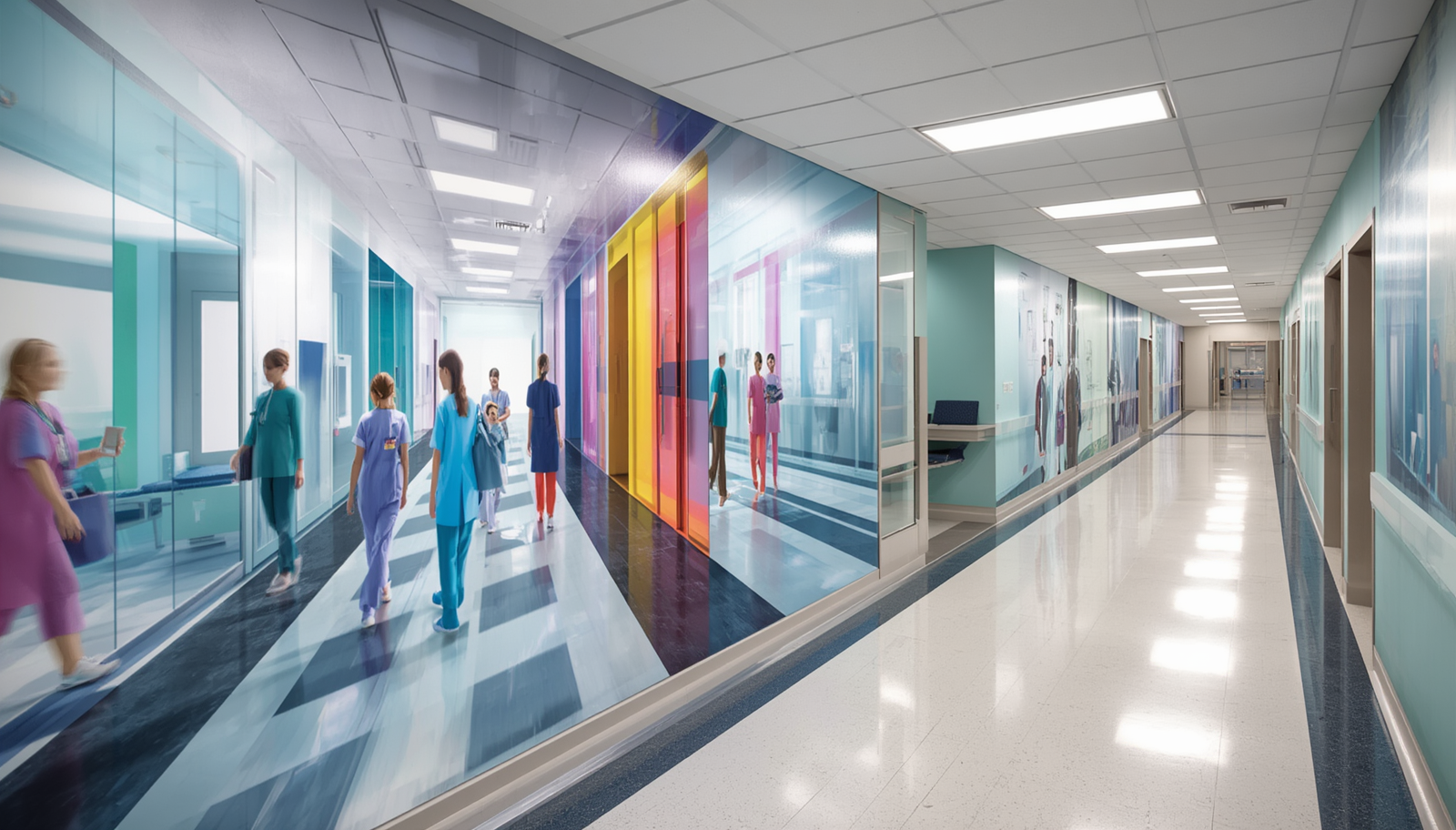
Durable Hospital Wall Graphics: Why Direct-to-Wall Printing Outperforms Vinyl
Table of Contents
Infection Control and Cleanability: Non-Negotiable in Healthcare
How Our Direct-to-Wall Printing Technology Changes Everything
The Challenge: Why Traditional Hospital Wall Solutions Fail
Healthcare facilities operate under constraints that most commercial spaces don't face. Patient safety, regulatory compliance, infection control, and 24/7 operational continuity all shape how you can update and maintain your interior environment. Yet when it comes to wall graphics—wayfinding, branding, safety signage, departmental identification—many hospitals still rely on vinyl wall coverings, wallpaper, and printed decals that were designed for retail or office settings, not clinical environments.
The result is a cycle of deterioration. Vinyl peels at seams, bubbles near high-traffic areas, and collects moisture that harbors microbial growth. Wallpaper tears, stains, and requires downtime to replace. Decals fade under fluorescent lighting and cleaning protocols. Each refresh requires procurement cycles, installation windows that conflict with patient schedules, and disposal of materials that add to your facility's environmental footprint.
We built our direct-to-wall printing technology specifically to break that cycle. Our approach eliminates adhesives, vinyl substrates, and seams altogether. Instead, we print high-resolution graphics directly onto your existing wall surfaces, creating durable, cleanable finishes that integrate seamlessly with your architecture and meet healthcare's exacting standards.
Infection Control and Cleanability: Non-Negotiable in Healthcare
Infection control is not negotiable in hospitals. Your walls are part of your infection prevention strategy. We understand that every surface in your facility—especially high-touch areas and walls adjacent to patient care zones—must be cleanable without degradation.
Our direct-to-wall printing creates a finish that can be wiped, sanitized, and disinfected repeatedly without peeling, bubbling, or color loss. We use proven inks and application methods that produce surfaces tested for compatibility with hospital-grade disinfectants including bleach-based cleaners, quaternary ammonium compounds, and alcohol-based solutions. The finish cures into a hard, non-porous layer that resists microbial adhesion far more effectively than vinyl seams or wallpaper edges.
Here's what matters operationally: your housekeeping and infection control teams can treat these graphics the same way they treat painted walls. No special protocols. No need to work around delicate seams or risk moisture infiltration. This simplicity reduces training burden and eliminates the hidden cost of workarounds.
Key takeaway: Test your final graphics against your facility's actual disinfection protocol before full rollout. We provide sample panels for validation in your lab environment.
Why Vinyl and Wallpaper Don't Meet Hospital Standards
Vinyl wall coverings and wallpaper present structural vulnerabilities that are particularly problematic in healthcare:
Seam separation: Moisture and temperature fluctuations cause vinyl seams to lift. In humid climates or near bathrooms and clinical sinks, seam failure is common within 18-24 months.
Microbial harboring: Moisture trapped under vinyl or at wallpaper edges creates ideal conditions for mold and bacterial growth. Infection control teams must monitor and often discard these materials earlier than planned.
Chemical incompatibility: Hospital disinfectants—especially bleach—degrade vinyl adhesives and cause color bleeding and surface breakdown.
Replacement disruption: Removing failed vinyl or wallpaper requires downtime, waste disposal, and re-procurement cycles that interrupt operations.
Sustainability burden: Vinyl and wallpaper generate considerable waste. Many facilities face pressure from environmental compliance and brand commitments to reduce single-use materials.
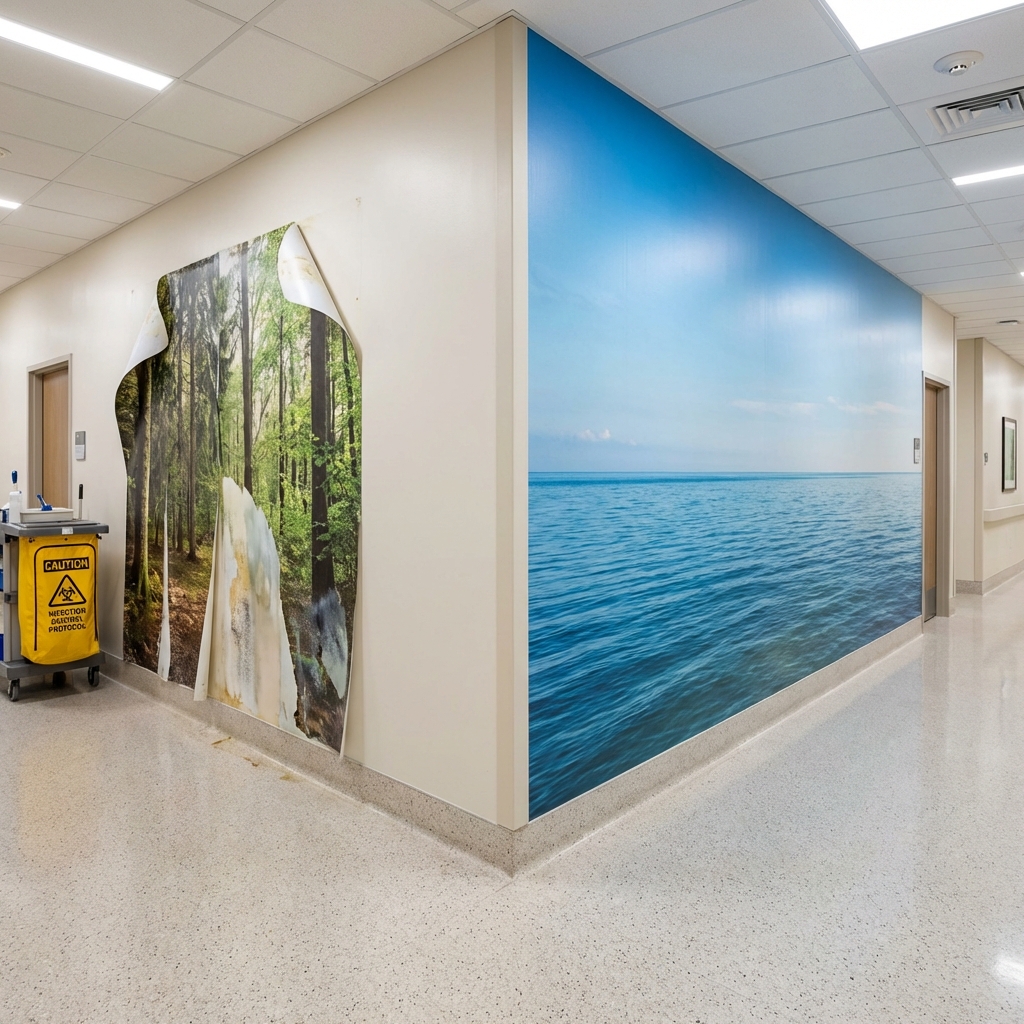
Our direct-to-wall vs vinyl comparison details the lifecycle performance differences in high-traffic settings. But in healthcare specifically, the infection control advantage alone justifies the switch. You're not just upgrading graphics; you're simplifying your infection prevention program.
How Our Direct-to-Wall Printing Technology Changes Everything
We bring industrial inkjet printing technology to your walls in place. Our equipment applies pigment-based inks directly to your substrate—drywall, CMU block, concrete, or painted surfaces—and bonds them into a cured, durable finish without intermediate adhesive layers.
The process is straightforward:
We assess your wall surface and prepare it (cleaning, minor repairs, primer if needed).
We calibrate our equipment for substrate type, ambient temperature, and humidity.
We print your graphics at full resolution, typically completing 300-500 square feet in a single session.
The finish cures within hours, requiring no additional sealing or post-processing.
What you gain is seam-free coverage at architectural scale. A 40-foot wayfinding corridor. A 16-foot departmental identity wall. Photorealistic imagery or bold graphic systems—all integrated directly into your space without visible transitions, edge lift, or maintenance vulnerabilities.
For healthcare, this means graphics that won't deteriorate and won't require special handling. Your maintenance team treats them as part of the wall itself.
Installation Speed: Minimal Disruption to Patient Care
Patient care continuity is non-negotiable. We designed our direct-to-wall installation method to operate in occupied facilities without shutdowns or extended windows.
Most hospital graphics projects complete in under 5 hours of active installation per wall or zone. We can work during off-peak hours—early mornings, evenings, weekends—to avoid patient movement, clinical operations, or visitor traffic. Our team brings all equipment on-site; there's no shipping delay, no fabrication facility lead time, no crated materials blocking corridors.
This speed matters in practice. A new departmental rebrand, wayfinding overhaul, or safety graphic refresh doesn't require a construction project or procurement delay. You schedule it around your existing calendar. We execute it with minimal disruption.
Action item: Identify your preferred installation window (weekend, evening, specific day of week) and communicate it upfront. We'll work backward from that date to ensure design approval and substrate preparation align.
Seam-Free, Integrated Branding Across Your Campus
Hospital campuses often include dozens of interconnected buildings, wings, and clinical zones. Maintaining visual consistency across this scale is difficult with traditional graphics. Vinyl installation across multiple buildings creates compound risks: seam misalignment between adjacent walls, color drift due to different fabrication batches, and installation quality variation.
We deliver seam-free consistency because we print on-site, in real-time, to your actual walls. A 60-foot wayfinding corridor with a gradient transition, a clinical zone with integrated safety signage, a patient waiting area with cohesive branding—all execute identically across your entire campus because we're working from one master file on one platform.
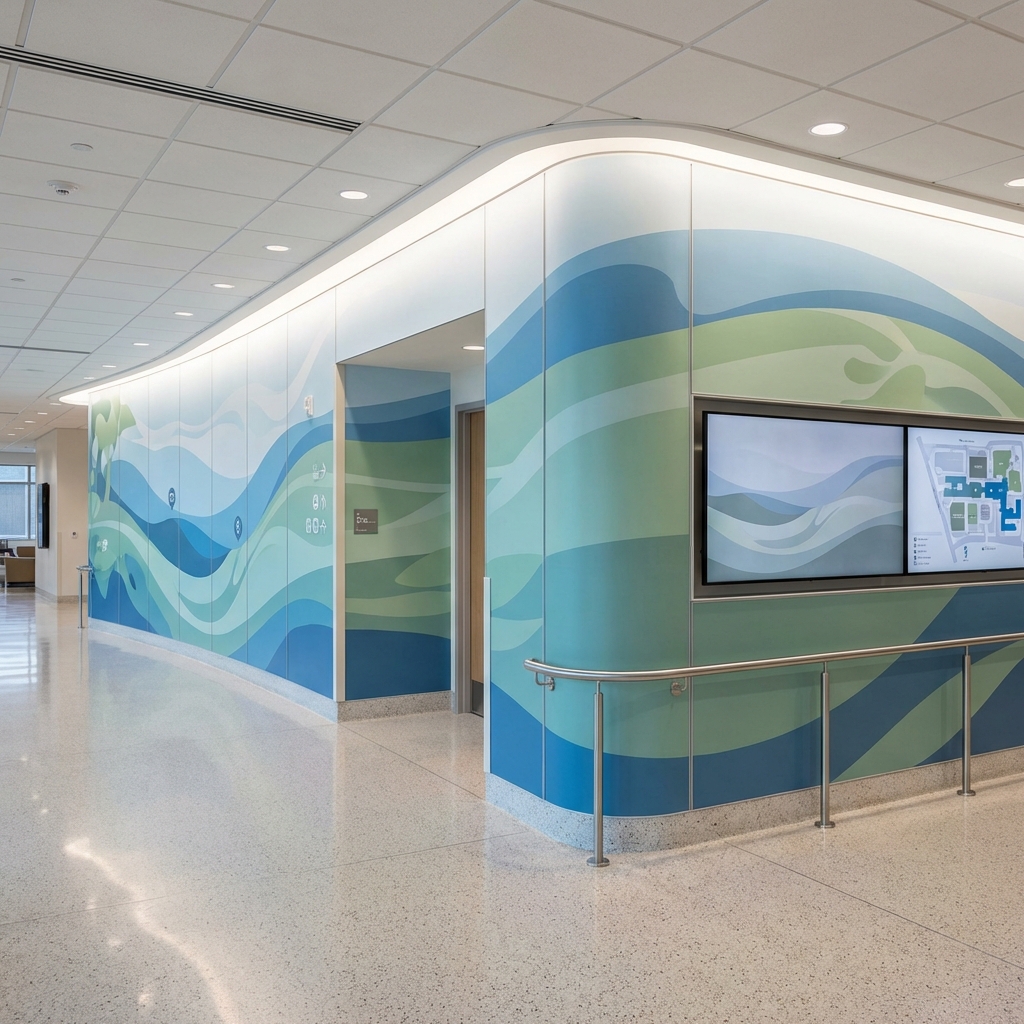
This also simplifies procurement and vendor management. You're working with a single team and single technology across your full campus rollout, not negotiating with multiple vinyl fabricators or managing installation inconsistency across regions.
Designing Wayfinding and Safety Graphics Into the Walls
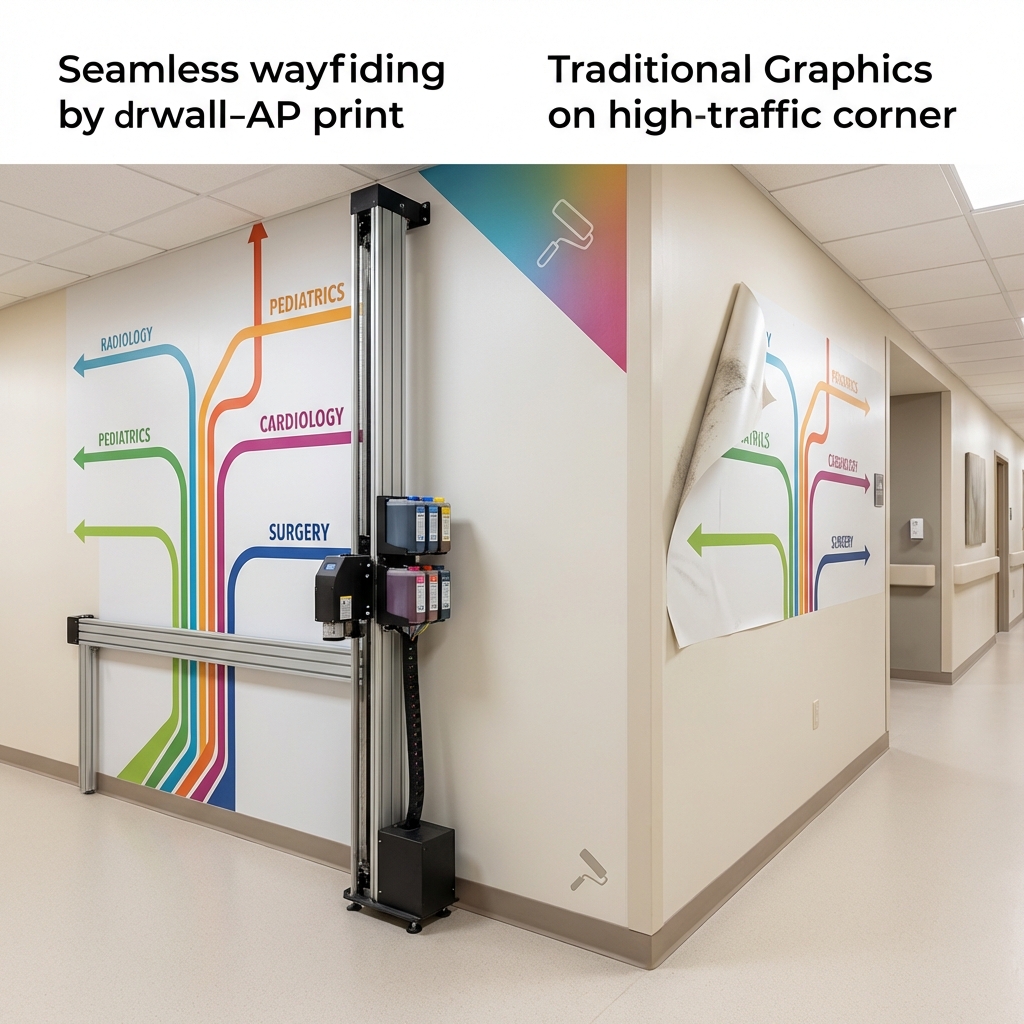
Wayfinding and safety signage are especially powerful when they're integrated into your architecture, not layered on top of it. We help you embed directional cues, exit routes, department names, and clinical protocols directly into wall graphics, reducing visual clutter and improving patient and staff navigation.
Consider a patient corridor where wall color, wayfinding arrows, departmental identity, and infection control protocols are all unified in one cohesive graphic system. Instead of multiple decals, printed signs, and painted stripes, you have a single, integrated solution that is more professional, easier to maintain, and easier to update.
When your facility needs to change protocols, redesign a department, or refresh branding, you update the digital file and reprint that section. No removal of adhesive remnants. No procurement of new signage. Just clean execution of your new design.
Lifecycle Efficiency: Lower Total Cost of Ownership
Total cost of ownership in healthcare includes material cost, labor, downtime, maintenance, and waste disposal. Traditional wall graphics often appear inexpensive upfront but become costly over their lifecycle.
Here's a real comparison: vinyl wall coverings for a 2,000-square-foot clinical zone costs roughly 8,000-12,000 dollars (material and labor). Typical lifespan is 3-5 years before seam failure or discoloration requires replacement. You repeat this cycle every 5 years indefinitely.
Our direct-to-wall graphics for the same space cost approximately 10,000-14,000 dollars but last 8-10 years in high-traffic, high-disinfection environments because they have no seams, no adhesives, and no moisture vulnerabilities. Over a 20-year facility lifecycle, the difference compounds significantly, especially when you factor in avoided downtime and reduced waste disposal costs.
Key takeaway: Request a lifecycle cost analysis from us for your specific square footage, traffic patterns, and refresh timeline. We'll model labor, material, and downtime costs across five- and ten-year spans so you can compare directly to vinyl quotes.
Scaling Graphics Across Multi-Hospital Systems
Health systems managing multiple facilities face coordination complexity. Inconsistent brand execution, divergent refresh timelines, and vendor management overhead across sites create operational friction.
We specialize in multi-location rollouts. We deliver the same graphics, same quality, same timeline to your flagship campus, your satellite clinic, and your regional network simultaneously. Our on-site printing capability means no central fabrication bottleneck. We manage digital asset consistency while your local facilities teams coordinate installation windows.
For a health system with five hospitals, this means unified brand presence, coordinated refresh cycles, and simplified procurement—one partner, one platform, scalable execution.
Real-World Results: Healthcare Facilities That Chose Us
A 400-bed academic medical center in the Mid-Atlantic used vinyl wall coverings across three clinical wings. Seams failed within 18 months in humid summer months; replacement cycles disrupted operations and contradicted their sustainability commitments. They switched to our direct-to-wall system for wayfinding and departmental branding across 5,000 square feet. Three years later, zero maintenance required. Their housekeeping teams report zero complications with disinfection protocols. The graphics remain sharp and vibrant.
A specialty children's hospital used our system for patient-facing corridors and waiting areas. They integrated bold, photorealistic imagery—underwater scenes, forest themes, space exploration—directly into walls. The seam-free integration created immersive environments that reduced patient anxiety. Maintenance is minimal; the durable finish withstands high-touch interaction and frequent cleaning.
These aren't one-off projects. They're templates for how healthcare facilities can upgrade their interiors without accepting the lifecycle burden of traditional wall graphics.
Getting Started With Your Hospital Graphics Strategy
The path forward is straightforward:
Identify your priority zones. Start with high-impact areas: patient corridors, wayfinding systems, departmental branding, or clinical protocol displays.
Conduct a substrate assessment. We evaluate your wall surfaces, current conditions, and any preparation needed.
Design collaboratively. We work with your facilities, branding, and infection control teams to develop graphics that align with your clinical and operational requirements.
Pilot before scaling. We recommend a 400-600 square foot pilot project to validate performance, maintenance protocols, and team buy-in before broader rollout.
Schedule and execute. Once approved, we coordinate installation timing around your operational calendar.
Reach out to our team with details about your facility's square footage, current wall covering situation, and timeline. We'll provide a detailed proposal and lifecycle analysis. Healthcare deserves wall graphics that are as reliable, cleanable, and durable as the rest of your clinical infrastructure.
Contact us to learn more
Frequently Asked Questions (FAQ)
How quickly can we install wall graphics in an occupied hospital without disrupting patient care?
We typically complete installation in under 5 hours, and our on-site direct-to-wall printing process requires minimal setup or cleanup. Because we don't use adhesives, panels, or extended curing times, we can work in occupied wings, hallways, and patient-facing areas without forcing closures or scheduling around operational downtime. We've designed our process specifically for healthcare environments where schedule certainty and low disruption are non-negotiable.
Can your wall graphics withstand the cleaning and infection control protocols hospitals require?
Yes. Our direct-to-wall surfaces are durable and fully cleanable with standard hospital-grade disinfectants and antimicrobial protocols. Unlike vinyl that can peel, bubble, or harbor bacteria at seams, our seamless graphics integrate directly into the wall and can be wiped down, sanitized, or re-cleaned without degradation. We've built our finishes specifically to meet infection control standards while maintaining image quality and durability over time.
What happens when a hospital needs to change graphics due to rebranding, departmental shifts, or lease expiration?
We finish our graphics paint-over-ready, so facilities can repaint and refresh without removal or remediation costs. If you want to replace the graphics entirely, we can print new designs directly over the old surface. This approach eliminates the waste and expense associated with vinyl removal and adhesive cleanup, and it gives you flexibility to evolve your space as your organization's needs change.


