
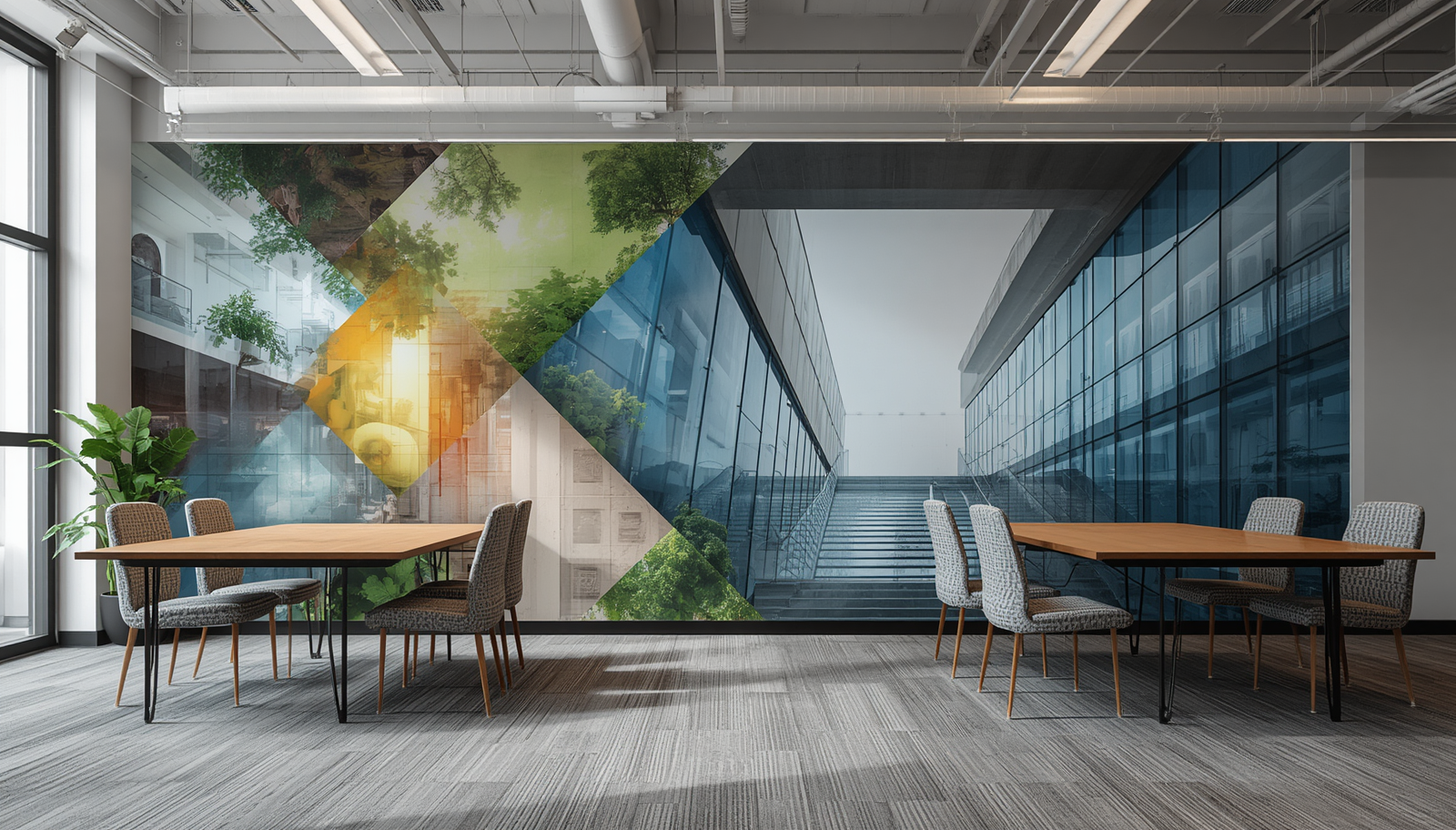
Direct-to-Wall Printing vs. Vinyl Wall Coverings: Which Solution Is Right for Your Space
Table of Contents
The Problem: Why Traditional Wall Solutions Fall Short
For decades, commercial facilities teams have relied on two methods to refresh interior walls: vinyl wall coverings and hand-painted murals. Both come with significant compromises that frustrate decision-makers and drain operating budgets.
Vinyl coverings peel at seams, bubble under humidity, and fade within 3 to 5 years in high-traffic environments. Hand-painted work requires weeks of scheduling, specialized talent, and produces inconsistent results across multi-location rollouts. Wallpaper, once thought of as residential only, has made a comeback in commercial spaces—but it absorbs stains, requires frequent touch-ups, and disintegrates under any moisture or frequent cleaning.
The deeper issue: all three solutions force you to choose between speed, durability, and cost. A fresh coat of vinyl gets installed quickly but fails prematurely. Hand-painted murals look stunning but demand extensive downtime and budget. Wallpaper feels premium upfront but becomes a liability in hospitals, schools, and retail environments where cleaning and durability are non-negotiable.
What's missing is a solution that delivers professional-grade results, high durability, and installation speed without eating into your capital or operational schedule. That's where we come in.
What You Need From Modern Wall Graphics
Today's commercial and institutional spaces demand wall graphics that do far more than fill empty space. Your walls must reflect your brand, guide people, withstand daily use, integrate with building systems, and remain cost-effective over their lifecycle.
We recognize that your ideal solution must address these core requirements:
Speed without compromise: Installation should take hours, not weeks, and minimize disruption to daily operations.
Durability in high-traffic zones: Graphics must resist scuffing, stains, and fading in corridors, lobbies, and patient or student areas.
Cleanability: In healthcare and education, your walls face frequent sanitization. Graphics must withstand washing, disinfection, and wear.
Seam-free integration: Visual discontinuities and panel lines undermine professional appearance and wayfinding clarity.
Lifecycle efficiency: You need solutions that reduce replacement cycles and lower total cost of ownership, not just upfront price.
Scalability: Whether you're refreshing one location or rolling out graphics across 20 facilities, consistency and speed matter.
Environmental responsibility: Adhesive-heavy, landfill-bound solutions no longer align with institutional sustainability commitments.
No traditional wall covering checks all these boxes. Vinyl fails on durability and environmental impact. Hand-painted work fails on speed and scalability. That's why we invested in direct-to-wall printing technology.
Direct-to-Wall Printing: How Our Technology Works
Our direct-to-wall printing system eliminates the intermediaries that slow down and degrade traditional solutions. Instead of applying vinyl sheets or coating walls by hand, we print high-resolution graphics directly onto your wall surface using industrial-grade inkjet technology.
Here's what happens on your site:
We assess your wall substrate—drywall, CMU block, concrete, or brick—and prepare it with a primer coat that ensures crisp ink adhesion and durability. Our equipment then prints your design in a single pass, layer by layer, building color depth and detail at 1200 DPI or higher. The result is a paint-like finish that feels integrated into the wall itself, not applied on top of it.
Because we print directly onto the substrate, there are no seams, no air pockets, no adhesive failure points. Your graphics remain vibrant and durable for 7 to 10 years under normal commercial use—or longer in lower-traffic areas. The finish is topcoated with a protective, cleanable layer that handles sanitization in hospitals and frequent hand contact in schools.
This approach also eliminates shipping delays, fabrication errors, and the inventory waste that plague vinyl and wallpaper workflows. We design, print, and install within your facility. What you see in mockup is what you get on your walls.
Installation Speed and Minimal Disruption
A typical wall graphic installation takes under 5 hours from start to finish, including substrate prep, printing, and curing. Compare that to vinyl installation (12 to 24 hours with seaming), hand-painted work (3 to 5 days), or wallpaper (2 to 3 days with drying time).
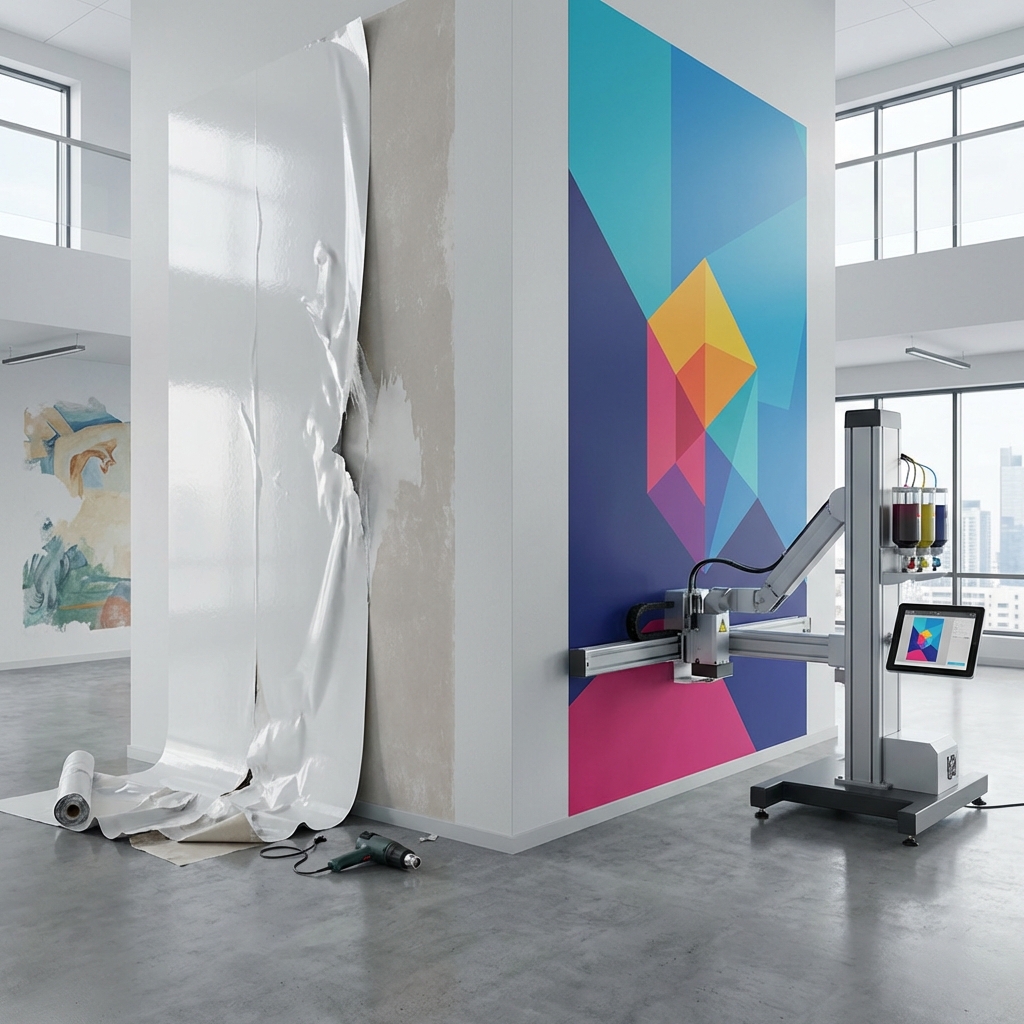
This speed matters operationally. In occupied schools, we work during evening or weekend windows. In hospitals, we coordinate with your facilities team to minimize disruption to patient care areas. In retail, you can refresh a flagship store or multi-unit rollout without closing during peak business hours.
For guidance on coordinating with your operations team and managing timelines in active facilities, see our project management guide for occupied facilities.
Our crews arrive with all equipment on-site, which also eliminates the logistical overhead of panel delivery, storage, and waste removal that traditional coverings require. Your real estate and facilities teams appreciate the simplicity: we handle substrate assessment, printing, installation, and cleanup. You focus on your operation.
Durability, Cleanability, and Lifecycle Cost
We've tested our direct-to-wall graphics in the harshest commercial environments: hospital corridors, school entry lobbies, retail food courts, and university wayfinding hubs. The results consistently outperform vinyl and wallpaper.
Our graphics resist:
Staining from food, beverages, and common contact marks
Abrasion from foot traffic, cart wheels, and furniture movement
Fading from UV light in high-window areas
Moisture and humidity fluctuations
Repeated cleaning with standard hospital-grade disinfectants (bleach-based, quaternary ammonium, alcohol)
The protective topcoat can be wiped clean without degrading the image or the substrate. Unlike wallpaper, which absorbs stains and moisture, or vinyl, which bubbles and peels, our finish maintains its appearance for the full lifecycle.
Vinyl wall coverings typically last 3 to 5 years before seams fail and color shifts noticeably. Wallpaper lasts 2 to 4 years in commercial settings. Our direct-to-wall graphics remain vibrant for 7 to 10 years, which cuts your replacement cycle in half and reduces cumulative maintenance labor.
Over a 10-year period, total cost of ownership—including labor, materials, substrate prep, and replacement—drops significantly compared to serial vinyl or wallpaper projects. You're also eliminating adhesive removal and wall damage that compounds with each new application cycle.
For a detailed durability comparison, see our direct-to-wall vs. vinyl analysis.
Sustainability and Environmental Impact
Institutional buyers—especially schools, colleges, and healthcare systems—have made sustainability a core procurement criterion. Our direct-to-wall printing aligns with those commitments in ways traditional wall coverings simply cannot.
Vinyl wall coverings are petro-chemical products requiring energy-intensive manufacturing and transportation. When they fail (seams bubble, adhesive breaks down), they're removed with harsh chemical strippers and sent to landfills. A typical office or institutional refresh using vinyl generates 800 to 2000 pounds of waste per 5000 square feet of coverage.
Wallpaper is paper-backed and adhesive-based, requiring water removal and disposal. It can be recycled, but the adhesive and primer residue often disqualify it from standard paper streams.
Our direct-to-wall process generates nearly zero waste. We prime and print once, on-site. There are no offcuts, no failed panels, no shipping boxes, no adhesive containers. The only material we apply is primer and ink—both formulated for low environmental impact. If a wall needs refreshing, we paint over the existing graphic and print a new design, leaving no toxic residue or debris.
For sustainability-focused institutions evaluating alternatives to vinyl and wallpaper, our solution often becomes the preferred choice during procurement review.
Design Flexibility and Scalability Across Locations
Our technology enables design flexibility that traditional coverings can't match. Because we print directly, you're not constrained by roll widths, seaming patterns, or pre-manufactured panel sizes. Murals can span entire walls, wrap corners, or integrate with architectural features—all seamlessly.
For multi-location rollouts, our process delivers consistency without the variability of hand-painted work or the installation error margin of vinyl. You provide a design file, and we produce identical results across 5, 20, or 50 locations. Wayfinding color codes, brand logos, and messaging remain pixel-perfect whether you're updating one campus or a national chain of retail stores.
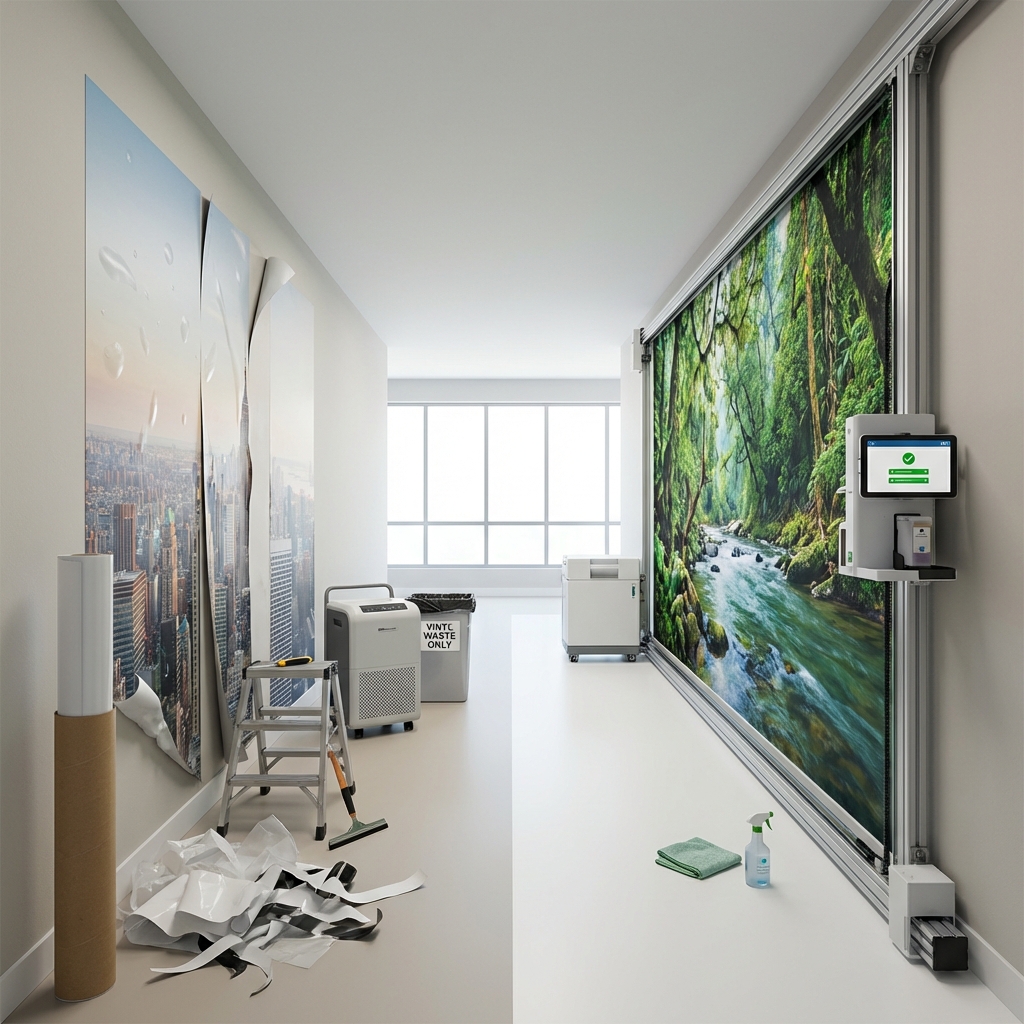
Our digital-first workflow also accelerates design iterations. You can test mockups, adjust colors, tweak imagery, and refine layouts before any wall is touched. This reduces approval cycles and rework compared to hand-painted or vinyl workflows, where changes require re-fabrication or repainting.
Schools and universities particularly benefit from this flexibility. A campus might use our service to brand new academic buildings, refresh dormitory hallways seasonally, and update wayfinding as programs shift. Healthcare systems use it for patient messaging, departmental branding, and safety graphics across multiple facilities. Retail chains deploy consistent brand environments with local customization where needed—all at scale and speed.
Why Vinyl Coverings No Longer Compete
Vinyl wall coverings dominated commercial interiors for 20 years because hand-painted murals were the only alternative, and murals were expensive and slow. That trade-off made vinyl's cost advantage clear. Today, that logic no longer holds.
Direct-to-wall printing delivers speed comparable to or faster than vinyl installation, durability 2 to 3 times longer, cleanability that vinyl cannot match, and environmental impact that's orders of magnitude lower. Vinyl's only remaining advantage is a lower up-front material cost—but that advantage disappears within the first replacement cycle.
Let's be clear: vinyl fails in institutional and commercial environments. Seams bubble within 6 to 18 months in humid spaces. Adhesive breaks down. Corners curl. Color shifts noticeably by year 3. When facilities teams finally decide to replace vinyl, they discover that removing old adhesive and stripping walls requires extended downtime, chemical solvents, and wall repairs. That total replacement cost often exceeds the original installation expense.
We've walked into facilities where outdated vinyl was slated for removal. The prep work and waste management alone justify switching to direct-to-wall printing for the refresh. One hospital system told us they'd spent more on vinyl replacement cycles over 12 years than they would spend on a single direct-to-wall installation that would last the full period with no sealing issues, no adhesive failure, and minimal maintenance.
Vinyl also creates visual compromise. Seams are visible on large murals. Roll width limitations force panel breaks that disrupt sightlines. Gloss or matte finishes are fixed at manufacturing and can't be adjusted for your actual lighting conditions. With direct-to-wall printing, we control every visual element and can adjust topcoat finish to match your architectural intent.
Total Cost of Ownership Comparison
When evaluating wall graphics, up-front cost is tempting but misleading. Total cost of ownership—what you actually spend over the graphic's life—is the metric that matters for capital planning.
Here's a real-world example: A 2000-square-foot wall graphic installation.
Vinyl coverings: $8,000 to $12,000 installed. Lasts 4 years. Requires removal and disposal at year 4 ($3,000 to $5,000) plus surface prep and adhesive stripping ($2,000 to $3,000). Over 10 years, you install vinyl 2 to 3 times. Total cost: $16,000 to $26,000 plus labor disruption.
Our direct-to-wall printing: $14,000 to $18,000 installed. Lasts 7 to 10 years. At year 8, you paint over the existing graphic and print a new design ($6,000 to $8,000 in materials and labor, no removal or stripping required). Total cost over 10 years: $20,000 to $26,000, with a single installation and minimal disruption at refresh.
The financial picture shifts when you factor in operational costs. Vinyl failures—seam bubbling, adhesive breakdown—require emergency repairs (500 to 1500 per incident). Our direct-to-wall graphics have not generated service calls for failure in our customer base; they degrade gracefully, remaining functional and visually acceptable until you choose to refresh.
For institutions managing dozens of locations, the labor and supply chain complexity of vinyl also adds hidden costs: tracking installation schedules, managing contractor relationships, coordinating removal and replacement across buildings, and dealing with occasional quality variance between vendors.
Direct-to-wall printing simplifies that. One vendor, predictable timelines, consistent quality, and extended replacement cycles.
When to Choose Direct-to-Wall Printing
Our solution is ideal for your organization if you operate in one or more of these scenarios:
Tenant transitions or lease-up: You need fast, professional graphics without construction delays. Lease commencement dates are fixed; downtime costs money. We deliver within your required window.
Multi-location brand rollouts: You're refreshing 5, 20, or 100 locations and need visual consistency, rapid execution, and minimal operational disruption. Our process scales predictably.
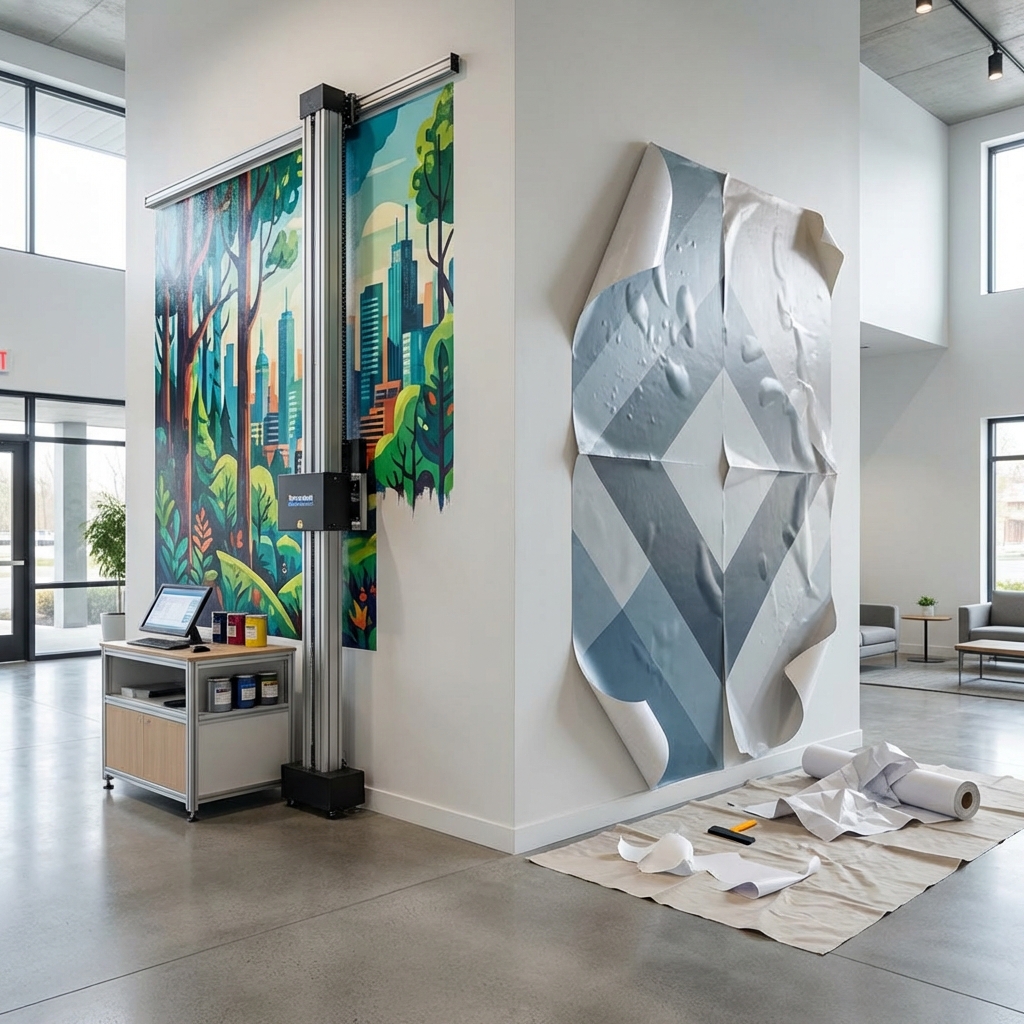
High-traffic or high-contact environments: Your walls face heavy use, frequent cleaning, or sanitization. Healthcare, education, and retail chains depend on durability and cleanability we provide.
Sustainability commitments: Your institution has pledged to reduce waste, lower carbon footprint, or transition from petro-chemical products. Vinyl and adhesives undermine those commitments; direct-to-wall printing aligns with them.
Wayfinding, safety, and instructional integration: You're consolidating multiple signage systems into integrated wall graphics. Direct-to-wall printing eliminates clutter and delivers visual clarity at architectural scale.
Long-term occupancy with evolving needs: You own or occupy a space for 10+ years and want a solution that refreshes gracefully without structural or environmental harm.
Design-forward environments: Museums, galleries, hospitality, and corporate spaces where image quality, seamlessness, and visual impact are brand assets. Our resolution and integration create effects that vinyl cannot match.
If any of these describe your situation, direct-to-wall printing is not just an option—it's the rational choice against traditional alternatives.
Getting Started With Your Project Today
Taking the first step is straightforward. Contact us with basic information: your wall dimensions, current substrate condition, design objectives, and installation timeline. We'll schedule a site assessment to evaluate your walls, lighting conditions, and operational constraints.
During the assessment, we photograph your space, discuss your brand and messaging goals, and outline the process timeline. We provide a preliminary budget range based on square footage and design complexity. If you move forward, we facilitate design development—working with your architects, brand teams, or facilities managers to refine your graphic through digital mockups and approval cycles.
Once design is final, we prepare your walls, arrive on-site with our equipment and crew, and complete installation in a single window. You're then set for 7 to 10 years of durable, cleanable, beautiful wall graphics that perform like nothing traditional coverings can deliver.
We've completed projects in schools, hospitals, corporate offices, retail chains, museums, and government buildings across the East Coast. Our team has learned what works, what fails, and how to protect your timeline and budget while delivering results that exceed expectations.
If you're ready to move beyond vinyl, wallpaper, and the compromises they force, let's talk about what direct-to-wall printing can do for your space. Contact us today to schedule your site assessment.
Contact us to learn more
Frequently Asked Questions (FAQ)
How does direct-to-wall printing hold up in high-traffic areas compared to vinyl?
We print directly onto your wall surface using industrial-grade inks that bond with the substrate, creating a cleanable, durable finish that outperforms vinyl in busy environments like hospitals, schools, and retail spaces. Our surfaces resist scuffing and can be wiped down without degradation, whereas vinyl typically starts peeling or bubbling within 3-5 years. We've designed our process specifically for facilities that can't afford downtime or frequent replacements.
What surfaces can we print on, and do you require any special wall preparation?
We work on drywall, CMU, concrete, and brick in both finished and unfinished states, which means we eliminate costly prep work that other solutions demand. Our on-site printing capability lets us adapt to your existing conditions rather than forcing you to match our requirements. We'll assess your specific walls during our consultation to confirm compatibility and timeline.
How much does direct-to-wall printing cost compared to vinyl and wallpaper over a 10-year period?
We typically cost less than vinyl when you factor in replacement cycles, maintenance labor, and downtime across a decade, especially at multi-location scale. Vinyl needs reinstallation every 3-5 years, while our printed surfaces maintain quality with simple cleaning and minimal intervention. We can provide a detailed lifecycle cost analysis for your project so you see the financial advantage in real numbers, not estimates.


