Custom School Branding Murals: Modern Wall Graphics for K-12 Institutions
Introduction: The Role of Visual Branding in K-12 Environments
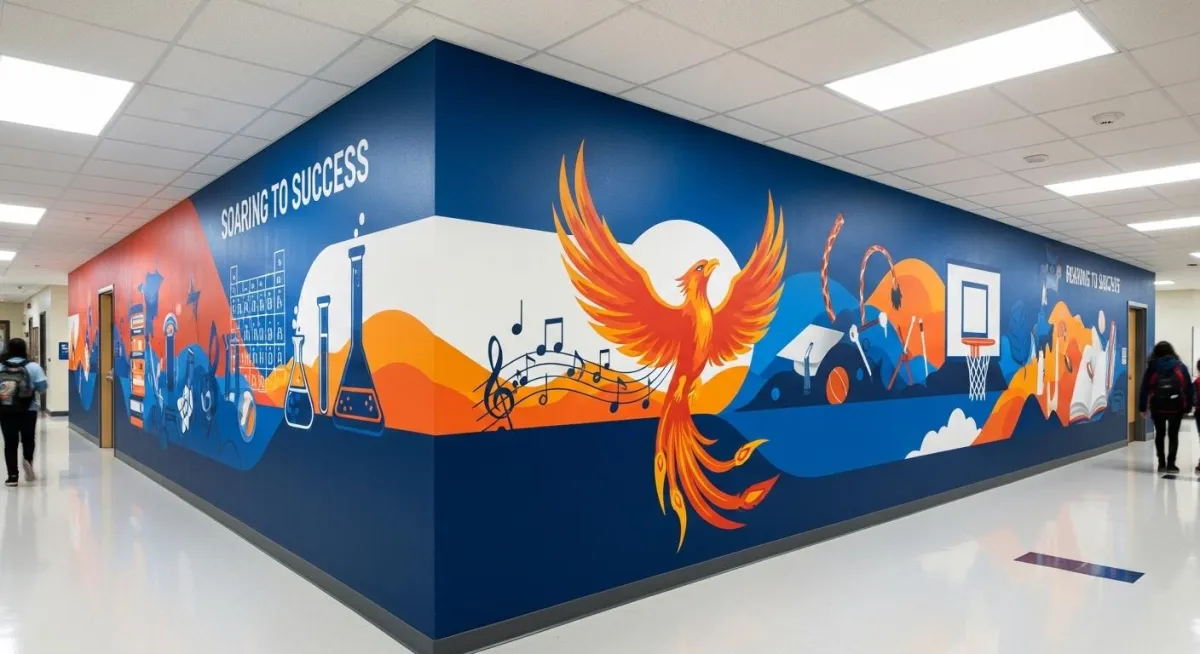
School buildings communicate long before a staff member or student says a word. Hallways, commons, libraries, and athletic corridors shape how learners navigate, feel, and perform. Thoughtfully executed custom school branding murals turn blank walls into tools for culture-building, wayfinding, and instruction—amplifying values, celebrating achievement, and making large campuses easier to understand at a glance.
For K-12 leaders balancing safety, engagement, and operational constraints, visual branding is no longer a “nice to have.” It’s an infrastructure strategy. High-resolution school wall graphics can create consistency across campuses, align multiple programs under a shared identity, and make older facilities feel current without capital-intensive renovations. When done well, educational institution murals become part of the architecture, not an overlay—reinforcing pride, improving first-time visitor orientation, and supporting daily routines with clarity and color.
EastCoast MuralPros partners with districts, facility teams, and in-house designers to deliver durable, photoreal graphics directly onto existing surfaces. The result is a seamless, systematized approach to K-12 campus branding that adapts to different grade levels, building types, and budgets—without relying on fragile vinyl or construction-heavy upgrades.
Why Traditional Vinyl and Wallpaper Fall Short in Schools
Vinyl wall coverings and wallpaper were built for calm, controlled environments—not the pace and pressure of hallways during passing periods or the humidity of natatoriums and locker rooms. Adhesive-backed graphics are vulnerable to peeling, bubbling, and seam lift as temperature and humidity fluctuate. The edges invite picking and vandalism, and routine cleaning can accelerate failure points. Over time, even premium vinyl often looks tired, especially along impact zones and corners.
Wallpaper creates its own challenges. Installation demands downtime, adhesives, and surface prep that can interfere with school schedules. Seams remain visible on long runs, and patterns that looked great on a design board can fall out of alignment across corridors, soffits, or masonry. When it’s time to refresh branding or update safety messaging, removal and reinstallation are messy, slow, and expensive—disrupting occupied buildings and creating waste.
Procurement teams also face unpredictability with off-site fabrication. Shipping delays, mis-measured panels, and color variances between runs can derail timelines, trigger rush charges, and strain vendor relationships. For multi-school rollouts, those small inconsistencies multiply. Ultimately, vinyl and wallpaper struggle to deliver a clean, architectural appearance with the durability, scalability, and lifecycle efficiency districts expect.
How Direct-to-Wall Printing Transforms Educational Spaces
Direct-to-wall printing introduces a different production model: the graphic is printed on-site, directly to finished or unfinished surfaces—drywall, CMU, sealed concrete, even brick—without adhesives or panels. A precision print head traverses the wall, laying down high-resolution imagery that reads like paint with photographic clarity. The process results in seamless wall graphics at architectural scale, free from bubbles or panel lines.
Because printing occurs in place, crews can verify placement in the exact hallway, commons, or media center before production begins. Color is tuned against real lighting conditions. There are no mismatched seams, and the risk of fabrication error or shipping damage drops dramatically. Schools gain schedule certainty and design accuracy.
EastCoast MuralPros brings mobile, low-disruption equipment into the building and typically completes a standard zone in under five hours—often during evenings or weekends—so teaching and operations continue unimpeded. The same technology supports full-campus systems for wayfinding and institutional identity, and it extends beyond walls: in-studio production on doors, tables, and standees helps unify branding for events, STEAM labs, or athletics. For a deeper look at the method, see this overview of wall printing in schools.
Key Benefits of Custom School Branding Murals
Custom school branding murals produced via direct-to-wall printing are engineered for the realities of K-12 buildings. Facilities, procurement, and academic leaders typically cite the following gains:
Architectural quality at scale: Photoreal, high-resolution imagery reads as part of the building, not an applied product. Long corridors, stairwells, and double-height spaces remain seamless.
Speed with minimal disruption: On-site printing windows are short and predictable. Standard areas are often completed in a single shift, allowing work to occur after hours or on in-service days.
Durability for high-traffic zones: Cleanable finishes hold up under daily wear, custodial routines, and incidental impacts—without seams that invite peeling or tampering.
Lifecycle efficiency: No adhesive layers to fail, and no panels to store or replace. When programs, mascots, or brand standards evolve, surfaces are paint-over-ready for rapid change.
Scalability across campuses: Consistent execution and color from school to school make district-wide rollouts feasible, with standardized wayfinding logic and brand elements.
Operational predictability: On-site proofing eliminates guesswork; shipping delays and re-fabrication cycles disappear. Procurement gains schedule certainty and clearer risk management.
Integrated communication: Wayfinding, safety reminders, and instructional graphics can be integrated into walls to reduce signage clutter and improve readability where people naturally look.
Design collaboration: District designers and digital artists can scale their work with templated systems, shared palettes, and collaborative production tools that maintain visual integrity.
Optional refresh cadence: Subscription programs enable seasonal or strategic updates (graduation, re-zoning, STEM initiatives) without restarting procurement from scratch.
Design Applications: Wayfinding, Safety, and Institutional Identity
A modern K-12 branding system does more than celebrate a mascot. It organizes space, supports safety, and communicates values in the flow of daily life. Direct-to-wall printing makes these layers legible and durable.
Wayfinding: Color-coded wings (e.g., Blue—Science, Green—Arts) guide students and visitors through complex buildings. Large-scale typography identifies zones (“C Wing,” “Performing Arts,” “Media Center”) at distance. Arrows and wall-mounted maps at key decision points reduce congestion and late arrivals, especially during the first weeks of school.
Safety and procedures: Graphics can embed evacuation routes, shelter-in-place zones, and nurse/first aid locations directly on walls near exits and gathering points. Note: building code signage requirements (like tactile/Braille) still apply; wall graphics complement, not replace, those mandates.
Institutional identity: Mission statements, graduate profiles, historic timelines, and recognition walls align stakeholders around what the school stands for. Athletic corridors highlight records and hall-of-fame inductees without brittle plaques or clutter.
Instructional layers: STEM timelines, language maps, literary quotes, or measurement scales along a hallway handrail turn circulation paths into teaching moments. Early childhood areas benefit from visual cues at child height: shapes, colors, and simple icons.
Community and culture: Multilingual welcomes, student artwork reproduced at exhibition quality, and donor recognition walls help broader communities see themselves inside the school.
Flexible/event needs: In-studio printing on doors, tables, and standees supports open houses, career days, and orientation. Temporary themes can be scheduled via a subscription to align with academic calendars.
With the right design system, campuses maintain a unified look while adapting content by grade level, building age, or specific program goals.
Installation and Operational Advantages for School Districts
For facilities and operations leaders, logistics can make or break an initiative. Direct-to-wall printing is designed to fit within real school schedules and constraints.
Low-disruption mobilization: Equipment rolls through standard doorways and sets up in minutes. Crews isolate work areas with light containment and clear signage; noise levels remain low and localized.
Occupied-building friendly: Work typically occurs after hours, on weekends, or during breaks. Because there’s no panel cutting or adhesive application, cleanup is straightforward and fast.
Surface versatility: Whether it’s painted CMU, sealed concrete, new drywall, or brick feature walls, the process adapts—reducing change orders tied to substrate surprises.
On-site verification: Teams confirm scale, placement, and color under actual lighting before production. That means fewer reworks and a smoother punch list.
Predictable scheduling: Standard hallway sections and common areas often complete in under five hours, making phased district installations practical without impacting instruction.
Multi-site consistency: Centralized art files, color management, and templated wayfinding logic ensure repeatable results across a district portfolio, keeping procurement and quality teams aligned.
Compliance-minded staffing: Professional crews accustomed to district vendor requirements (badging, background checks, site safety) integrate with school security and custodial workflows.
EastCoast MuralPros often conducts a pilot in one building to refine standards, then scales to additional schools with repeatable, dependable execution—reducing risk and accelerating impact.
Durability and Maintenance Considerations for High-Traffic Areas
Hallways, cafeterias, and gym entries demand materials that tolerate constant contact and routine cleaning. Seam-free, direct-to-wall murals eliminate weak points where damage typically starts, and finishes are engineered to be cleanable in high-traffic environments.
Custodial teams can maintain surfaces with standard, non-abrasive cleaners and soft cloths or sponges. Because the imagery is printed directly onto the wall, there are no lifted edges to catch a mop or a backpack and no air pockets to trap grime. In most schools, the finish resists common scuffs and marks; if a section is impacted by hard objects or requires touch-up after minor wall repairs, targeted reprinting or painting remains straightforward.
Sunlit areas and vestibules benefit from inks and coatings selected for interior light stability. In labs, art rooms, or maker spaces, where incidental splashes are common, districts can specify additional protective layers or locate graphics above direct splash zones. Importantly, if school branding evolves or a program space changes use, surfaces are paint-over-ready—enabling fast, clean refreshes without adhesive residue or panel removal.
Cost and Lifecycle Efficiency Compared to Alternatives
Total cost of ownership matters more than the first invoice. When districts compare direct-to-wall printing to vinyl or wallpaper across a 5–7 year window, three patterns emerge:
Fewer failure points: Without adhesives and seams, there’s little to peel or re-stick. Custodial routines don’t accelerate edge failure, and there’s no periodic panel replacement to budget.
Lower refresh friction: Brand updates or room reassignments happen with simple paint-over and targeted reprints. Wallpaper removal and vinyl tear-outs often require nights and weekends plus wall repair—costly labor that rarely appears in initial estimates.
Predictable scheduling: On-site production eliminates shipping delays, off-site fabrication re-dos, and cascading change orders. That schedule reliability reduces soft costs from rescheduling labor and site access.
Districts also gain scale economies. Once a wayfinding system and brand standards are established, additional schools become incremental expansions rather than net-new projects. EastCoast MuralPros supports subscription models for seasonal or strategic refreshes, spreading costs over time and allowing schools to plan updates around fiscal calendars. For procurement teams deciding between capital projects and operating budgets, lifecycle efficiency and minimal disruption can be decisive advantages over vinyl wall coverings and traditional wallpaper.
Case Studies: Successful School Branding Projects
The following composite examples reflect common scopes and outcomes in K-12 environments. They illustrate how strategy, design, and on-site production come together.
1) Elementary Wayfinding and Culture Refresh A 650-student elementary school struggled with first-week congestion and a confusing classroom numbering system. The district implemented a color-coded wayfinding standard—Early Literacy (Yellow), STEM (Blue), Student Services (Teal)—with large-scale icons for emerging readers. EastCoast MuralPros printed directly to painted CMU walls across two floors in three evening shifts. Staff reported faster orientation for new families and smoother transitions between specials. Graphics integrated the school’s values at child height and reserved long walls for rotating student artwork reproduced at exhibition quality.
2) High School Athletics and Academics Integration A 1,800-student high school wanted to balance athletic pride with college and career messaging. The design team developed a corridor sequence: a hall-of-records wall with photoreal action shots leading into a “Future-Ready” wing featuring industry pathways and alumni profiles. Direct-to-wall printing produced seamless visuals along a 180-foot run, including a brick feature wall by the gym. Installation wrapped over a long weekend, avoiding interruptions to practice schedules. The maintenance team appreciated the cleanable finish and the absence of seams near locker clusters, where prior vinyl had failed repeatedly.
3) District-Wide Wayfinding Standardization Across six K-8 buildings, visitors struggled to locate nurse’s offices and student services. The district commissioned a unified wayfinding system with consistent iconography, typography, and color assignments that scaled to each floor plan. Following a pilot at one campus to test legibility and placement, EastCoast MuralPros executed the program at five additional schools over a month, scheduling evening work to avoid class disruption. The on-site printing model eliminated shipment staging and panel storage between schools, streamlining logistics for the facilities director and custodial teams.
In each case, the throughline was the same: architectural-quality imagery, predictable schedules, and surfaces designed to last under real school conditions.
Sustainability and Environmental Impact of Modern Wall Solutions
Sustainability is a performance requirement for many districts—not a sideline priority. Direct-to-wall printing advances those goals in several ways:
Material efficiency: There are no PVC-based vinyl panels to fabricate, ship, and dispose of. Printing directly on existing walls reduces material inputs and end-of-life waste.
Fewer replacements: Durable, cleanable finishes extend life cycles, lowering the frequency of tear-outs and the landfill burden associated with adhesive-backed systems.
Paint-over readiness: When programs change or campuses rebrand, refreshes occur with minimal materials and labor, avoiding solvent-intensive adhesive removal.
Streamlined logistics: On-site production cuts packaging and transportation impacts while reducing the risk of re-fabrication and duplicate shipments due to damage or errors.
Reduced signage clutter: Integrating wayfinding and instructional content into walls can decrease reliance on temporary foam-core or plastic signs that are quickly discarded.
For districts pursuing broader ESG objectives or aligning with green procurement frameworks, the material-light, lifecycle-efficient profile of direct-to-wall printing offers a credible, measurable improvement over wallpaper and vinyl alternatives.
Implementation Timeline and District Planning Considerations
Successful campus branding is equal parts strategy, design, and logistics. A typical district process looks like this:
Discovery and site assessment: Facilities and design stakeholders walk target buildings to understand traffic patterns, wall conditions, and daylight. Surfaces like drywall, CMU, sealed concrete, and brick are evaluated for readiness.
Standards development: Establish wayfinding logic (color zones, icons, typography), brand applications (mascot usage, academic highlights), and placement rules. Templates and style guides ensure consistency across campuses.
Pilot and stakeholder testing: Install a representative pilot area to confirm scale, legibility, and cleaning performance. Gather feedback from administrators, staff, custodial teams, and students.
Artwork production: District design teams or partnered digital artists create content using collaborative tools, enabling repeatable layouts and variable content (e.g., different room names or mascots per campus).
Scheduling and phasing: Align printing windows with school calendars—after hours, weekends, breaks. Group areas so each session completes in under five hours where possible to simplify access and security.
On-site printing and QA: EastCoast MuralPros verifies color and placement under real lighting, then prints and completes a punch list the same visit. Any adjustments are handled on-site, avoiding re-fabrication delays.
Handover and maintenance: Provide cleaning guidance, finish specifications, and update protocols. If using a subscription model, pre-plan seasonal or strategic refreshes and content swaps.
Scale-up: Once the first campus is complete, apply standards to additional schools with predictable scheduling and consistent outcomes. Centralized file management ensures color and layout integrity district-wide.
For more program-level considerations and examples, see this perspective on campus branding with wall printing.
Conclusion: Strategic Branding as an Asset for Schools
Custom school branding murals are more than decoration. They are a practical infrastructure upgrade that helps students navigate, focuses community identity, and reduces operational friction across K-12 campuses. When produced with direct-to-wall printing, school wall graphics achieve architectural quality without adhesives, install quickly in occupied buildings, and hold up under real-world use—delivering a lifecycle-efficient alternative to vinyl and wallpaper.
For districts managing multiple buildings, the ability to standardize wayfinding, align culture across campuses, and refresh content without capital-heavy renovations is a strategic advantage. EastCoast MuralPros supports this shift with on-site printing, collaborative design workflows, and finishes built for high-traffic environments—so schools can communicate clearly, operate predictably, and keep facilities looking like the future rather than the past.
If your team is evaluating educational institution murals for a single wing or a district-wide rollout, consider how a print-in-place approach can de-risk schedules, simplify maintenance, and scale your brand standards. The result is a cleaner, clearer, more connected learning environment—exactly what K-12 students and educators deserve.


