Top 5 Adhesive-Free Wall Mural Solutions for Commercial Spaces in 2026
Table of Contents
The Problem With Traditional Adhesive Wall Solutions
Vinyl wall coverings and wallpaper have dominated commercial interiors for decades. They're familiar, relatively affordable, and installers know how to hang them. But that familiarity masks serious operational costs and frustration.
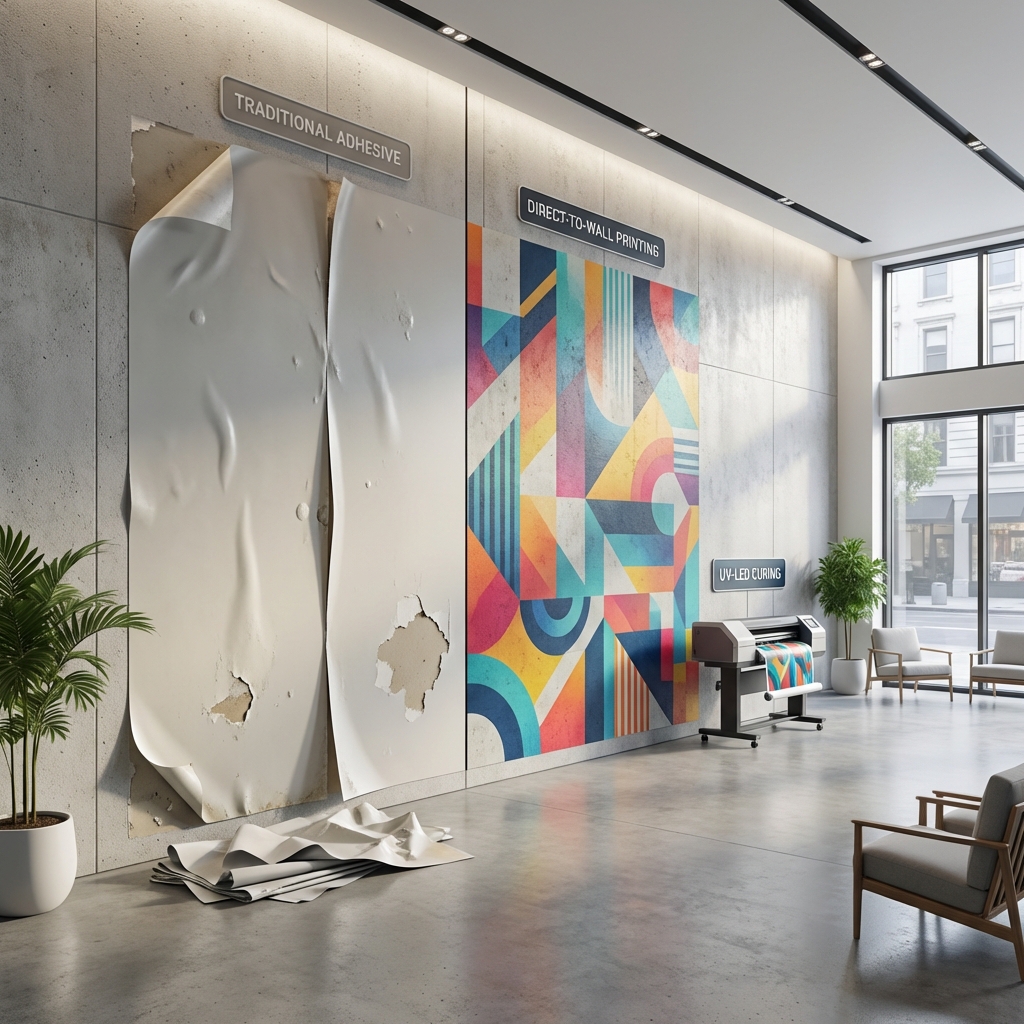
We've watched facilities teams wrestle with vinyl that bubbles at seams after six months, peels at edges in high-traffic corridors, and yellows under fluorescent lighting. Wallpaper absorbs moisture in humid environments like hospitals and kitchens, leading to mold risk and visible degradation. Both solutions require adhesives that off-gas, leave residue when removed, and complicate future modifications. Replacement cycles are expensive and disruptive. A full wall re-wrap at a multi-location retail chain can mean days of downtime per location, logistical overhead, and waste disposal costs.
The core problem isn't the aesthetics—it's the lifecycle. Organizations spend capital on installation, only to face predictable maintenance headaches within 18 to 36 months. In occupied buildings, removal and reinstallation multiply disruption. For schools, healthcare systems, and corporate campuses managing dozens or hundreds of spaces, that compounds quickly.
Most decision-makers we speak with don't realize there's a fundamentally different technology available. They assume wall graphics = vinyl + adhesive. That assumption is costly.
Why Adhesive-Free Technology Outperforms Vinyl and Wallpaper
Adhesive-free wall printing eliminates the root causes of traditional mural failure.
We print directly onto the wall substrate using industrial inkjet technology—no vinyl layer, no adhesive, no seams. The ink bonds to the surface at a molecular level, creating a graphic that's integrated into the wall itself, not applied on top of it. That single shift transforms durability, maintenance, and total cost of ownership.
Adhesive-free solutions resist bubbling, peeling, and edge separation because there's no adhesive layer to fail. They're cleanable with standard facilities protocols (soap, water, mild disinfectants) without risk of degradation. Seams vanish entirely—you can print seamlessly across 40 feet or across an architectural corner without visible discontinuity. Lifecycle is dramatically longer: we design for 5+ years in high-traffic spaces with minimal maintenance, compared to 18-36 months for vinyl.
Removal is also simpler. When your tenant changes or a school refreshes a wayfinding system, we can paint over the graphic or, if the wall is being refinished, our finish is paint-compatible. You're not scraping residue or hiring specialized removal crews. The wall becomes a canvas again, not a problem to solve.
Environmental impact matters to many of our customers. Vinyl and wallpaper generate waste at removal; adhesives are chemical inputs. Our process uses water-based inks and produces no waste on-site. For organizations tracking carbon footprint or pursuing sustainability certifications, that's a meaningful advantage.
Comparison: Five Commercial Mural Approaches Evaluated
To help decision-makers compare options objectively, we've evaluated five common approaches across key criteria: durability, installation speed, cost of ownership, design flexibility, and disruption.
1. Hand-Painted Murals Hand-painted work delivers artistic authenticity and can cover any surface. The downside is steep: skilled muralists cost $3,000–$8,000+ per wall, take 5–20 days per installation, and produce inconsistent results across multiple locations. Durability depends entirely on painter skill and paint quality. Refreshes require repainting.
2. Vinyl Wall Wraps Vinyl is fast to apply (1–2 days) and familiar to installers. Cost runs $150–$400 per square foot installed. However, seams are visible, adhesive failure is predictable after 18–36 months, removal leaves residue, and color can shift under UV or fluorescent light. Multi-location rollouts require shipping vinyl rolls nationally, which adds lead time and introduces fabrication errors.
3. Wallpaper (Commercial Grade) Wallpaper costs $50–$150 per square foot installed. It's quick to apply but absorbs moisture, hides wall irregularities poorly, and is susceptible to mold in humid spaces. Removal can damage drywall. It's largely obsolete for high-performance commercial environments.
4. Architectural Paint Finishes High-end painted finishes (murals applied by spray or brush) cost $1,500–$5,000+ per wall and take 3–10 days. They're durable but labor-intensive, not easily duplicated across locations, and difficult to modify without repainting.
5. Direct-to-Wall Printing (Our Approach) We print directly onto clean wall substrate, no adhesive. Cost ranges $200–$400 per square foot installed, depending on complexity and substrate prep. Installation is 4–8 hours. Durability exceeds 5 years in standard commercial environments. Seams are eliminated entirely. Design modifications are simple: paint over and reprint if needed. Multi-location rollouts are fast and consistent because we can deliver identical graphics across all sites without shipping delays.
Direct-to-Wall Printing: Our Proven Technology
Our technology uses industrial-grade inkjet systems to deposit UV-cured, water-based inks directly onto wall surfaces. The ink penetrates the substrate (drywall, CMU, concrete, brick) and cures into a durable, integrated layer. No adhesive layer means no interface failure points.
The substrate matters. We prep walls by cleaning and, if necessary, applying a light primer or substrate conditioner that ensures optimal ink adhesion without changing the wall's finish or feel. This takes 2–4 hours depending on wall size and existing conditions. That prep work is critical—it's what allows us to guarantee durability and performance.
Once the wall is prepped, our mobile printing systems deliver the graphic in a single pass. Resolution is 1200 DPI or higher, which means photoreal imagery, fine typography, and crisp brand detail at architectural scale. We've printed museum-quality photography, intricate wayfinding systems, and full-wall brand graphics. The quality holds from close viewing distance.
The finish is designed to balance durability and aesthetics. Our standard finish is cleanable and scuff-resistant. It feels like painted wall, not plastic or vinyl. If you need a textured or matte finish, we customize the topcoat. For high-moisture environments (kitchens, bathrooms), we offer hydrophobic finishes that shed water without looking artificial.
We can also print on substrates brought to us—doors, tables, standees—for consistency across environments. A school might print the same wayfinding graphic on walls, classroom doors, and hallway signage. A hospital might match branding across main corridors and intake zones. One design, one file, multiple surfaces delivered in-studio and on-site.
Installation Speed and Minimal Disruption
Most of our installations finish in under 5 hours. That's the number that gets facilities directors' attention.
[Minimal-disruption installation] is possible because we don't require adhesives, don't generate wet material, and don't rely on extended curing times. A typical installation follows this sequence: wall inspection and cleaning (30 minutes to 1 hour), substrate prep if needed (1–2 hours), printing (1–3 hours depending on wall size), and inspection/cleanup (30 minutes). We're in and out the same day.
Contrast that with vinyl, which requires 1–2 days of application, 24 hours of cure time before the space can be fully used, and potential edge-sealing work. Hand-painted murals take weeks. Construction-heavy interior upgrades can mean months of disruption and permitting overhead.
Our crew typically consists of two to three technicians. We work around occupancy—early morning, after-hours, or scheduled downtime windows. For multi-location rollouts, we coordinate across sites so each location experiences the same predictable install window. Schools finish installations during summer break or winter closure. Corporate offices schedule during non-business hours. Healthcare facilities work within patient care schedules. We've installed in operating hospitals without interrupting clinical workflows.
Access requirements are minimal: a clear wall, adequate power (standard 120V outlet), and climate control (typically 60-85F, 30-60% relative humidity). We don't require scaffolding, ladders beyond standard step-ladders, or specialized equipment that needs to stage in your space for days.
Lead time is also shorter than traditional alternatives. Once you approve the design file and we schedule the install, we can often begin within 2–4 weeks. Vinyl requires fabrication at a remote facility, then shipping. Hand-painted work requires artist availability and scheduling. We manage the entire process in-house, so there's no external bottleneck.
Durability and Long-Term Cost Efficiency
We designed this solution for high-traffic commercial environments. Hospitals see thousands of foot traffic; schools have summer cleaning protocols; retail spaces operate 16-hour days. Our graphics need to survive that without degrading.
[Direct-to-wall durability] exceeds 5 years in standard conditions and can extend to 7+ years with proper maintenance. We've tested our finishes against industry standards for surface hardness, color fastness, and chemical resistance. The ink bonds to the substrate itself, so there's no interface where failure originates. Scuffs are cleanable; they don't expose an underlayer because there is no underlayer.
Maintenance is straightforward. Dust with a soft cloth. For marks or smudges, use mild soap and water or standard commercial disinfectants (the kind hospitals and schools already use). Avoid abrasive scouring pads and acetone-based cleaners. That's it. Most organizations don't even need a maintenance protocol—the graphic just works.
Cost of ownership is where this technology delivers measurable financial value. Over a 5-year lifecycle, the total cost—installation plus maintenance—typically runs 30-40% lower than vinyl with its predictable re-wrap cycles. A 1,000-square-foot mural might cost $300–$350 per square foot to install ($300,000–$350,000 total). Vinyl at the same scale costs $150–$400 per square foot but requires replacement every 2–3 years. Over 10 years, you're installing vinyl 3–5 times. We install once.
For multi-location organizations, that compounds significantly. A 50-location retail rollout costs $15–$17.5 million once with our solution. The same chain re-wrapping vinyl locations every 2–3 years across 10 years spends $22.5–$37.5 million. The capital leverage favors adhesive-free technology, and the operational headache is eliminated entirely.
If you change tenants or programs, we paint over the graphic and start fresh. No removal residue, no environmental waste, no wall damage to repair. You're back to a blank canvas in a day.
Design Flexibility and Architectural Integration
One advantage we hear less about in industry discussions is design freedom.
With vinyl, your designer works within the constraints of what can be fabricated as a flat roll and applied seam-to-seam. Complex curves, integrated wayfinding, multi-color transitions at corners—all of these become logistically complex or impossible.
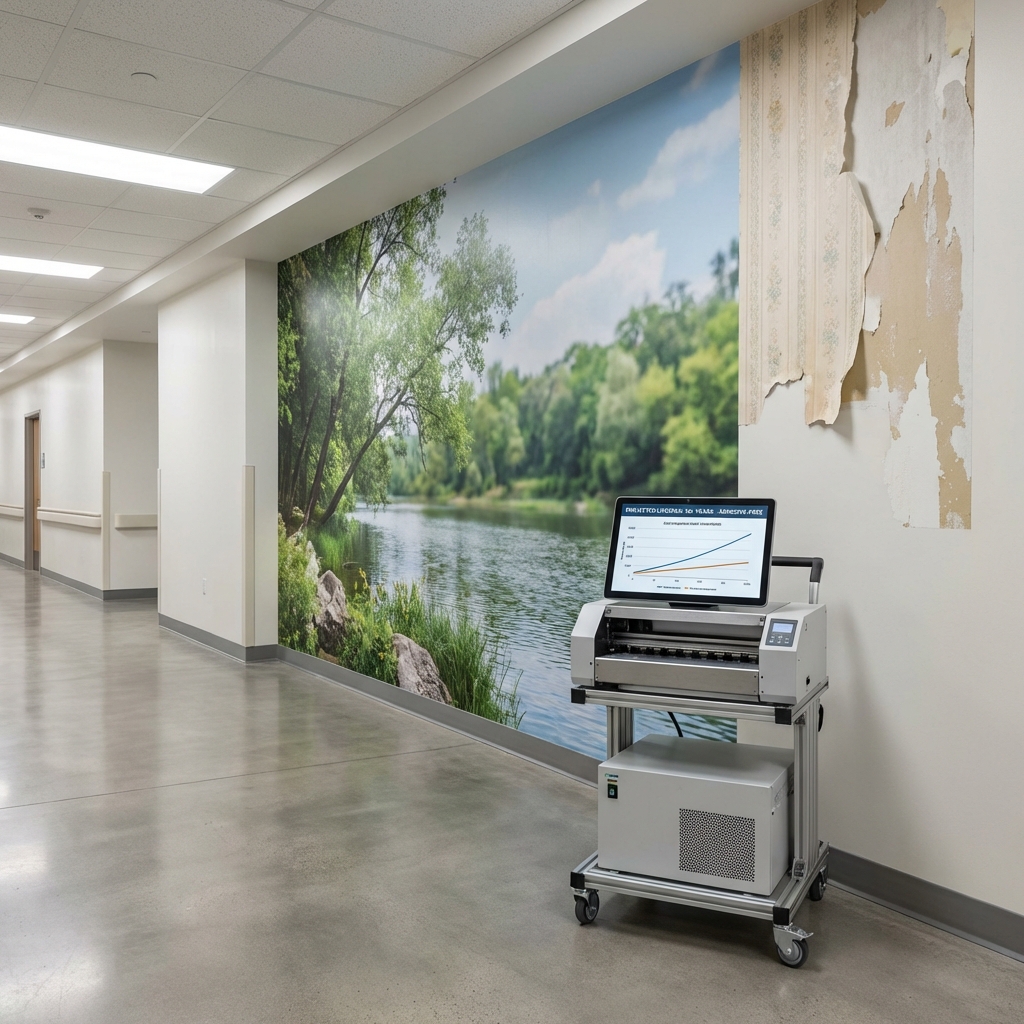
With direct-to-wall printing, the wall is your canvas. You can design seamlessly across architectural features—around columns, doorways, windows—without visible seams or pattern breaks. A hospital might print wayfinding that integrates directional arrows, floor markers, and color-coded zones into a single cohesive graphic. A university might print a full-height 80-foot wayfinding corridor with layered information (building names, floor numbers, directional cues) that feels like the architecture itself, not a layer applied on top.
We work with architects and interior designers directly. You provide the design file (typically a high-resolution image, PDF, or vector artwork). Our production team color-proofs the design on a small test section of your actual wall substrate to confirm it matches your expectations under your specific lighting. Then we scale and install across the full wall.
Design modifications are reversible. If you decide to refresh a branded space, repaint the wall and we print a new graphic. If you want to test a design at one location before rolling out nationally, we print a pilot. If you discover that a color shifts under your lighting, we repaint and adjust. The wall itself doesn't limit your creativity; the process does.
This flexibility makes direct-to-wall printing ideal for institutions with evolving needs. Schools refresh wayfinding annually. Museums rotate exhibitions. Healthcare systems rebrand or reorganize. Retail adapts seasonally. We support that fluidity without the waste and disruption that vinyl replacements generate.
Multi-Location Rollouts and Scaling
Organizations managing 20, 50, or 200 locations face a critical challenge: consistency and coordination.
We handle multi-location rollouts by printing identical graphics across all sites on your schedule. You approve one master design file. We execute it identically at location A, location B, and location C. No vendor variation, no fabrication errors, no design drift. Our in-house printing and installation teams ensure execution standards are maintained.
Logistics simplify dramatically. Instead of manufacturing vinyl rolls at a centralized facility, shipping them to each location (introducing delay and potential damage), we dispatch our team to each site with digital design files and materials. If a location needs adjustment—a different wall dimension, substrate condition—we adapt the file in real time without affecting other locations. Vinyl requires physical inventory management; we manage digital files.
Scheduling is coordinated but flexible. For a 30-location corporate rollout, we might deploy crews across multiple regions simultaneously, each completing installations within a two-week window. For a school district rolling out wayfinding across 15 schools, we time installations during summer break to avoid disruption. The predictability of 4–8 hour install windows allows us to batch work efficiently.
Cost scales predictably. As you add locations, the per-location cost doesn't increase (assuming identical design and substrate conditions). Volume purchasing of materials and crew scheduling efficiencies may actually reduce per-location costs at 20+ locations. Compare that to vinyl, where logistical complexity and shipping costs often increase at scale.
We've coordinated national rollouts for healthcare systems, multi-unit retail operators, and university systems. The common thread is that clients benefit from standardized execution, faster timelines, and lower total cost of ownership than traditional alternatives.
Why Our Adhesive-Free Solution Wins Every Category
When you evaluate mural options for your commercial space, the choice becomes clear: adhesive-free direct-to-wall printing outperforms vinyl, wallpaper, hand-painted work, and architectural finishes across every meaningful dimension.
Speed: 4–8 hours for full installation versus 1–3 days for vinyl, weeks for hand-painted work, and months for construction-heavy upgrades. You're operational the same day.
Durability: 5+ years with minimal maintenance. Vinyl fails predictably at 18–36 months, requiring costly re-wraps. Paint and hand-painted work degraded faster in high-traffic spaces without the durability engineering we've built into our finishes.
Cost of Ownership: Direct-to-wall printing costs 30-40% less than vinyl over a 10-year lifecycle when you factor in multiple replacement cycles. Removal is simple and non-destructive, eliminating disposal and wall repair costs.
Design Flexibility: You can print seamlessly across architectural features, integrate wayfinding and branding, and modify designs without generating waste. Vinyl is constrained by fabrication and seaming realities.
Multi-Location Consistency: Identical execution across all sites, no shipping delays, no fabrication variation, flexible scheduling, and predictable per-location costs.
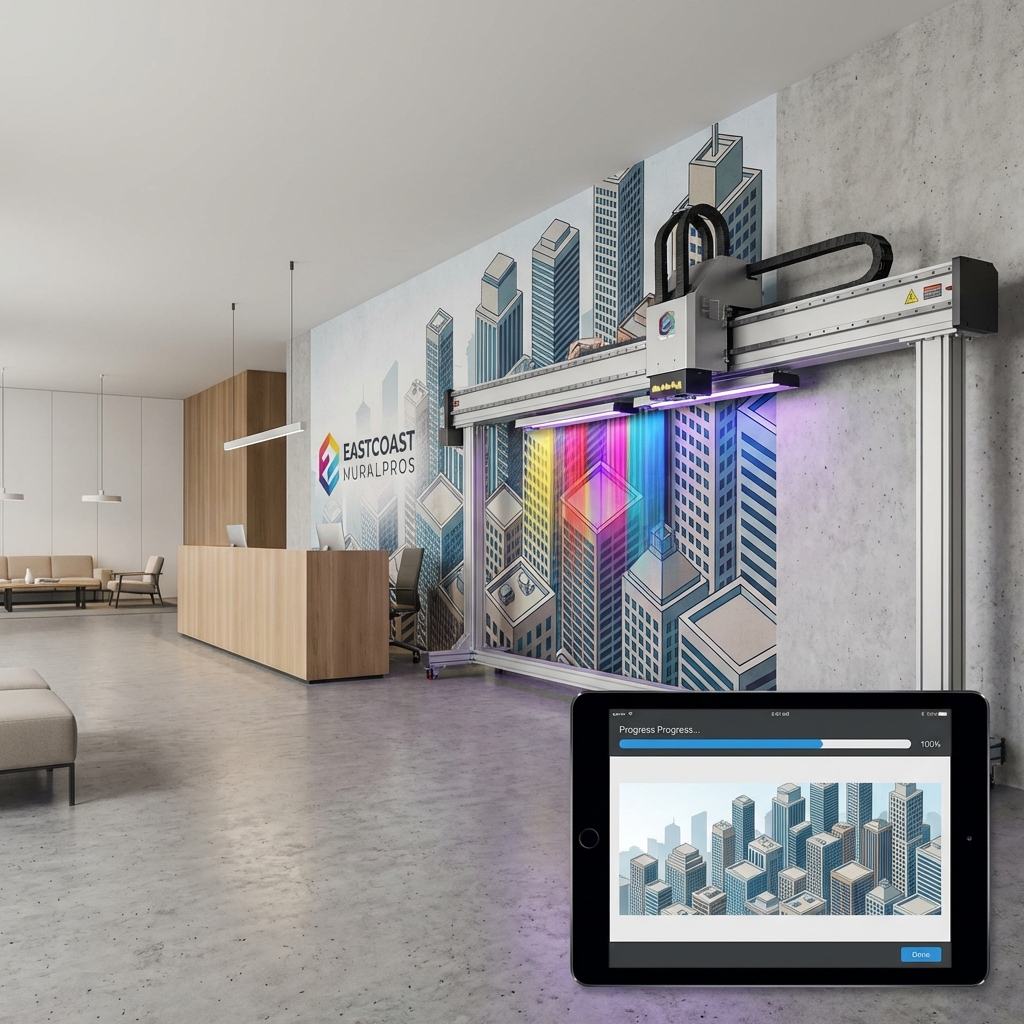
Minimal Disruption: Small crew, no extended cure times, no adhesives or wet materials, works in occupied buildings. Vinyl installations require longer windows and extend cure periods.
Sustainability: Water-based inks, no chemical adhesives, no waste on-site, paint-over-ready for end-of-life. Vinyl and wallpaper generate waste at removal and rely on petrochemical inputs.
We're not saying this because we're biased toward our own technology—we're saying this because we've installed hundreds of projects, spoken with facilities teams at schools, hospitals, corporate offices, and retail locations, and consistently heard the same feedback: adhesive-free direct-to-wall printing solves problems that vinyl and traditional murals create.
Getting Started With Your First Project
If you're ready to explore whether direct-to-wall printing is right for your space, here's how we work with you.
Step 1: Share Your Project Details Tell us about the wall (size, substrate, current condition), the timeline you're targeting, and what you want to achieve visually. Are you refreshing a brand? Installing wayfinding? Creating an artistic focal point? We'll assess feasibility and provide a preliminary timeline and budget range.
Step 2: Design Consultation If you have a design file, we'll review it. If you're starting from scratch, we collaborate with you (or your designer or architect) to develop a concept that fits your space and goals. We can provide design references, suggest materials, and recommend finishes based on your environment.
Step 3: Site Visit and Substrate Assessment We visit your location to inspect the wall, assess substrate condition, measure precisely, and confirm lighting and environmental factors. This is where we catch any surprises and confirm what the final graphic will look like under your actual conditions.
Step 4: Design Proof and Approval We deliver a high-resolution color proof on your actual wall substrate (a small section) so you see exactly how the design performs under your lighting. Once you approve, we proceed to production.
Step 5: Installation Our crew arrives, preps the wall, prints the graphic, and completes final inspection—typically in one working day. You're ready to use the space immediately.
Step 6: Handoff and Maintenance We provide cleaning and maintenance guidelines and support. That's it. Your graphic is integrated into the wall and will perform for years with minimal attention.
The difference between adhesive-free wall printing and every other mural approach is the difference between solving a problem once and well, versus managing it repeatedly and expensively. We've invested in this technology because organizations deserve better options. If you're evaluating how to refresh, brand, or communicate within your commercial space, contact us. We'll assess your project honestly and tell you whether this is the right fit. If it is, you'll experience installation, durability, and operational efficiency that leave traditional approaches behind.
For further reading: Direct-to-wall durability.
Contact us to learn more
Frequently Asked Questions (FAQ)
How long does installation typically take, and can you work around our operating schedule?
We complete most installations in under 5 hours with minimal disruption to your space. Our on-site printing process eliminates shipping delays and allows us to work during off-hours or occupied building scenarios, so your team experiences no downtime. We coordinate timing directly with your facilities team to ensure the installation fits your operational needs.
What surfaces can you print directly onto, and do we need to prep our walls?
We work seamlessly on finished drywall, CMU, concrete, and brick, so extensive surface prep isn't necessary. Our direct-to-wall technology adheres to most standard commercial interiors without requiring adhesives or special coatings. If you're concerned about compatibility with your specific surfaces, we'll assess them during our consultation and let you know upfront.
How durable are these murals compared to vinyl wraps, and what happens when we need to change the design?
Our graphics are built to withstand high-traffic environments and can be cleaned like standard painted walls, meaning they hold up far better than vinyl in busy commercial spaces. When you're ready for a refresh, we simply paint over the existing graphic and install your new design, making lifecycle changes faster and more cost-effective than removing vinyl or wallpaper.