Does Office Design Actually Impact Productivity? What the Data Really Says
Introduction
Office design improves productivity.
It’s a statement that gets repeated constantly—but rarely examined closely.
For decision-makers, the real question is:
Is there measurable evidence that the physical environment affects how people perform at work?
The answer is yes—but not in the way most people think.
What Research Actually Confirms
The strongest studies don’t claim that design alone drives productivity.
Instead, they show something more nuanced—and more useful:
Workplace environments influence the conditions that enable productivity.

1. Engagement Is the Leading Indicator
One of the most widely cited workplace studies, the
found that:
Employees in high-performing workplaces are significantly more engaged
Engaged employees are more likely to report higher productivity, better focus, and stronger collaboration
This matters because engagement is directly tied to business outcomes.
According to
,
highly engaged teams show 21% higher profitability and 17% higher productivitycompared to disengaged teams.
Translation:
Environment → Engagement → Productivity → Business results
2. Environmental Quality Drives Cognitive Performance
The physical environment also impacts how people think.
A study from the
found that:
Improved indoor environmental conditions led tosignificant increases in cognitive performance scores
Participants performed better in areas like strategy, crisis response, and information usage
While this study focuses heavily on air quality and ventilation, the takeaway is broader:
Environmental inputs directly affect mental performance.
3. Workplace Design Impacts Focus and Distraction
Another commonly misunderstood area is focus.
Open offices were designed to increase collaboration—but often reduce productivity.
Research highlighted in
shows that:
Open environments can increase distractions
Employees compensate by reducing face-to-face interaction
Digital communication often increases instead of collaboration
This reinforces a key point:
Design decisions shape behavior—sometimes in unintended ways.
Where Most Companies Get It Wrong
Companies often make one of two mistakes:
Mistake #1: Treating Design as Aesthetic
They invest in:
Furniture upgrades
Trend-driven layouts
Generic finishes
But ignore how the space actually influences:
Attention
Energy
Identity
Mistake #2: Overlooking Visual Stimulus
Even in well-designed offices, one element is consistently underutilized:
The visual environment.
Walls are:
Constantly in view
Highly scalable
Emotionally and cognitively influential
Yet in most offices, they remain:
Blank
Neutral
Functionally invisible
Why Visual Environments Matter for Productivity
From a behavioral standpoint, visual input affects:
Cognitive load(clarity vs clutter)
Emotional tone(energy, calm, motivation)
Cultural reinforcement(mission, identity, pride)
Research summarized by the
indicates that:
Visual comfort, layout, and environmental quality all contribute to productivity outcomes
While most companies address lighting and layout…
very few actively design what employees see every day.
The Opportunity: Low-Disruption, High-Impact Change
Here’s where the opportunity becomes practical.
Unlike full renovations, updating the visual environment:
Requires minimal downtime
Can be implemented quickly
Scales across large spaces
Has immediate perceptual impact
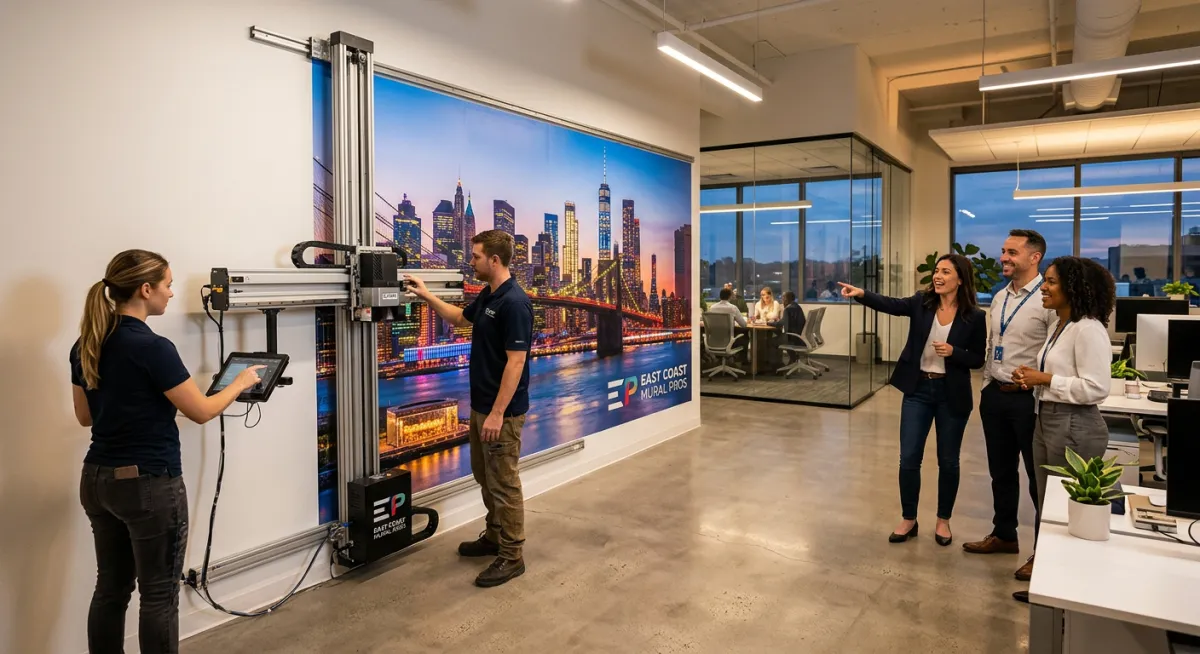
This is why more organizations are exploring:
High Resolution wall graphics
On-site, on-demand installation
Eco-Friendly alternatives to vinyl and wallpaper
Not as decoration—but as aperformance lever.
Bottom Line
Office design does impact productivity.
But not directly.
It works through:
Engagement
Focus
Cognitive performance
Behavioral patterns
And one of the most underutilized tools in shaping those factors is:
The visual environment.
What’s Next
In the next post, we’ll break down a hidden cost most companies never measure:
What blank walls are actually costing your business.