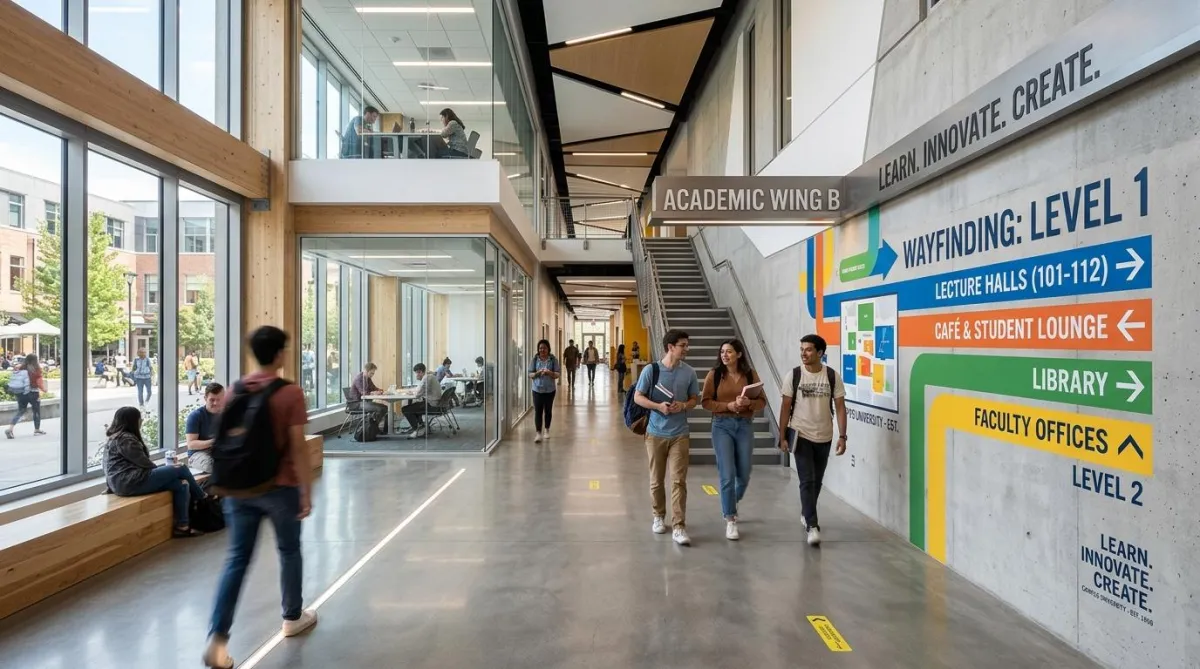
How to Roll Out Campus Wayfinding Graphics Without Disrupting Operations
Table of Contents
The Campus Wayfinding Challenge: Why Traditional Approaches Fall Short
What Makes Our Direct-to-Wall Technology Different for Campus-Scale Projects
Planning Your Campus Wayfinding Rollout: How We Structure Multi-Building Deployment
Installation Without Disruption: Why Our 5-Hour Timeline Matters for Operating Institutions
Designing Cohesive Wayfinding Systems Across Multiple Locations and Buildings
Durability and Maintenance: Why Our Graphics Outperform Vinyl and Wallpaper on High-Traffic Campuses
From Concept to Execution: Our Collaborative Design and Approval Process
Measuring Success: Performance Metrics for Campus Wayfinding Implementation
Scaling Strategically: Phased Rollouts and Subscription-Based Refresh Models for Campuses
The Campus Wayfinding Challenge: Why Traditional Approaches Fall Short
Campus wayfinding is a logistics puzzle. You're managing buildings spread across acres, populations that change seasonally or annually, and spaces where every hour of downtime costs money or disrupts learning. Traditional signage requires installation crews, directional sign clutter, and replacement cycles every 3-5 years. Vinyl wall coverings peel under foot traffic. Hand-painted murals take weeks and demand artist scheduling. Wallpaper bubbles in humid hallways. Meanwhile, your buildings stay static while your needs shift: new programs launch, departments relocate, safety protocols update.
We encounter this friction constantly with universities, hospitals, and K-12 districts. Facilities teams tell us the same story: they can't afford long installations, they can't have vinyl failing in high-traffic corridors, and they're tired of sourcing vendors separately for art, signage, and branding. The result is underinvestment in wayfinding. Spaces feel dated or confusing because the cost and disruption of updates exceed the perceived benefit.
The real issue isn't the graphics themselves. It's the constraint of time. Campuses don't shut down for a week. They operate around the clock, with classes, patients, staff, and visitors flowing through. Your wayfinding solution has to fit into that reality, not against it.
What Makes Our Direct-to-Wall Technology Different for Campus-Scale Projects
We print directly onto your walls without vinyl, adhesives, or substrate layers. Our technology combines industrial-grade inkjet systems with UV-cured inks that bond to drywall, CMU block, concrete, and finished surfaces. The result is a seamless, photoreal graphic that becomes part of the wall itself, not something applied on top of it.
For campuses, this matters operationally. First, we eliminate the substrate prep and adhesion failures that plague vinyl installations. Vinyl peels when it encounters humidity, seams, or foot traffic patterns. Our printed surface is flush with the wall, cleanable with standard institutional cleaning products, and rated for high-touch, high-traffic environments. Second, we compress installation into single days or short windows. No curing time, no bubble-out periods, no return visits. A 600-square-foot directional graphic in a campus corridor takes roughly 5 hours from arrival to handoff. Third, we deploy consistent branding across your entire campus without the variation that comes from multiple contractors or hand-applied techniques.
Key operational advantages for multi-building campuses:
On-site printing eliminates shipping delays and fabrication errors that can derail tight schedules
Paint-over-ready finishes allow future tenants or program changes without removal costs
Seam-free installation at architectural scale maintains visual coherence across entire buildings or quads
Compatible with finished and unfinished surfaces, so you don't need expensive substrate work
Durable, cleanable surfaces handle heavy foot traffic and institutional cleaning protocols
Photoreal resolution captures detail that engages visitors and reinforces your brand identity
We've worked with hospital systems rolling out wayfinding across 8-building campuses in under 8 weeks, and university clients who've used phased deployments to refresh wayfinding every 2-3 years as programs evolve. The predictability of our timeline and output quality gives your team confidence to plan around campus operations rather than wait for a convenient "downtime window" that never arrives.
Planning Your Campus Wayfinding Rollout: How We Structure Multi-Building Deployment
We start with a facilities inventory and audit. You provide a campus map, building names, floor plans, and traffic patterns. Our team walks the site (or reviews plans if remote) and identifies wayfinding pinch points: entry lobbies, intersections, elevator banks, stairwells, and decision points where visitors or patients get confused.
From that audit, we scope wall space, measure substrate conditions, and document existing lighting, finishes, and accessibility requirements. We then propose a phased rollout plan tied to your operational calendar: which buildings go first, which windows work around classes or patient schedules, and how phases connect to build cumulative brand impact.
A typical large-campus timeline looks like this:
Initial audit and design brief: 2 weeks
Design concepts and stakeholder review: 3-4 weeks
Pre-production substrate prep coordination: 1-2 weeks per phase
Installation execution: 3-5 days per building (depending on scope)
Closeout and touch-up: 1-2 days
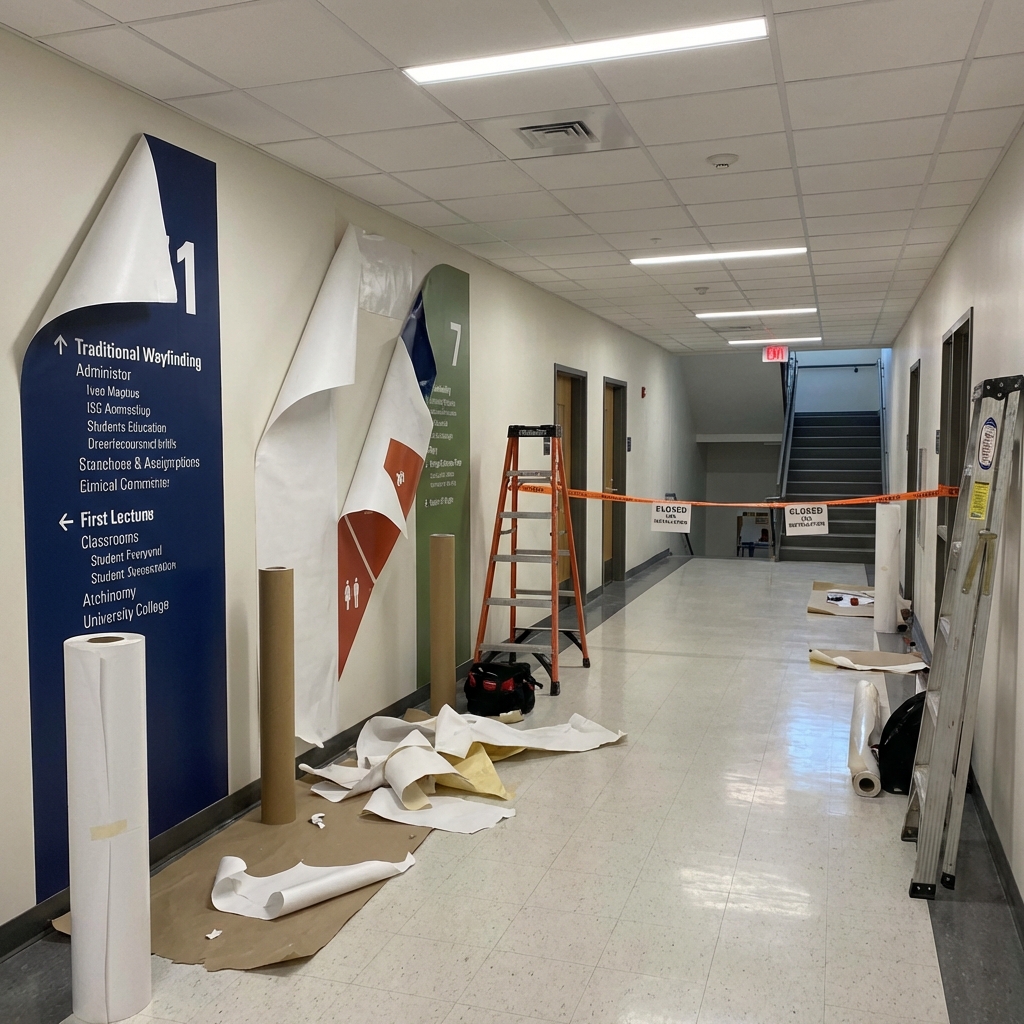
For a 10-building campus, you might phase it as: administrative buildings (Phase 1, 8 weeks), academic buildings (Phase 2, 8 weeks), residential and student life (Phase 3, 8 weeks). This spreads the project, maintains operational normalcy, and lets you gather feedback and adjust designs between phases.
Cost planning benefits from phasing too. Rather than a single large capital expenditure, you can budget phases annually or by fiscal period. We also offer subscription-based refresh models, where you commit to updating graphics seasonally or on a 2-3 year cycle as programs and branding evolve. This flips maintenance from reactive (something failed, we need it fixed) to strategic (we're investing in campus appearance and navigation as part of our brand).
Installation Without Disruption: Why Our 5-Hour Timeline Matters for Operating Institutions
Speed isn't just a convenience. On a campus or in a hospital, it's operational currency.
Our project management for occupied facilities process centers on minimal occupant impact. We schedule installations during off-peak hours: early mornings, evenings, or weekends. A single wall mural in a hospital corridor gets printed and finished between 6 a.m. and 11 a.m., long before morning rounds. A multi-floor directional graphic in a university building can be completed before classes resume.
The 5-hour window breaks down roughly as: surface prep and protection (30-45 min), printing execution (2.5-3.5 hours depending on area), curing and quality check (30-45 min), and final touches (15-30 min). We bring our own power, ventilation, and protective barriers. No dust, no toxic fumes, no scaffolding that blocks hallways. Your occupants may notice activity, but they don't experience disruption.
This matters most when you're managing safety, liability, and reputation. A renovation firm painting or wallpapering a corridor means caution tape, access restrictions, and noise. Patients or students question whether the space is safe. Our process looks professional and feels non-invasive. The mural goes up cleanly, and the space opens immediately.
We also build redundancy into campus-scale rollouts. If one team finishes Phase 1 ahead of schedule, we can immediately deploy to Phase 2 buildings. If a weather delay pushes a wall prep window, we shift to another building rather than delay the entire project. For institutions managing complex calendars, that flexibility is valuable.
Designing Cohesive Wayfinding Systems Across Multiple Locations and Buildings
Wayfinding graphics aren't isolated murals. They're part of a system that connects your entire campus visually and functionally.
We work with your brand, marketing, and facilities teams to develop a cohesive visual language: color palette, typography, icon systems, and layout templates that feel consistent whether someone is entering a lobby, navigating a corridor, or finding a department office. This system then scales to every building and floor, creating a unified experience.
A large university client we worked with needed to help 25,000 students navigate a 200-acre campus. Rather than post signage everywhere (costly, cluttered, and visually chaotic), we designed a floor-level color-coding system: each academic quad got a distinct color; each building got accent colors tied to departments. Floor markers, directional arrows, and wayfinding murals all reinforced the color hierarchy. Students learned the system within a few days, and wayfinding become intuitive rather than signage-dependent.
For healthcare systems, we often integrate safety and operational graphics into the wayfinding design: infection control zones, emergency exits, and equipment locations get visual emphasis using the same design language as directional wayfinding. This consolidates multiple communication needs into a unified aesthetic and reduces installation surface area.
Design work happens collaboratively. We provide digital mockups at full scale using photorealistic rendering, so stakeholders see exactly what the finished mural will look like in context, with your specific logo, color palette, and typography. Approval loops typically take 2-3 review cycles. Once approved, design files lock, and we move directly to production without the delays or surprises that plague traditional signage projects.
Durability and Maintenance: Why Our Graphics Outperform Vinyl and Wallpaper on High-Traffic Campuses
High-traffic environments destroy traditional wall coverings. Vinyl starts peeling within 18-24 months in corridors where foot traffic, luggage carts, and stretcher traffic happen daily. Wallpaper bubbles in humid areas and fades under UV light. Hand-painted murals chip and require constant touch-up.
Our direct-to-wall printing graphics are designed for institutional punishment. UV-cured inks cure permanently into the wall substrate, so there's no surface degradation, peeling, or bubble-out. Institutional cleaning products (bleach, ammonia-based cleaners, alcohol-based sanitizers) don't damage the finish. Scuffs and marks clean easily with appropriate wipes.
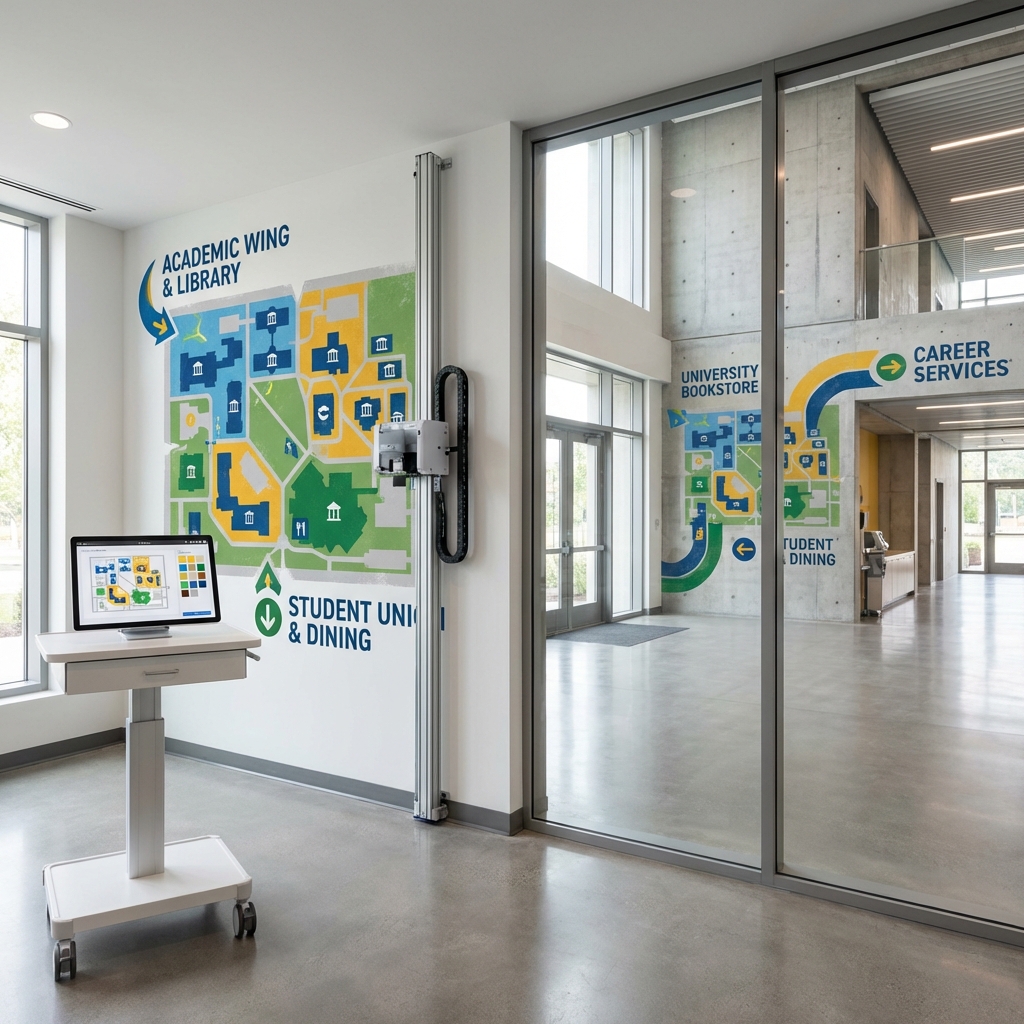
We rate our graphics for 7-10 years in standard institutional settings, and longer in lower-traffic areas. For campuses planning 3-year refresh cycles (to keep wayfinding current with program changes), durability is actually less of a constraint than adaptability. You can refresh without worrying that the previous generation failed due to wear.
Maintenance expectations are straightforward: annual cleaning with your standard protocols and quarterly touch-ups if signage suffers vandalism or wear. Repair, if needed, is localized. Unlike vinyl panels or wallpaper where damage spreads, our graphics allow spot correction without full removal or substrate replacement.
Lifecycle cost heavily favors our approach. A vinyl wrap installation requires replacement every 2-3 years, meaning removal costs, substrate repair, and reapplication. A hand-painted mural requires periodic artist touch-up and eventual repainting. Our graphics stretch that cost per year significantly by compressing total lifecycle cost while delivering better visual impact.
From Concept to Execution: Our Collaborative Design and Approval Process
We work with your creative team to develop concepts, but we also manage procurement-side rigor that institutional buyers need.
The process starts with a design brief where we clarify scope, budget, timeline, and stakeholder approval structure. For a 10-building campus wayfinding rollout, this might involve facilities leadership, the marketing or brand team, the accessibility officer, and executive approval. We map that approval chain upfront so there's no surprise gatekeeping later.
Design development follows our iterative approach: we produce 2-3 concept directions based on your campus map, brand guidelines, and wayfinding objectives. Each concept includes mockups showing the graphic in context (a rendered photo showing the mural on an actual building lobby wall). Stakeholders vote or provide feedback. We refine the preferred direction and produce final design files and a detailed specification document that includes: wall dimensions, color accuracy, typography, image resolution, curing time, surface protection, and maintenance protocols.
Once design is approved, we lock the file and move to pre-production. We coordinate with your facilities team on scheduling, substrate prep (cleaning, primer if needed on raw concrete), and protective barriers. Then production and installation proceed on schedule.
For multi-phase projects, we often design Phase 1 to completion while initiating Phase 2 designs in parallel. This keeps momentum and reduces overall project duration. We also offer design subscription models, where you can refresh graphics seasonally or annually without full design fees, leveraging existing templates and content.
Measuring Success: Performance Metrics for Campus Wayfinding Implementation
We track tangible outcomes so you can measure whether wayfinding actually improves navigation and campus experience.
Pre- and post-installation, we gather data on:
Wayfinding effectiveness: Do campus tours take less time to navigate? Do new students/visitors find departments without asking for directions? (Surveys or brief polling at key locations)
Operational feedback: Do facilities staff report fewer "lost visitor" inquiries? Do front desk staff field fewer navigation questions?
Visual impact: Do prospective students or patients comment on the campus appearance? Do facility tours emphasize the refreshed spaces?
Durability: Track maintenance requests by location and surface condition at 6, 12, and 24 months
Brand perception: Do internal surveys show improved perception of campus organization and professionalism?
We provide a post-installation report 90 days after completion that documents installation quality, any remedial work, and recommended maintenance intervals. For larger rollouts, we offer quarterly check-ins where our team revisits to assess wear, gather occupant feedback, and plan Phase 2 designs based on what worked.
Success metrics vary by institution. A university might prioritize new-student onboarding speed and campus appearance. A hospital might focus on operational efficiency (staff movement, fewer wayfinding errors) and patient anxiety reduction. We align measurement with your institutional goals rather than imposing a generic scorecard.
Scaling Strategically: Phased Rollouts and Subscription-Based Refresh Models for Campuses
Most campuses can't (and shouldn't) refresh everything at once. Phased deployment spreads cost, manages operational disruption, and lets you refine the approach as you learn.
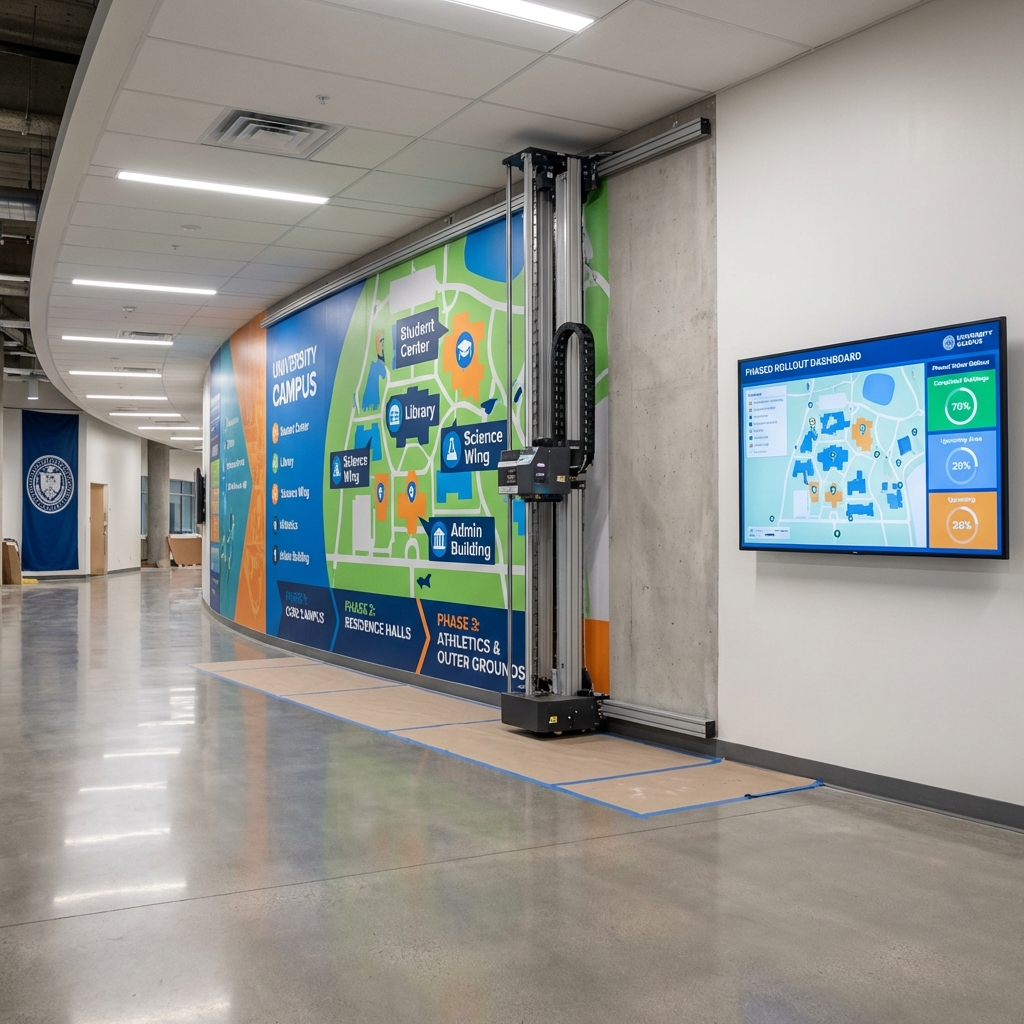
A typical strategy for a large institution:
Phase 1 (Months 1-8): High-traffic entry and orientation spaces. Admin buildings, main quad, student center. Goal: establish visual identity and demonstrate impact.
Phase 2 (Months 9-16): Academic and departmental buildings. Tailor wayfinding to discipline-specific needs (lab safety signage in science buildings, equipment graphics in medical facilities). Goal: extend system coherence and reduce operational signage clutter.
Phase 3 (Months 17-24): Residence halls, recreational facilities, support service areas. Goal: complete campus coverage and establish maintenance routines.
Beyond the initial rollout, we recommend a subscription refresh model. Commit to updating 15-20% of your wayfinding graphics annually or every 18 months. As programs evolve, buildings rename, or branding refreshes, you systematically update graphics rather than living with outdated signage. Annual refresh budgets are predictable and fit into operating budgets more comfortably than sporadic large capital projects.
For institutions embracing this approach, we handle design, production, and installation on a rolling schedule. You notify us of buildings or spaces slated for refresh, we coordinate with your calendar, and we execute. It becomes a managed service rather than a project, reducing planning burden on your team.
The financial model works too. Spreading cost across multiple years via subscription pricing is often more accessible than a single large capital request. And the guaranteed refresh cycle means your campus consistently looks current and professionally maintained, which strengthens recruitment, retention, and institutional pride.
---
Wayfinding done right makes your campus feel intentional, organized, and welcoming. It reduces friction for students, patients, visitors, and staff. It reflects your brand and values without signage clutter or visual chaos.
We're here to help you plan, design, and execute campus wayfinding at the scale and speed your institution needs. If you're ready to move beyond vinyl, wallpaper, and piecemeal signage, reach out. We'll audit your campus, propose a phased strategy, and deliver graphics that serve your campus for years.
Contact us to learn more
Frequently Asked Questions (FAQ)
How quickly can we implement wayfinding graphics across our entire campus?
We typically complete installation in under 5 hours per wall or building section, which means we can coordinate phased rollouts across your campus without shutting down operations. Our on-site direct-to-wall printing eliminates shipping delays and fabrication errors, so we move from design approval to installation much faster than traditional vinyl or hand-painted approaches. For multi-building campuses, we work with your facilities team to schedule installations during lower-traffic periods or in coordinated waves that fit your academic or operational calendar.
What surfaces can we print directly onto, and will we need to prepare our walls?
We print on finished and unfinished surfaces including drywall, CMU, concrete, and brick, so most campus buildings require minimal prep work. Our process is compatible with existing wall conditions, which reduces construction timelines and cost. If a wall needs future changes, our paint-over-ready finishes mean you can repaint or update graphics without the removal headaches that come with vinyl or wallpaper.
How do wayfinding graphics from your team compare to traditional signage in terms of cost and maintenance?
We eliminate signage clutter by integrating wayfinding, safety, and instructional graphics directly into your walls at architectural scale, which reduces the number of physical signs you need to install and maintain. Our durable, cleanable surfaces are designed for high-traffic environments and significantly outperform vinyl and wallpaper on durability and lifecycle costs. Because our graphics don't peel, bubble, or fade like vinyl does, you'll spend less on replacement and maintenance cycles over time.